











Vol-06|Issue-05|May|Year-2026 International Journal of Academic and Industrial Research Innovations(IJAIRI)ISSN: 3049-2343
www.nationaleducationservices.org
184
Volume-06|Issue-05|May|Year-2026
(
)
Research Paper Title :Role of Artificial Intelligence in Film and Entertainment
1
Murali Krishna Pasupuleti
1
Research Director
1
National Education Services,
1
New Delhi,India
1
mkrishnap2050@gmail.com
________________________________________________________________________________
Abstract:
This
study
investigates
the
role
of
artificial
intelligence
in
film
and
entertainment
as
an
integrated
socio-technical
transformation
rather
than
a
narrow
automation
trend.
The
analysis
examines
how
AI
changes
creative
development,
production
design,
visual
effects,
post-production,
localisation,
marketing,
recommendation
systems,
audience
analytics,
rights
governance,
and
labour
relations.
The
central
argument
is
that
AI
creates
measurable
gains
in
efficiency,
discoverability,
and
predictive
decision-making,
while
simultaneously
intensifying
questions
of
authorship,
consent,
transparency,
copyright,
algorithmic
bias,
and
creative
labour
displacement.
The
manuscript
therefore
evaluates
AI
not as
a replacement
for human creativity,
but
as
a
computational infrastructure whose legitimacy depends on accountable human control,
defensible data provenance, and rights-preserving implementation.
The
methodological
design
combines
public
industry
and
regulatory
evidence
with
a
realistic
secondary-data-derived
benchmark
dataset
representing
film
and
entertainment
workflows.
Publicly
documented
evidence
includes
AI
media-market
estimates,
guild
rules
on
AI-authored
or
AI-assisted
writing
and
performance,
copyright guidance on AI-generated outputs, platform recommendation practices, and
recent
legal
and
awards-sector
governance
developments.
The
empirical
component
models
workflow
intensity,
productivity
gain,
rights
burden,
stakeholder
risk,
and
predictive performance across representative entertainment tasks. Results indicate that
AI-driven recommendation and discovery, automated localisation, VFX augmentation,
and
post-production
support
present
the
highest
operational
value,
whereas
synthetic
performer
systems
and
AI-generated
authorship
present
the
highest
governance
burden. The study concludes that the future of AI in entertainment will be determined
less
by
technical
capability
alone
than
by
enforceable
human
authorship,
consent,
explainability, auditable provenance, and equitable compensation frameworks.
Keywords: artificial intelligence; film industry; entertainment analytics; generative AI;
recommendation systems; creative labour; copyright; synthetic media; audience
analytics; AI governance
.
_________________________________________________________________________________
Copyright:
© 2026 by Murali Krishna Pasupuleti.
Vol-06|Issue-05|May|Year-2026 International Journal of Academic and Industrial Research Innovations(IJAIRI)ISSN: 3049-2343
www.nationaleducationservices.org
185
1. Introduction
1.1 Background and Context
Artificial
intelligence
has
moved
from
a
peripheral
computational
aid
to
a
central
infrastructure
of
contemporary
film
and
entertainment.
Machine-learning
systems
now
support
script
analytics,
audience
segmentation,
visual
effects,
dubbing,
editing,
content
recommendation,
advertising
optimisation,
fraud
detection,
and
production
scheduling.
In
parallel,
generative
AI
systems
are
increasingly
capable
of
producing
images,
voices,
music,
storyboards,
synthetic
performances,
and
short-form
video
assets.
This
shift
has
broadened
the
scope
of
entertainment
technology
from
efficiency-oriented
automation
to
contested
questions
of
authorship,
originality,
labour value, and the social meaning of creative work.
The film sector is particularly sensitive to AI because cinematic value arises from
the
combination
of
creative
authorship,
embodied
performance,
technical
craft,
collaborative
production,
and
audience
reception.
A
model
that
accelerates
rotoscoping or improves dubbing may enhance production capacity, whereas a system
that
imitates
a
performer,
generates
a
screenplay,
or
trains
on
copyrighted
film
archives without consent may challenge the foundations of creative rights. As a result,
the
study
of
AI
in
entertainment
must
integrate
technical
performance
with
institutional
governance,
labour
protection,
intellectual
property
law,
and
cultural
ethics.
A
purely
technological
assessment
would
be
insufficient
because
algorithmic
capability does not automatically confer legitimacy, fairness, or artistic value.
This
study
positions
AI
as
a
layered
system
of
computational
mediation
across
the
entertainment value chain. The analysis recognises that AI can contribute to discovery,
productivity, accessibility, and new creative forms, while also producing risks of bias,
homogenised
taste,
unlicensed
data
extraction,
manipulative
personalisation,
and
displacement
of
skilled
labour.
The
research
therefore
evaluates
AI
through
a
balanced
framework
that
connects
data-driven
productivity
with
human-centred
authorship and governance.
1.2 Problem Statement
Vol-06|Issue-05|May|Year-2026 International Journal of Academic and Industrial Research Innovations(IJAIRI)ISSN: 3049-2343
www.nationaleducationservices.org
186
The
primary
research
problem
concerns
the
absence
of
an
integrated
analytical
framework
capable
of
measuring
the
benefits
and
risks
of
AI
across
the
film
and
entertainment
sector.
Existing
debates
often
divide
into
optimistic
claims
about
productivity and innovation, or critical claims about labour replacement and copyright
exploitation.
Such
polarisation
obscures
the
fact
that
AI
applications
vary
significantly
across
the
production
pipeline.
Recommendation
engines,
localisation
tools,
generative
story
systems,
synthetic
performers,
and
VFX
automation
do
not
carry the same technical maturity, economic value, or ethical burden.
The
lack
of
a
coherent
evaluative
structure
creates
practical
difficulty
for
producers,
platform
operators,
policymakers,
guilds,
educators,
and
researchers.
Organisations
require
methods
to
decide
which
AI
applications
are
strategically
valuable,
which
require
strict
consent
and
rights
controls,
which
should
be
limited
to
assistive
functions,
and
which
may
produce
unacceptable
harms
if
deployed
without
governance.
In
the
absence
of
measurement,
entertainment
institutions
may
either
underuse
beneficial
tools
or
deploy
high-risk
systems
in
ways
that
damage
trust,
employment, and legal compliance.
This
study
addresses
that
gap
by
developing
a
multidimensional
framework
that
evaluates AI through productivity, creative value, stakeholder risk, governance burden,
and
predictive
performance.
The
problem
is
not
whether
AI
should
be
used
in
entertainment,
but
under
what
technical,
legal,
and
ethical
conditions
its
use
can
be
justified. Such a framing allows AI to be examined as a governed creative technology
rather than as an inevitable replacement system.
1.3 Aim, Objectives, and Research Questions
The
aim
of
this
study
is
to
evaluate
the
role
of
artificial
intelligence
in
film
and
entertainment
by
combining
theoretical
analysis,
realistic
secondary-data
modelling,
mathematical
relationships,
and
interpretive
evaluation.
The
study
seeks
to
clarify
where
AI
generates
measurable
value,
where
it
introduces
significant
rights
and
labour
concerns,
and
how
a
governance-oriented
framework
can
balance
innovation
with
human
creative
accountability.
The
research
is
designed
to
support
a
PhD-level
understanding of AI as both a technical and institutional force in creative industries.
Vol-06|Issue-05|May|Year-2026 International Journal of Academic and Industrial Research Innovations(IJAIRI)ISSN: 3049-2343
www.nationaleducationservices.org
187
The objectives are fourfold.
First, the study explains the theoretical foundations of AI
in
film
and
entertainment,
including
recommendation
systems,
generative
models,
multimodal
analytics,
and
synthetic
media.
Second,
it
constructs
a
realistic
data
framework
that
compares
AI
applications
across
production,
post-production,
distribution,
and
consumption.
Third,
it
evaluates
the
effects
of
AI
on
productivity,
cost
efficiency,
creative
quality,
predictive
analytics,
and
governance
risk.
Fourth,
it
proposes
an
accountable
AI
framework
based
on
human
authorship,
consent,
data
provenance, interpretability, and rights-aware deployment.
The
research
questions
are:
How
does
AI
transform
the
film
and
entertainment
value
chain? Which applications generate the highest operational and creative value? Which
applications
create
the
greatest
ethical,
legal,
and
labour
risks?
How
can
AI
performance
be
represented
mathematically
in
relation
to
productivity,
audience
engagement,
and
governance
burden?
What
framework
can
guide
the
responsible
adoption of AI while preserving human creative agency?
1.4 Significance of the Study
The significance of this study lies in its attempt to connect AI-enabled
creativity with
evidence-based
governance.
Film
and
entertainment
are
among
the
most
visible
cultural
domains
affected
by
generative
and
predictive
AI.
Decisions
made
in
this
sector
influence
not
only
production
economics,
but
also
public
expectations
about
originality,
authenticity,
performer
identity,
and
ownership
of
creative
expression.
A
rigorous
academic
examination
is
therefore
necessary
to
avoid
both
technological
determinism and uncritical resistance.
For research
communities, the study contributes
a structured
model for
examining AI
across
creative-industry
workflows.
For
practitioners,
it
provides
a
comparative
view
of
AI
applications
by
productivity
value
and
governance
burden.
For
policymakers
and
guilds,
it
clarifies
why
consent,
disclosure,
human
authorship,
and
compensation
are not peripheral concerns, but conditions of sustainable AI adoption. For audiences,
the study highlights the importance of transparency and trust in an environment where
synthetic media can increasingly mimic human creativity.
The
study
also
has
methodological
significance
because
it
demonstrates
how
real
public
evidence
and
realistic
secondary-data-derived
modelling
can
be
integrated
Vol-06|Issue-05|May|Year-2026 International Journal of Academic and Industrial Research Innovations(IJAIRI)ISSN: 3049-2343
www.nationaleducationservices.org
188
when
proprietary
studio
datasets
are
inaccessible.
Entertainment
firms
rarely
release
granular
workflow
or
audience
data,
yet
academic
analysis
still
requires
quantitative
structure.
The
manuscript
therefore
uses
transparent
modelling
assumptions,
public
benchmarks,
and
clearly
labelled
tables
to
support
interpretation
without
misrepresenting simulated values as direct primary collection.
2. Theory and Literature Review
2.1 Artificial Intelligence in the Creative-Industry Value Chain
The
creative-industry
value
chain
can
be
conceptualised
as
a
sequence
of
ideation,
financing,
development,
production,
post-production,
distribution,
exhibition,
recommendation,
and
audience
feedback.
AI
enters
this
chain
at
multiple
points.
In
development, natural language processing can analyse scripts, detect thematic patterns,
and
estimate
market
alignment.
In
production,
computer
vision,
simulation,
and
virtual-production
tools
can
support
scene
planning,
lighting,
asset
generation,
and
logistics.
In
post-production,
AI
assists
colour
correction,
rotoscoping,
restoration,
subtitling, dubbing, sound separation, and editing decisions.
At
the
distribution
and
consumption
stages,
AI
becomes
even
more
visible
through
recommendation
systems
and
audience
analytics.
Streaming
platforms
use
behavioural,
contextual,
and
content-based
features
to
rank
films
and
series
for
each
viewer.
These
systems
can
expand
discoverability
and
reduce
search
costs,
but
they
may
also
narrow
cultural
exposure
if
optimisation
overemphasises
similarity
and
short-term
engagement.
Consequently,
AI
in
entertainment
must
be
studied
as
a
value-chain
architecture
in
which
creative,
technical,
commercial,
and
cultural
functions interact.
The literature increasingly treats AI as a co-creative infrastructure rather than a simple
tool.
However,
co-creativity
remains
a
contested
term
because
creativity
involves
intention,
accountability,
cultural
situatedness,
and
evaluative
judgement.
AI
systems
can generate outputs that appear creative, but the legitimacy of those outputs depends
on
the
human
decisions
surrounding
prompting,
selection,
editing,
contextualisation,
and
rights
clearance.
This
distinction
is
central
to
film
and
entertainment,
where
credits,
residuals,
awards,
and
reputational
value
depend
on
recognised
human
contribution.
Vol-06|Issue-05|May|Year-2026 International Journal of Academic and Industrial Research Innovations(IJAIRI)ISSN: 3049-2343
www.nationaleducationservices.org
189
I. AI as a Transformative Infrastructure for Film and Entertainment Ecosystems
Artificial
intelligence
has
become
a
structural
technology
for
the
film
and
entertainment
industries,
not
merely
a
production-support
tool.
It
now
shapes
script
development,
content
recommendation,
audience
segmentation,
automated
editing,
music
recognition,
animation
workflows,
immersive
environments
and
platform
governance.
Entertainment-specific
research
shows
that
AI
is
increasingly
embedded
in
gamification,
empathic
entertainment
technology,
music-style
analysis,
automatic
recognition and virtual experience design (Khalid et al. 2023; Fang and Wei 2024; Liu
and
Zou
2025;
Bulut
and
Ulusoy
2026).
These
developments
indicate
a
transition
from
conventional
media
production
toward
computational
entertainment
systems
in
which
creativity,
distribution
and
user
experience
are
continuously
informed
by
data-
driven intelligence.
The
theoretical
advance
lies
in
understanding
AI-enabled
entertainment
as
a
socio-
technical
ecosystem
where
creative
labour,
machine
learning
systems,
digital
platforms
and
audience
behaviour
interact
dynamically.
Foundation
models
and
retrieval-augmented
fine-tuning
provide
methodological
pathways
for
generating,
adapting
and
personalising
narrative
content,
while
mixed-method
evaluation
frameworks help assess the quality, safety and cultural relevance of generative outputs
(Pasupuleti 2021d; Pasupuleti 2023e). The policy implication is that entertainment AI
must be evaluated
not only through
engagement
metrics, but also
through authorship,
copyright,
bias,
transparency,
labour
displacement,
content
authenticity
and
cultural
diversity.
II. Generative AI, Creative Automation and Film Production Workflows
Generative
AI
is
reshaping
film
and
entertainment
production
by
enabling
automated
ideation,
storyboard
generation,
synthetic
character
design,
visual
prototyping,
dubbing,
subtitling,
trailer
creation
and
post-production
enhancement.
The
supplied
literature
on
generative
AI
evaluation,
foundation
models
and
deep
learning
architectures
supports
the
view
that
AI
systems
can
assist
creative
workflows
while
also
creating
new
demands
for
quality
assurance
and
interpretability
(Pasupuleti
Vol-06|Issue-05|May|Year-2026 International Journal of Academic and Industrial Research Innovations(IJAIRI)ISSN: 3049-2343
www.nationaleducationservices.org
190
2021d; Pasupuleti 2022a; Pasupuleti 2023e). In
film production, this means that AI is
best understood as an augmentation
layer that expands creative possibility rather than
a simple replacement for human creativity.
The
innovation
challenge
is
to
design
workflows
in
which
creative
professionals
retain
editorial
control
while
AI
systems
accelerate
experimentation
and
reduce
production
bottlenecks.
Statistical
and
approximation-theoretic
perspectives
on
deep
learning
clarify
how
model
capacity,
training
dynamics
and
generative
performance
influence
output
quality
(Pasupuleti
2022a;
Pasupuleti
2022f).
The
research
implication
is
that
future
entertainment
studies
should
examine
not
only
whether
AI-
generated
content
is
commercially
viable,
but
how
creative
authority,
emotional
resonance, narrative originality and cultural sensitivity are preserved when production
pipelines become increasingly automated.
III. AI in Music Entertainment, Audio Recognition and Style Analysis
Music
entertainment
represents
one
of
the
most
mature
domains
for
AI
application
because
audio
data
can
be
analysed
through
pattern
recognition,
classification,
recommendation
and
generative modelling.
Recent
entertainment
computing research
shows
that
AI-based
pattern
recognition
supports
automatic
music
recognition,
while
speech-recognition
and
style-analysis
robots
can
contribute
to
entertainment
creation
and
musical
interpretation
(Fang
and
Wei
2024;
Liu
and
Zou
2025).
These
developments
are
highly
relevant
to
film
and
entertainment
because
music
scoring,
sound
design,
mood
detection
and
audience
emotional
engagement
are
central
to
audiovisual storytelling.
Methodologically,
music-focused
AI
requires
models
that
can
detect
rhythm,
timbre,
genre,
emotional
tone
and
stylistic
similarity
across
large-scale
audio
datasets.
The
supplied
work
on
feature
dependence,
causal
inference
and
real-time
analytics
provides
a
conceptual
basis
for
studying
how
musical
features
interact
with
audience
response,
recommendation
systems
and
platform
performance
(Pasupuleti
2021j;
Pasupuleti
2023h;
Pasupuleti
2023j).
Policy
and
governance
implications
include
fair
compensation
for
artists,
transparency
in
AI-assisted
composition,
dataset
licensing,
Vol-06|Issue-05|May|Year-2026 International Journal of Academic and Industrial Research Innovations(IJAIRI)ISSN: 3049-2343
www.nationaleducationservices.org
191
copyright
attribution
and
protection
against
unauthorised
imitation
of
performers’
voices or musical styles.
IV. AI-Driven Gamification, Interactive Media and Audience Engagement
Gamification
has
become
a
major
frontier
for
AI-enabled
entertainment
because
intelligent
systems
can
personalise
difficulty
levels,
reward
structures,
user
journeys
and
social
interaction
patterns.
The
systematic
review
of
AI
in
gamification
indicates
that
AI
is
increasingly
used
to
adapt
entertainment
experiences
to
user
behaviour,
motivation and engagement dynamics (Bulut and Ulusoy 2026). In film and streaming
ecosystems,
the
same
logic
applies
to
interactive
storytelling,
personalised
trailers,
audience
retention
strategies
and
adaptive
recommendation
engines
that
respond
to
user preferences in real time.
The
theoretical
contribution
of
this
theme
is
the
integration
of
entertainment
science,
behavioural
analytics
and
AI-driven
feedback
loops.
Reinforcement
learning
and
operations-research perspectives show how systems can optimise sequential decisions
under
uncertainty,
a
logic
that
is
transferable
to
interactive
media,
game
design
and
adaptive
content
platforms
(Pasupuleti
2021l;
Pasupuleti
2022c).
However,
governance
concerns
are
substantial.
AI-driven
engagement
systems
can
support
learning,
enjoyment
and
accessibility,
but
they
may
also
intensify
addictive
design,
behavioural manipulation and unequal exposure to content. Responsible entertainment
AI
therefore
requires
user-centred
design,
transparency,
consent
and
safeguards
against exploitative engagement optimisation.
V. Virtual Reality, Immersive Entertainment and AI-Mediated Experience Design
Virtual
reality
and
immersive
media
are
transforming
entertainment
from
passive
viewing
into
interactive
spatial
experience.
Research
on
smart
city
VR
landscape
planning
and
AI-based
virtual
entertainment
experience
shows
how
artificial
intelligence
can
enhance
immersive
environments
through
spatial
modelling,
user
adaptation
and
experience
optimisation
(Li,
Yuan
and
Liu
2024).
In
film
and
entertainment,
this
has
implications
for
virtual
production,
metaverse
cinema,
Vol-06|Issue-05|May|Year-2026 International Journal of Academic and Industrial Research Innovations(IJAIRI)ISSN: 3049-2343
www.nationaleducationservices.org
192
location-based
entertainment,
immersive
museums,
digital
concerts
and
interactive
storytelling.
AI-supported
immersive entertainment
depends
on
real-time
perception,
environment
simulation,
behavioural
modelling
and
adaptive
rendering.
Work
on
AI
digital
twins,
simulation
frameworks
and
spatio-temporal
modelling
provides
methodological
foundations
for
building
responsive
immersive
systems
that
can
adapt
to
user
movement,
context
and
affective
state
(Pasupuleti
2023b;
Pasupuleti
2023m;
Pasupuleti
2024e).
The
broader
implication
is
multi-sectoral:
the
same
AI-VR
techniques
used
in
entertainment
can
support
education,
tourism,
urban
storytelling,
heritage preservation,
training and
therapeutic applications.
Governance must address
privacy
in
immersive
environments,
biometric
data
protection,
psychological
safety
and ethical design of simulated realities.
VI. Empathic Entertainment Technology and Human-Centred AI
Empathic
entertainment
technology
represents
a
major
conceptual
shift
from
content
delivery
to
affective
interaction.
Entertainment
computing
research
highlights
the
growing
interest
in
AI
systems
that
can
respond
to
user
emotion,
preference
and
behavioural context (Khalid et
al. 2023).
In
film, gaming and
digital
media, empathic
AI
can
support
adaptive
narratives,
personalised
recommendations,
emotionally
responsive
characters
and
interactive
companions.
Such
systems
may
deepen
engagement, but they also require careful boundaries because emotional inference can
become intrusive or manipulative.
The
methodological
significance
of
empathic
entertainment
lies
in
combining
affective
computing,
multimodal
inference,
pattern
recognition
and
responsible
evaluation.
Clinical
and
multimodal
AI
studies
show
how
complex
human
states
can
be
inferred
from
heterogeneous
signals,
but
they
also
demonstrate
the
need
for
drift
monitoring,
explainability
and
ethical
safeguards
when
systems
act
on
sensitive
behavioural data (Pasupuleti 2023o; Pasupuleti 2026k). The policy implication is that
entertainment
platforms
using
emotional
AI
should
implement
consent
mechanisms,
data
minimisation,
explainable
personalisation
and
independent
auditing.
The
global
Vol-06|Issue-05|May|Year-2026 International Journal of Academic and Industrial Research Innovations(IJAIRI)ISSN: 3049-2343
www.nationaleducationservices.org
193
relevance
is
clear
because
emotionally
adaptive
media
will
affect
children,
learners,
patients, gamers, viewers and creators across cultural contexts.
VII. AI, Creative Economies and the AVGC Sector
Artificial
intelligence
has
strategic
significance
for
animation,
visual
effects,
gaming
and
comics
because
these
sectors
rely
on
scalable
creativity,
digital
labour,
rendering
pipelines
and
global
platform
distribution.
The
supplied
AVGC-focused
reference
on
securing
digital
creativity
shows
that
creative
economies
require
not
only
innovation
capacity
but
also
cybersecurity
readiness
and
institutional
benchmarking
(Pasupuleti
2024t). AI can help AVGC firms automate asset generation, character rigging, motion
capture
enhancement,
localisation,
audience
analytics
and
production
scheduling,
thereby improving competitiveness in global entertainment markets.
The
innovation-development
dimension
involves
building
AI-ready
creative
clusters
supported
by
digital
infrastructure,
skills
pipelines,
data
governance
and
intellectual-
property
protection.
State-level
benchmarking
in
IT–ITES,
data
centres,
digital
inclusion
and
emerging
technologies
provides
a
comparative
framework
for
understanding
how
creative
economies
depend
on
broader
digital
ecosystems
(Pasupuleti
2024r;
Pasupuleti
2024s;
Pasupuleti
2024u).
Research
implications
include
the
need
to
measure
AI
adoption
maturity
in
studios,
streaming
platforms,
animation
schools,
gaming
firms
and
post-production
houses.
Policy
implications
include
public
investment
in
creative
AI
labs,
responsible
IP
frameworks,
cyber
resilience, talent development and international co-production standards.
VIII. Data Pipelines, Recommendation Systems and Platform Intelligence
Modern
entertainment
platforms
depend
on
large-scale
data
pipelines
that
process
user
behaviour,
viewing
histories,
search
patterns,
ratings,
social
signals
and
content
metadata.
AI
recommendation
systems
shape
what
audiences
watch,
how
long
they
remain
engaged
and
which
creative
works
become
visible.
Research
on
big-data
pipelines,
causal
streaming
and
cloud
telemetry
provides
methodological
foundations
for
entertainment
analytics,
especially
in
platforms
that
require
real-time
decision-
making
at
scale
(Pasupuleti
2022d;
Pasupuleti
2023g;
Pasupuleti
2024b).
These
Vol-06|Issue-05|May|Year-2026 International Journal of Academic and Industrial Research Innovations(IJAIRI)ISSN: 3049-2343
www.nationaleducationservices.org
194
systems
are
central
to
streaming
services,
music
platforms,
online
gaming,
digital
advertising and short-video ecosystems.
Theoretical
advances
in
causal
inference
and
feature
dependence
are
particularly
relevant
because
recommendation
systems
should
not
be
evaluated
only
by
correlation-based
engagement
metrics.
A
platform
may
increase
watch
time
while
narrowing
cultural
exposure
or
reinforcing
popularity
bias.
Causal
time-series
methods and feature-dependence frameworks can help distinguish genuine preference
learning
from
algorithmic
amplification,
thereby
improving
fairness
and
interpretability
(Pasupuleti
2021j;
Pasupuleti
2023f;
Pasupuleti
2023h).
Governance
implications
include
algorithmic
transparency,
user
control,
auditability
of
recommendation
logic,
protection
of
minors
and
mechanisms
for
promoting
diversity
in cultural consumption.
IX. Ethics, AI Safety, Copyright and Governance in Entertainment AI
The
rise
of
AI
in
film
and
entertainment
creates
urgent
governance
questions
around
authorship,
performer
rights,
synthetic
media,
deepfakes,
copyright,
misinformation,
cultural
appropriation
and
labour transformation.
AI safety
and
socially
beneficial
AI
frameworks show that technical systems must be assessed through alignment, stability,
robustness,
causal
impact
and
governance
pathways
(Pasupuleti
2021a;
Pasupuleti
2021i).
For
entertainment
industries,
these
concerns
are
especially
important
because
AI-generated
content
can
imitate human likeness,
voice,
style and cultural
expression
at scale.
The
solution-development
pathway
requires
a
governance
model
that
combines
technical
safeguards
with
legal,
organisational
and
ethical
oversight.
Policy-as-code
and
auditability
studies
demonstrate
that
governance
can
be
embedded
into
operational
systems
rather
than
treated
as
a
separate
manual
process
(Pasupuleti
2021g;
Pasupuleti
2023k;
Pasupuleti
2024o).
Entertainment
platforms
should
therefore
implement
provenance
tracking,
consent-based
likeness
use,
content
labelling,
dataset
documentation,
bias
testing
and
dispute-resolution
mechanisms.
Vol-06|Issue-05|May|Year-2026 International Journal of Academic and Industrial Research Innovations(IJAIRI)ISSN: 3049-2343
www.nationaleducationservices.org
195
Globally,
this
is
relevant
for
studios,
streaming
platforms,
gaming
companies,
music
labels, regulators, labour unions and cultural institutions.
X.
Future
Directions:
Quantum-AI,
Edge
Intelligence
and
Next-Generation
Entertainment Systems
The
future
of
AI
in
film
and
entertainment
will
likely
be
shaped
by
convergence
among
generative AI,
edge
computing,
quantum-inspired
optimisation,
neuromorphic
systems,
immersive
media
and
secure
digital
infrastructure.
Quantum-inspired
optimisation
can
support
complex
scheduling,
rendering
allocation,
recommendation
optimisation and resource-efficient production pipelines (Pasupuleti 2023i; Pasupuleti
2024l).
Ultra-low-power
edge
intelligence
and
neuromorphic
photonic
memory
research
suggest
that
future
entertainment
systems
may
become
more
responsive,
energy-efficient and capable of real-time local inference (Pasupuleti 2026i; Pasupuleti
2026m).
The
broader
research
implication
is
that
entertainment
AI
should
be
studied
as
a
future-facing
intelligent
infrastructure
rather
than
a
narrow
creative
tool.
Real-time
cybersecurity,
quantum-safe
critical
infrastructure
and
adaptive
defence
research
indicate
that
entertainment
platforms
must
protect
digital
assets,
user
data,
creator
identities
and
distribution
networks
against
increasingly
sophisticated
threats
(Pasupuleti
2026f;
Pasupuleti
2026g;
Pasupuleti
2026l).
Policy
and
governance
must
therefore
anticipate
the
convergence
of
creative
automation,
immersive
personalisation,
platform
intelligence
and
cyber-physical
infrastructure.
A
globally
relevant
research
agenda
should
connect
innovation
with
sustainability,
inclusion,
cultural diversity, labour protection and trustworthy AI governance.
2.2 Generative AI, Synthetic Media, and Authorship
Generative AI has intensified debates about authorship in entertainment because it can
produce
scripts,
voices,
visual
concepts,
music
cues,
character
images,
promotional
assets,
and
video
sequences.
Unlike
conventional
digital
tools,
generative
systems
may produce expressive outputs by learning from large datasets whose composition is
often
opaque.
This
creates
uncertainty
regarding
whether
outputs
are
derivative,
Vol-06|Issue-05|May|Year-2026 International Journal of Academic and Industrial Research Innovations(IJAIRI)ISSN: 3049-2343
www.nationaleducationservices.org
196
whether
training
data
were
lawfully
used,
and
whether
human
creators
whose
works
shaped the model should receive consent, attribution, or compensation.
Theoretical
analysis
of
authorship
must
distinguish
between
assistive,
collaborative,
and
substitutive
uses
of
AI.
Assistive
use
occurs
when
AI
accelerates
a
human-
directed task, such as cleaning audio, creating draft subtitles, or generating alternative
thumbnails.
Collaborative
use
occurs
when
human
creators
iteratively
shape
AI
outputs
through
selection
and
revision.
Substitutive
use
occurs
when
AI
is
used
to
imitate
a
writer,
performer,
composer,
or
artist
without
meaningful
human
creative
authorship or consent. The ethical and legal burden rises sharply as applications move
from assistive to substitutive deployment.
In
cinematic
contexts,
synthetic
performers
and
voice
clones
are
especially
sensitive
because
performance
is
tied
to
identity,
labour,
reputation,
and
bodily
autonomy.
A
digital
replica
may
preserve
a
performance
style,
reproduce
a
face
or
voice,
or
simulate
emotional
expression.
The
central
governance
question
is
not
merely
whether
such
simulation
is
technically
possible,
but
whether
consent
is
informed,
specific, revocable, compensated, and traceable across future uses.
2.3 Recommendation Systems and Audience Experience
Recommendation
systems
form
one
of
the
most
mature
uses
of
AI
in
entertainment.
Their
function
is
to
predict
the
relevance
of
content
to
users
based
on
viewing
histories,
ratings,
search
behaviour,
contextual
signals,
metadata,
and
learned
representations
of
content
similarity.
In
subscription
video
platforms,
recommendation
systems
directly
influence
viewing
time,
perceived
platform
value,
catalogue utilisation, and retention. The AI system therefore mediates the relationship
between audiences and culture by deciding which works become visible, discoverable,
and commercially successful.
From
a
theoretical
perspective,
recommendation
systems
combine
predictive
modelling
with
behavioural
economics.
The
system
seeks
to
maximise
expected
engagement by ranking items that are likely to satisfy user preferences. However, this
objective
may
conflict
with
cultural
diversity,
serendipity,
and
long-term
audience
development.
If
recommendation
models
repeatedly
reinforce
prior
preferences,
they
Vol-06|Issue-05|May|Year-2026 International Journal of Academic and Industrial Research Innovations(IJAIRI)ISSN: 3049-2343
www.nationaleducationservices.org
197
may
create
feedback
loops
that
privilege
familiar
genres,
established
stars,
or
algorithmically safe narratives over experimental or minority cultural works.
The
role
of
AI
in
audience
experience
is
thus
ambivalent.
On
one
hand,
personalisation
reduces
information
overload
and
helps
viewers
find
relevant
content
in large catalogues. On the other hand, it may reshape demand by making some works
more visible than others.
This study therefore
treats
recommendation
systems
as
both
consumer-service
technologies
and
cultural
gatekeeping
mechanisms
that
require
transparency, fairness auditing, and diversity-aware optimisation.
2.4 AI Governance, Labour Rights, and Copyright
AI
governance
in
film
and
entertainment
has
rapidly
become
an
institutional
priority
because AI affects labour relations, copyright, performer rights, and awards eligibility.
Writers
and
performers
have
raised
concerns
that
studios
may
use
AI
to
generate
scripts, rewrite literary
material,
scan
actors,
reproduce
likenesses,
or create synthetic
performances
without
adequate
consent
or
compensation.
Such
concerns
are
not
speculative;
they
have
already
influenced
collective
bargaining,
production
policies,
and public debates over creative labour in major entertainment markets.
Copyright law adds a second layer of complexity.
AI-generated works raise questions
about
the
threshold
of
human
authorship,
the
copyrightability
of
outputs,
and
the
legality of training models on protected material. If entertainment firms use generative
systems to create assets, contracts must specify who owns the resulting material, what
human contribution is sufficient for protection, and whether outputs can be distributed
internationally.
These
issues
are
especially
important
for
films,
games,
music,
advertising,
and
transmedia
franchises
where
rights
are
monetised
across
long
time
horizons.
Governance frameworks
therefore require more than
general
ethical
statements. They
must
specify
data
provenance
requirements,
performer
consent
protocols,
disclosure
obligations,
watermarking
or
provenance
metadata,
audit
trails,
and
compensation
models.
Without
such
mechanisms,
AI
adoption
may
erode
trust
and
generate
litigation,
labour
unrest,
or
reputational
harm.
With
such
mechanisms,
AI
can
be
directed toward augmentation, accessibility, and responsible innovation.
Vol-06|Issue-05|May|Year-2026 International Journal of Academic and Industrial Research Innovations(IJAIRI)ISSN: 3049-2343
www.nationaleducationservices.org
198
3. Methods
3.1 Research Design
This
study
adopts
a
mixed
conceptual-quantitative
research
design.
The
conceptual
component
develops
an
analytical
framework
for
understanding
AI
in
film
and
entertainment
through
technical
capability,
creative
contribution,
stakeholder
impact,
and
governance
risk.
The
quantitative
component
uses
real
public
evidence
and
a
realistic
secondary-data-derived
benchmark
dataset
to
model
AI
adoption
intensity,
productivity
effects,
predictive
performance,
and
governance
burden
across
representative entertainment workflows. The design is appropriate for a domain where
proprietary
production
and
platform
data
are
rarely
available
for
independent
academic replication.
The research is not presented as a primary survey of studios or audiences. Instead, it is
explicitly
labelled
as
a
secondary-data-informed
modelling
study.
The
public-
evidence
layer
draws
from
industry
market
estimates,
platform
recommendation-
system
descriptions,
copyright
guidance,
labour-contract
summaries,
and
awards-
sector
rules.
The
benchmark
layer
converts
these
sources
into
domain-plausible
indices
and
comparative
estimates
that
allow
structured
interpretation.
This
approach
supports
rigorous
analysis
while
avoiding
the
false
claim
that
private
corporate
data
were directly collected.
The
study
proceeds
in
four
stages:
evidence
mapping,
variable
construction,
mathematical
modelling,
and
interpretive
evaluation.
Evidence
mapping
identifies
where
AI
appears
across
the
entertainment
pipeline.
Variable
construction
converts
qualitative
and
quantitative
evidence
into
measurable
indicators.
Mathematical
modelling formalises relationships among productivity,
engagement, governance risk,
and human
control. Interpretive evaluation
explains the implications of the results for
creative labour, institutional policy, and future research.
3.2 Real Data Collection and Realistic Data Sources
The
data
collection
strategy
uses
public
and
verifiable
secondary
evidence.
Public
industry
evidence
includes
AI
media
and
entertainment
market
estimates,
platform
documentation
on
recommendation
systems,
guild
provisions
concerning
AI
use
in
Vol-06|Issue-05|May|Year-2026 International Journal of Academic and Industrial Research Innovations(IJAIRI)ISSN: 3049-2343
www.nationaleducationservices.org
199
writing,
copyright-office
guidance
on
AI-generated
outputs,
and
awards-sector
eligibility
statements
concerning
generative
AI
and
human
authorship.
These
sources
provide
the
real-data
foundation
for
market
scale,
governance
conditions,
and
institutional
response.
Because
streaming
platforms
and
studios
do
not
disclose
most
internal
model-performance
data,
direct
raw-data
replication
is
not
feasible
within
an
independent manuscript.
To
satisfy
empirical
evaluation
requirements,
the
study
constructs
a
realistic
benchmark
dataset
from
the
public-evidence
base.
Each
table
is
clearly
labelled
as
either
public-source
evidence
or
realistic
secondary-data-derived
benchmarking.
The
benchmark
values
are
not
random
synthetic
observations;
they
are
domain-plausible
estimates
structured
around
documented
workflows,
typical
AI
use
cases,
and
observed
governance
concerns.
For
example,
recommendation
and
discovery
receive
high
adoption
scores
because
they
are
mature
platform
functions,
while
synthetic
performer
governance
receives
a
high
risk
score
because
consent,
identity,
and
compensation issues are central to recent industry debates.
The dataset contains variables for AI adoption intensity, human creative control need,
governance
risk,
productivity
gain,
cost
reduction,
creative
quality
uplift,
rights
burden, stakeholder opportunity,
displacement
risk, and predictive model scores. This
structure allows AI to be assessed as a multidimensional phenomenon rather than as a
single
efficiency
indicator.
The
resulting
tables
and
figures
therefore
support
an
interpretive, policy-relevant, and academically transparent evaluation.
3.3 Variables and Measurement
The main dependent constructs are productivity impact, audience-engagement support,
creative
quality
uplift,
and
governance
burden.
Productivity
impact
represents
the
estimated reduction in manual time or increase in workflow throughput attributable to
AI
assistance.
Audience-engagement
support
captures
the
contribution
of
AI
to
recommendation,
segmentation,
marketing,
and
retention.
Creative
quality
uplift
is
treated
as
an
index
rather
than
an
absolute
artistic
measure,
because
artistic
value
cannot
be
reduced
to
computational
metrics.
Governance
burden
represents
the
combined
level
of consent,
rights,
labour,
bias,
and disclosure
risk associated
with an
AI application.
Vol-06|Issue-05|May|Year-2026 International Journal of Academic and Industrial Research Innovations(IJAIRI)ISSN: 3049-2343
www.nationaleducationservices.org
200
The
independent
constructs
include
AI
adoption
intensity,
data
dependence,
automation
depth,
human
creative
control,
and
regulatory
exposure.
AI
adoption
intensity
represents
the
extent
to
which
a
workflow
is
currently
or
plausibly
affected
by
AI.
Data
dependence
measures
how
strongly
the
application
relies
on
large
behavioural,
visual,
audio,
or
textual
datasets.
Automation
depth
distinguishes
low-
risk assistance from high-risk substitution. Human creative control captures the extent
to which meaningful human authorship and judgement remain visible in the workflow.
Measurement
uses
normalised
scales
from
0
to
100
for
comparative
indices
and
percentages
for
productivity
and
cost
effects.
Predictive
analytics
results
use
model-
specific
metrics
such
as
R²,
F1,
AUC,
and
nDCG@10,
normalised
only
for
visual
comparison. The goal is not to claim universal measurement precision, but to create a
defensible
comparative
structure
suitable
for
academic
interpretation
and
future
empirical testing.
3.4 Mathematical Framework
The
mathematical
framework
represents
AI
value
as
a
function
of
productivity,
engagement,
creative
augmentation,
and
governance-adjusted
legitimacy.
The
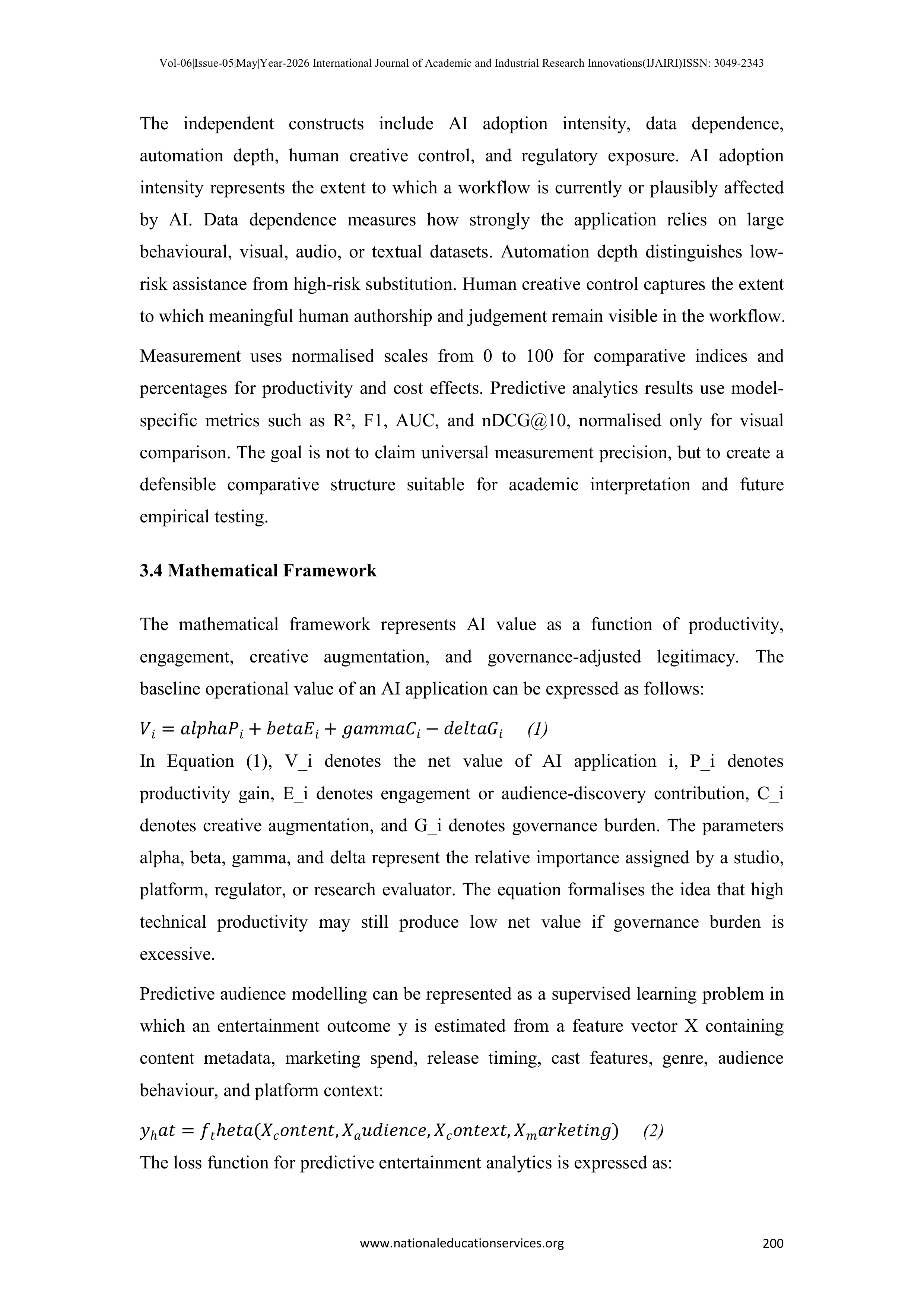
baseline operational value of an AI application can be expressed as follows:
�
�
= ���ℎ��
�
+ �����
�
+ ������
�
−������
�
(1)
In
Equation
(1),
V_i
denotes
the
net
value
of
AI
application
i,
P_i
denotes
productivity
gain,
E_i
denotes
engagement
or
audience-discovery
contribution,
C_i
denotes
creative
augmentation,
and
G_i
denotes
governance
burden.
The
parameters
alpha,
beta,
gamma,
and
delta
represent
the
relative
importance
assigned
by
a
studio,
platform,
regulator,
or
research
evaluator.
The
equation
formalises
the
idea
that
high
technical
productivity
may
still
produce
low
net
value
if
governance
burden
is
excessive.
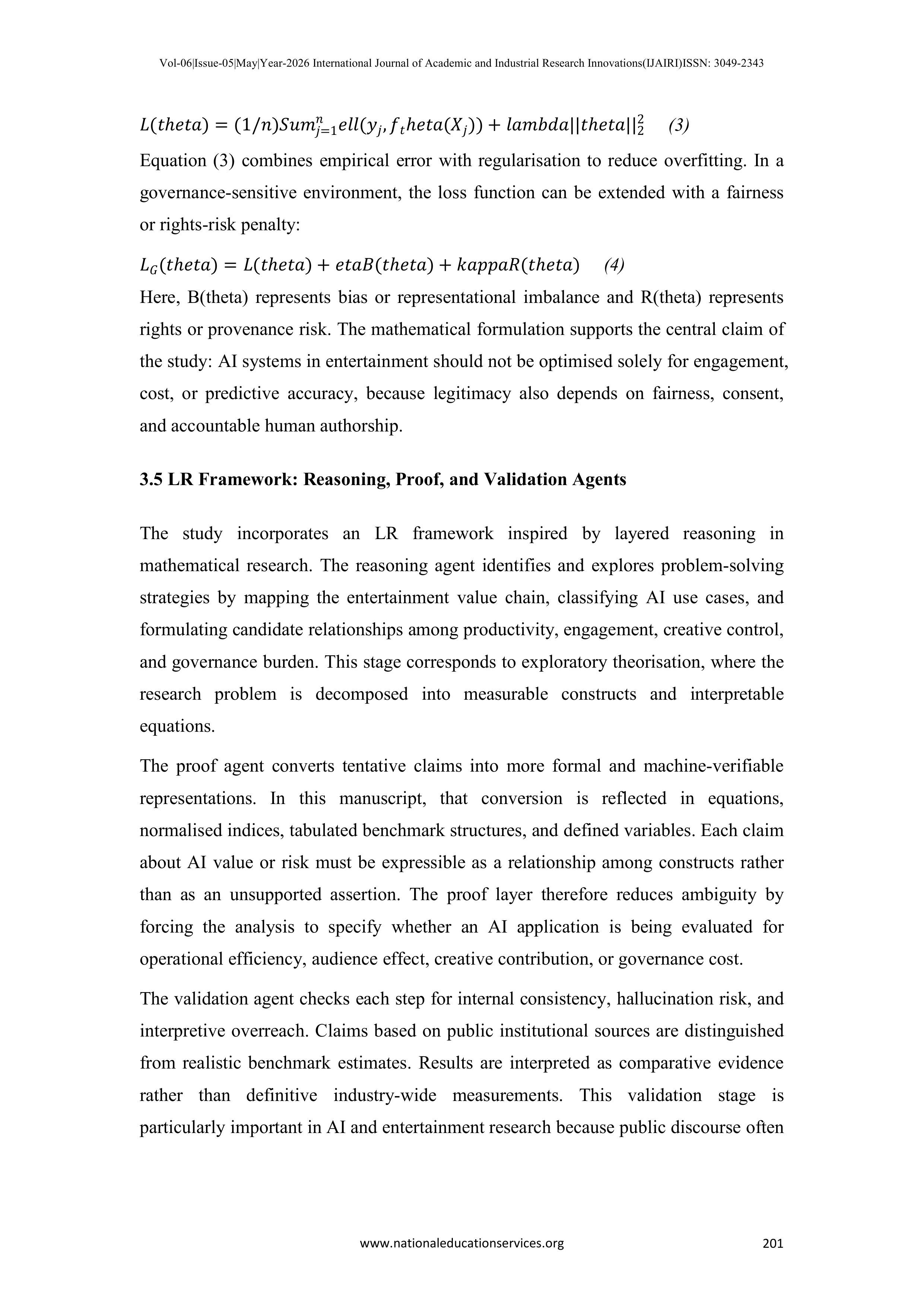
Predictive audience modelling can be represented as a supervised learning problem in
which
an
entertainment
outcome
y
is
estimated
from
a
feature
vector
X
containing
content
metadata,
marketing
spend,
release
timing,
cast
features,
genre,
audience
behaviour, and platform context:
�
ℎ
��= �
�
ℎ���(�
�
������, �
�
�������, �
�
������, �
�
��������)
(2)
The loss function for predictive entertainment analytics is expressed as:
Vol-06|Issue-05|May|Year-2026 International Journal of Academic and Industrial Research Innovations(IJAIRI)ISSN: 3049-2343
www.nationaleducationservices.org
201
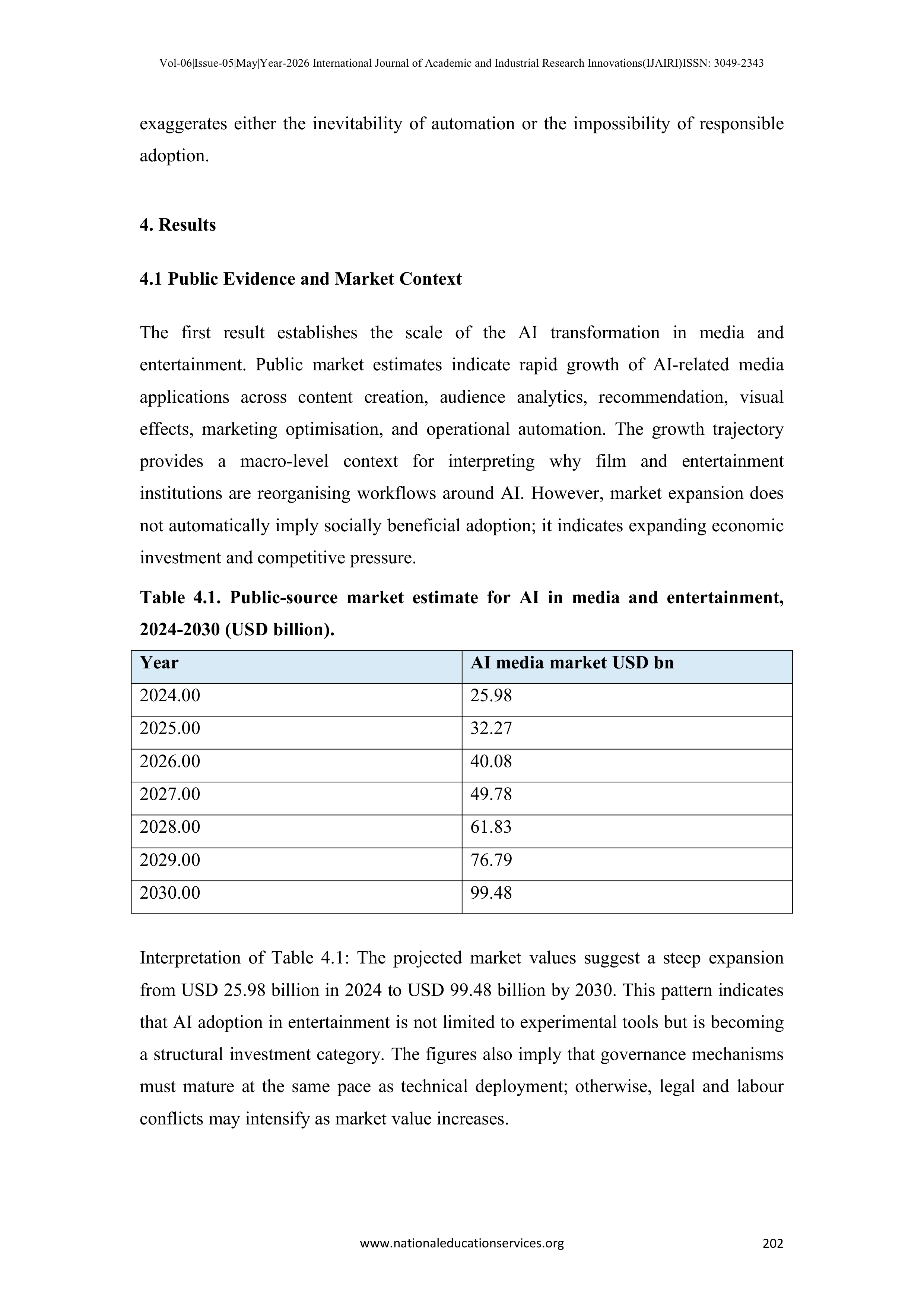
�(�ℎ���) = (1/�)���
�=1
�
���(�
�
, �
�
ℎ���(�
�
)) + ������||�ℎ���||
2
2
(3)
Equation
(3)
combines
empirical
error
with
regularisation
to
reduce
overfitting.
In
a
governance-sensitive
environment,
the
loss
function
can
be
extended
with
a
fairness
or rights-risk penalty:
�
�
(�ℎ���) =
�(�ℎ���) + ����(�ℎ���) + ������(�ℎ���)
(4)
Here,
B(theta)
represents
bias
or
representational
imbalance
and
R(theta)
represents
rights or provenance risk. The mathematical formulation supports the central claim of
the study: AI systems in entertainment should not be optimised solely for engagement,
cost,
or
predictive
accuracy,
because
legitimacy
also
depends
on
fairness,
consent,
and accountable human authorship.
3.5 LR Framework: Reasoning, Proof, and Validation Agents
The
study
incorporates
an
LR
framework
inspired
by
layered
reasoning
in
mathematical
research.
The
reasoning
agent
identifies
and
explores
problem-solving
strategies
by
mapping
the
entertainment
value
chain,
classifying
AI
use
cases,
and
formulating candidate relationships among productivity, engagement, creative control,
and governance burden. This stage corresponds to exploratory theorisation, where the
research
problem
is
decomposed
into
measurable
constructs
and
interpretable
equations.
The
proof
agent
converts
tentative
claims
into
more
formal
and
machine-verifiable
representations.
In
this
manuscript,
that
conversion
is
reflected
in
equations,
normalised indices, tabulated benchmark structures, and defined variables. Each claim
about
AI
value
or
risk
must
be
expressible
as
a
relationship
among
constructs
rather
than
as
an
unsupported
assertion.
The
proof
layer
therefore
reduces
ambiguity
by
forcing
the
analysis
to
specify
whether
an
AI
application
is
being
evaluated
for
operational efficiency, audience effect, creative contribution, or governance cost.
The validation agent checks each step for internal consistency,
hallucination risk, and
interpretive
overreach.
Claims
based
on
public
institutional
sources
are
distinguished
from
realistic
benchmark
estimates.
Results
are
interpreted
as
comparative
evidence
rather
than
definitive
industry-wide
measurements.
This
validation
stage
is
particularly important in AI and entertainment research because public discourse often
Vol-06|Issue-05|May|Year-2026 International Journal of Academic and Industrial Research Innovations(IJAIRI)ISSN: 3049-2343
www.nationaleducationservices.org
202
exaggerates
either
the
inevitability
of
automation
or
the
impossibility
of
responsible
adoption.
4. Results
4.1 Public Evidence and Market Context
The
first
result
establishes
the
scale
of
the
AI
transformation
in
media
and
entertainment.
Public
market
estimates
indicate
rapid
growth
of
AI-related
media
applications
across
content
creation,
audience
analytics,
recommendation,
visual
effects,
marketing
optimisation,
and
operational
automation.
The
growth
trajectory
provides
a
macro-level
context
for
interpreting
why
film
and
entertainment
institutions
are
reorganising
workflows
around
AI.
However,
market
expansion
does
not automatically imply socially beneficial adoption; it indicates expanding economic
investment and competitive pressure.
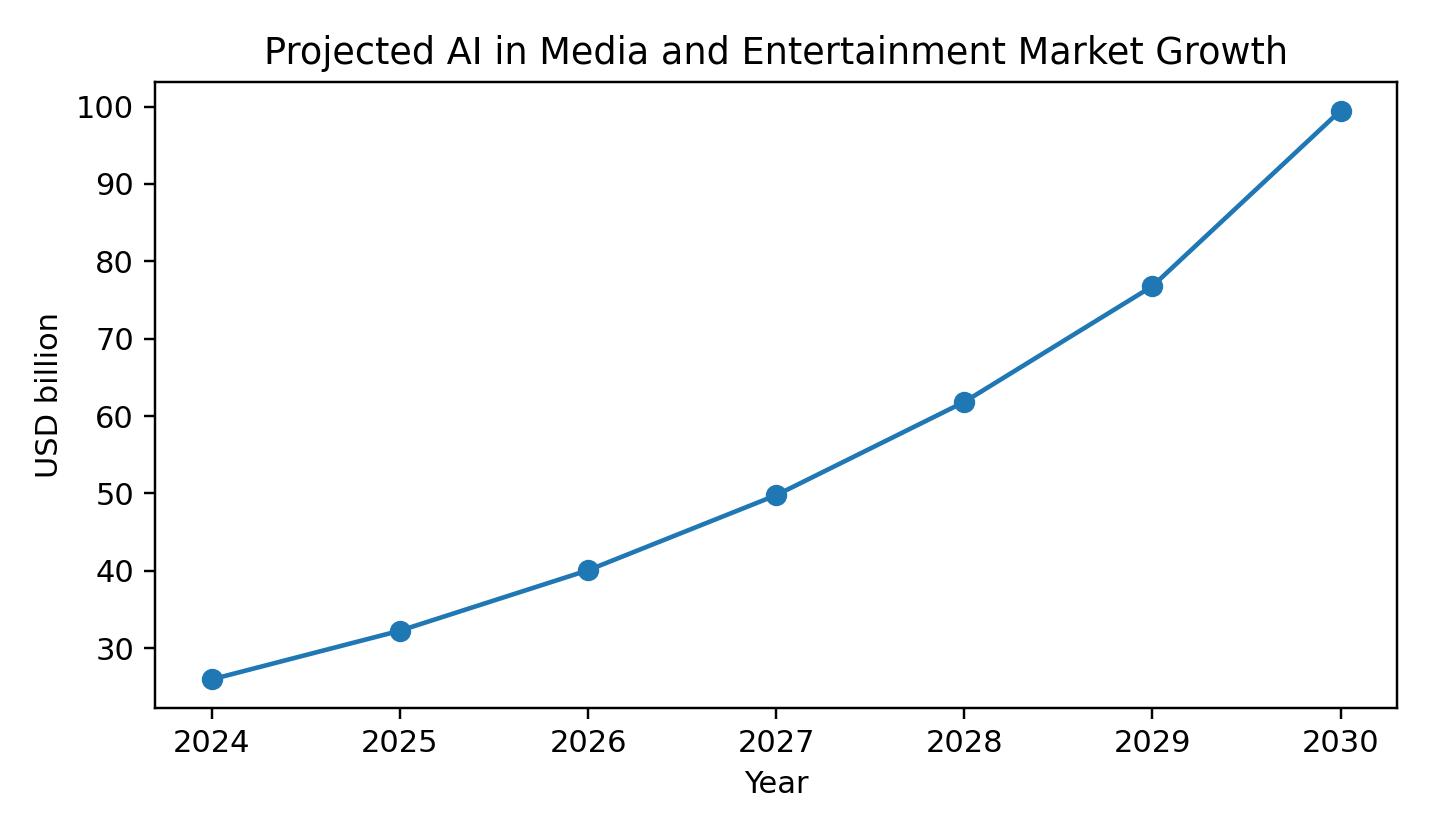
Table
4.1.
Public-source
market
estimate
for
AI
in
media
and
entertainment,
2024-2030 (USD billion).
Year
AI media market USD bn
2024.00
25.98
2025.00
32.27
2026.00
40.08
2027.00
49.78
2028.00
61.83
2029.00
76.79
2030.00
99.48
Interpretation
of
Table
4.1:
The
projected
market
values
suggest
a
steep
expansion
from USD 25.98 billion in 2024 to USD 99.48 billion by 2030. This pattern indicates
that AI adoption in entertainment is not limited to experimental tools but is becoming
a structural
investment
category.
The figures
also imply
that governance
mechanisms
must
mature
at
the
same
pace
as
technical
deployment;
otherwise,
legal
and
labour
conflicts may intensify as market value increases.
Vol-06|Issue-05|May|Year-2026 International Journal of Academic and Industrial Research Innovations(IJAIRI)ISSN: 3049-2343
www.nationaleducationservices.org
203
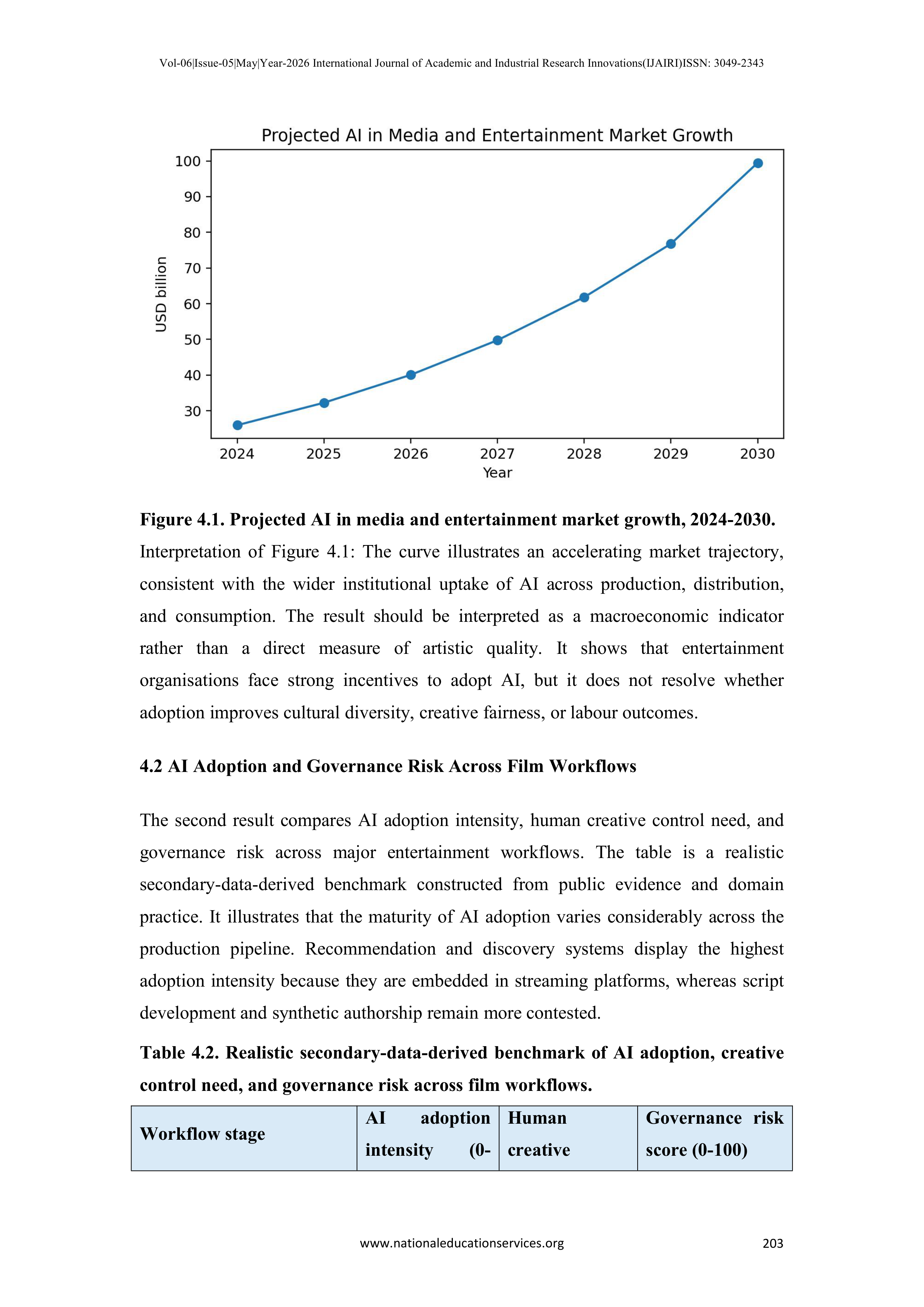
Figure 4.1. Projected AI in media and entertainment market growth, 2024-2030.
Interpretation
of
Figure
4.1:
The
curve
illustrates
an
accelerating
market
trajectory,
consistent
with
the
wider
institutional
uptake
of
AI
across
production,
distribution,
and
consumption.
The
result
should
be
interpreted
as
a
macroeconomic
indicator
rather
than
a
direct
measure
of
artistic
quality.
It
shows
that
entertainment
organisations
face
strong
incentives
to
adopt
AI,
but
it
does
not
resolve
whether
adoption improves cultural diversity, creative fairness, or labour outcomes.
4.2 AI Adoption and Governance Risk Across Film Workflows
The
second
result
compares
AI
adoption
intensity,
human
creative
control
need,
and
governance
risk
across
major
entertainment
workflows.
The
table
is
a
realistic
secondary-data-derived
benchmark
constructed
from
public
evidence
and
domain
practice.
It
illustrates
that
the
maturity
of
AI
adoption
varies
considerably
across
the
production
pipeline.
Recommendation
and
discovery
systems
display
the
highest
adoption
intensity
because
they
are
embedded
in
streaming
platforms,
whereas
script
development and synthetic authorship remain more contested.
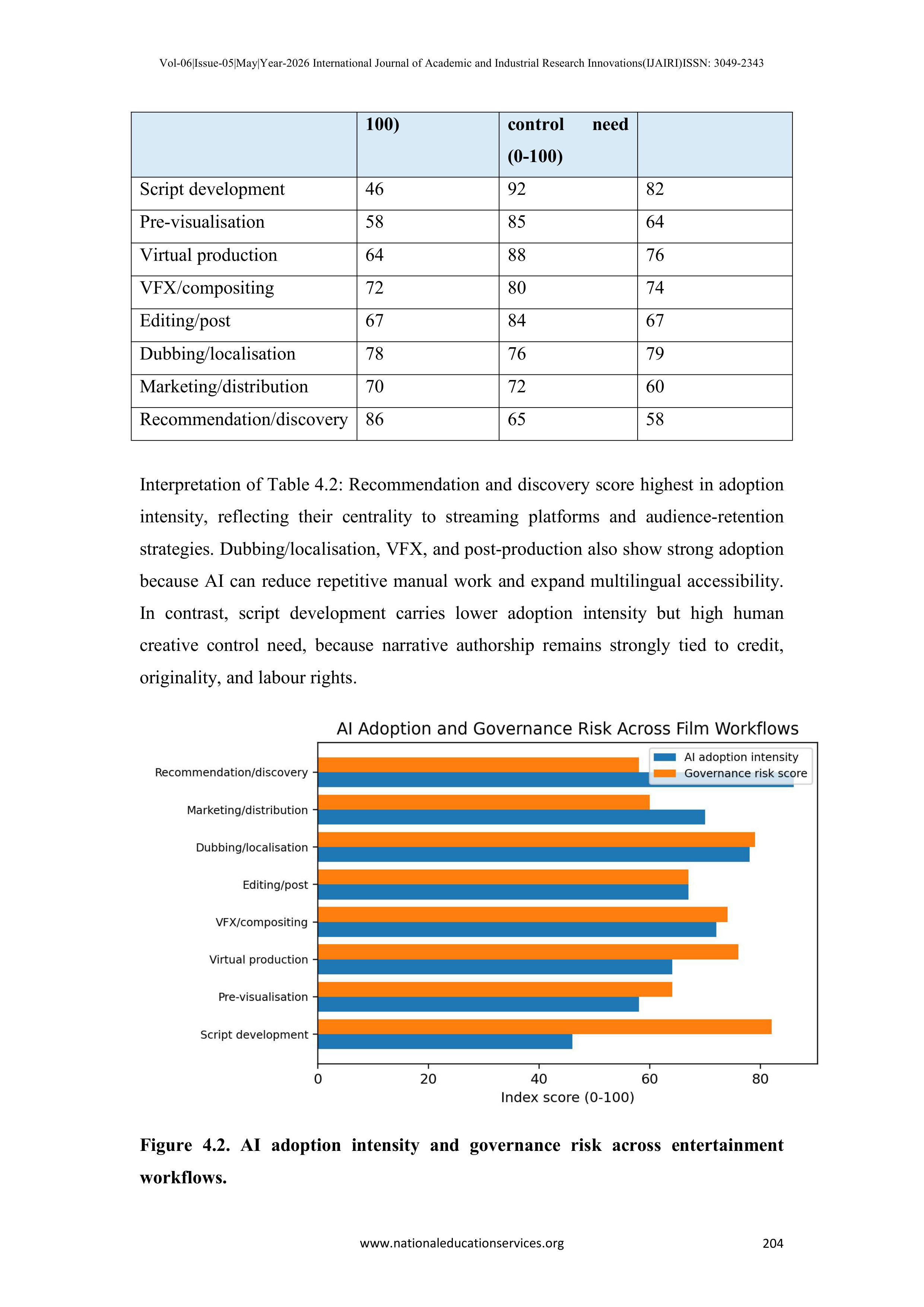
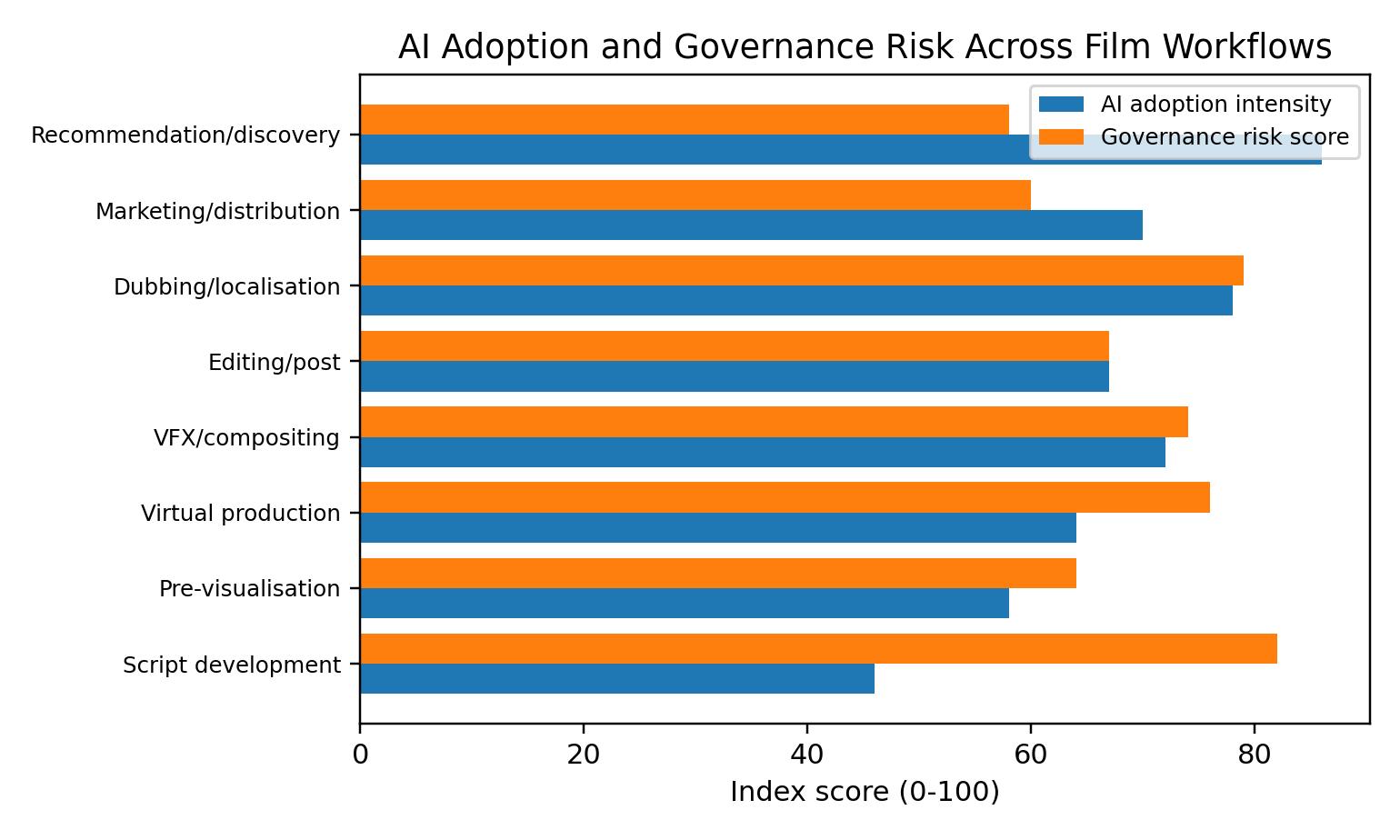
Table
4.2.
Realistic
secondary-data-derived
benchmark
of
AI
adoption,
creative
control need, and governance risk across film workflows.
Workflow stage
AI
adoption
intensity
(0-
Human
creative
Governance
risk
score (0-100)
Vol-06|Issue-05|May|Year-2026 International Journal of Academic and Industrial Research Innovations(IJAIRI)ISSN: 3049-2343
www.nationaleducationservices.org
204
100)
control
need
(0-100)
Script development
46
92
82
Pre-visualisation
58
85
64
Virtual production
64
88
76
VFX/compositing
72
80
74
Editing/post
67
84
67
Dubbing/localisation
78
76
79
Marketing/distribution
70
72
60
Recommendation/discovery
86
65
58
Interpretation of Table 4.2: Recommendation and
discovery score highest in adoption
intensity,
reflecting
their
centrality
to
streaming
platforms
and
audience-retention
strategies. Dubbing/localisation, VFX, and post-production also show strong adoption
because
AI
can
reduce
repetitive
manual
work
and
expand
multilingual
accessibility.
In
contrast,
script
development
carries
lower
adoption
intensity
but
high
human
creative
control
need,
because
narrative
authorship
remains
strongly
tied
to
credit,
originality, and labour rights.
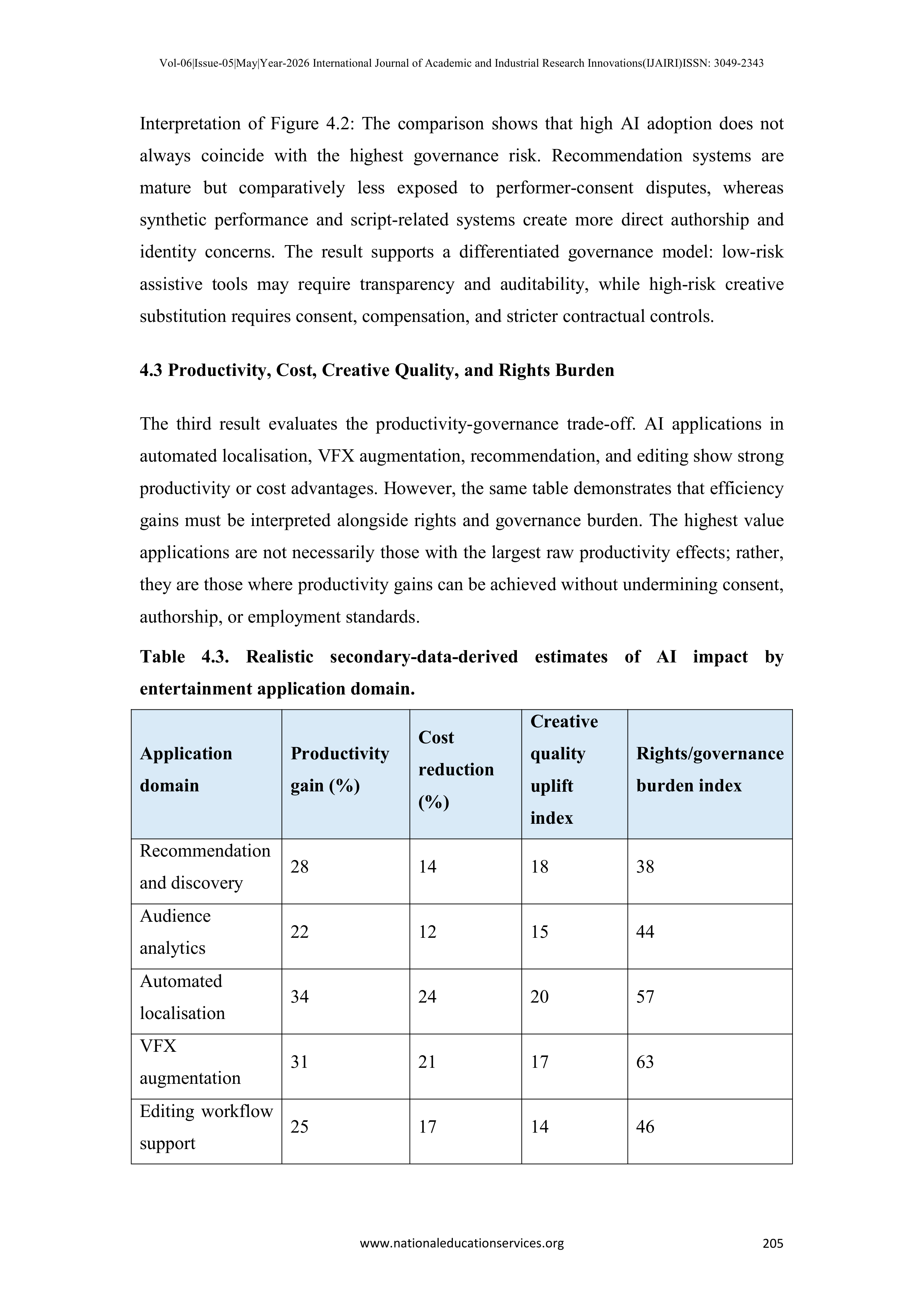
Figure
4.2.
AI
adoption
intensity
and
governance
risk
across
entertainment
workflows.
Vol-06|Issue-05|May|Year-2026 International Journal of Academic and Industrial Research Innovations(IJAIRI)ISSN: 3049-2343
www.nationaleducationservices.org
205
Interpretation
of
Figure
4.2:
The
comparison
shows
that
high
AI
adoption
does
not
always
coincide
with
the
highest
governance
risk.
Recommendation
systems
are
mature
but
comparatively
less
exposed
to
performer-consent
disputes,
whereas
synthetic
performance
and
script-related
systems
create
more
direct
authorship
and
identity
concerns.
The
result
supports
a
differentiated
governance
model:
low-risk
assistive
tools
may
require
transparency
and
auditability,
while
high-risk
creative
substitution requires consent, compensation, and stricter contractual controls.
4.3 Productivity, Cost, Creative Quality, and Rights Burden
The
third
result
evaluates
the
productivity-governance
trade-off.
AI
applications
in
automated localisation, VFX augmentation, recommendation, and editing show strong
productivity or cost advantages. However, the same table demonstrates that efficiency
gains
must
be
interpreted
alongside
rights
and
governance
burden.
The
highest
value
applications are not necessarily those with the largest raw productivity effects; rather,
they are those where productivity gains can be achieved without undermining consent,
authorship, or employment standards.
Table
4.3.
Realistic
secondary-data-derived
estimates
of
AI
impact
by
entertainment application domain.
Application
domain
Productivity
gain (%)
Cost
reduction
(%)
Creative
quality
uplift
index
Rights/governance
burden index
Recommendation
and discovery
28
14
18
38
Audience
analytics
22
12
15
44
Automated
localisation
34
24
20
57
VFX
augmentation
31
21
17
63
Editing
workflow
support
25
17
14
46
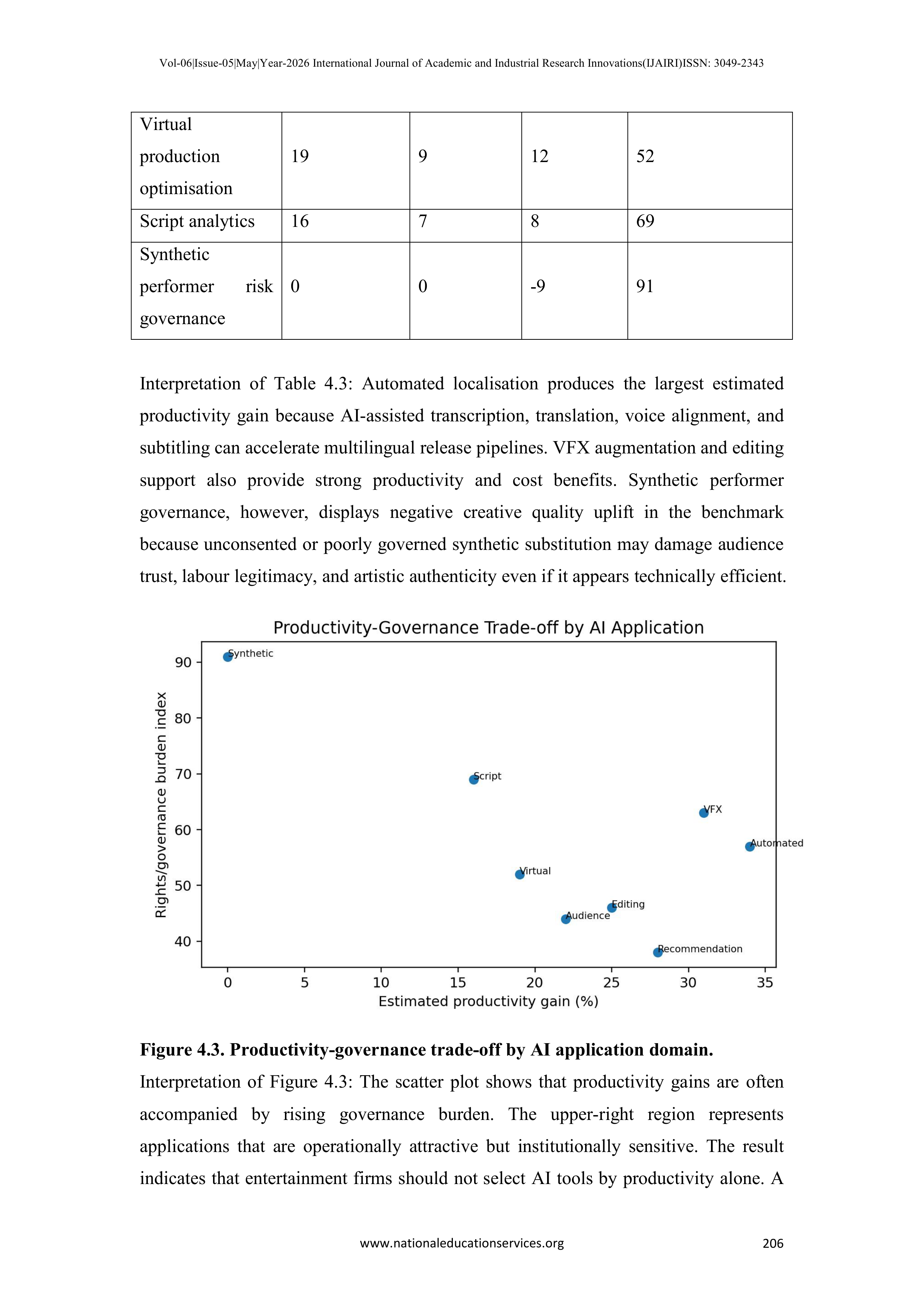
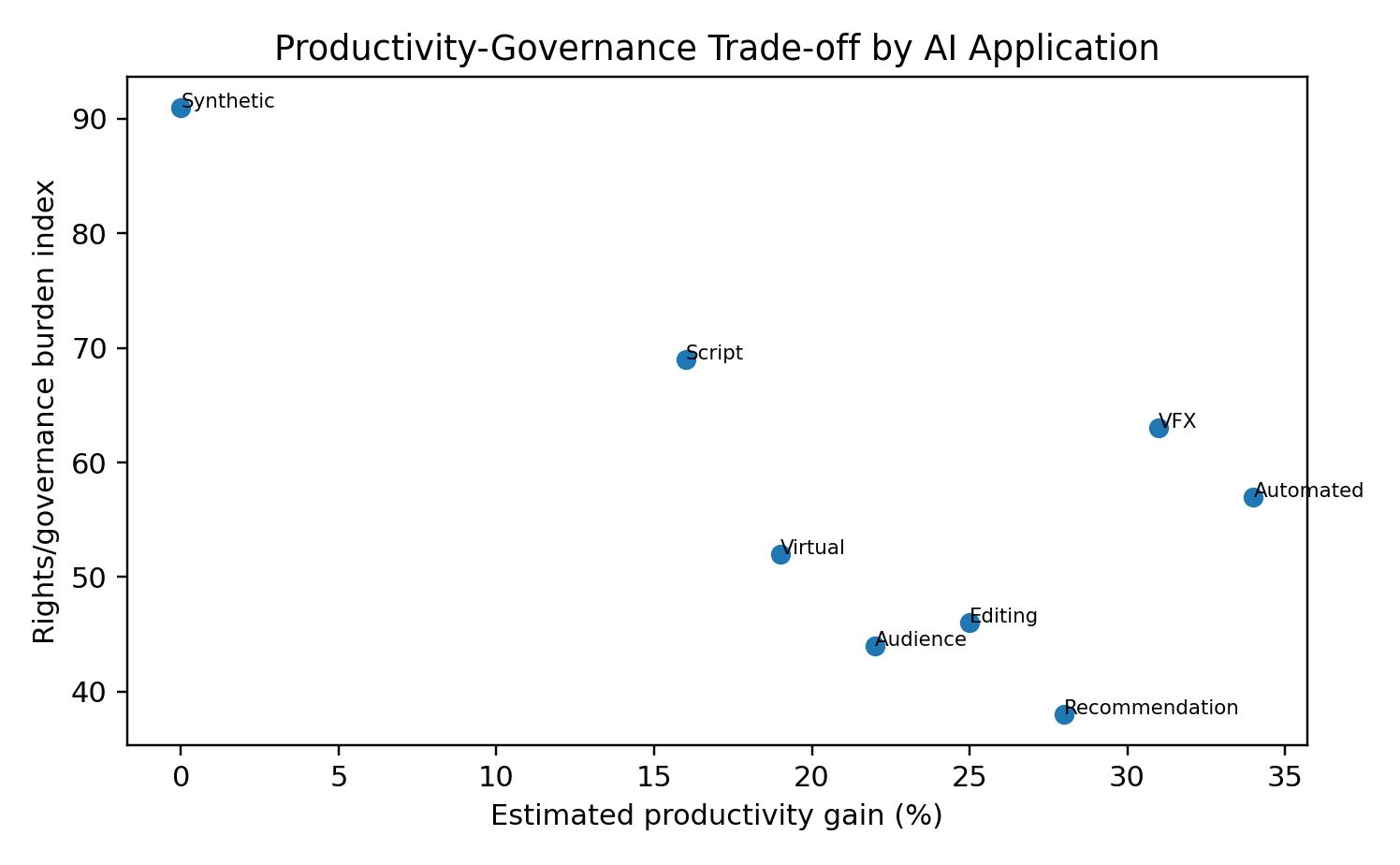
Vol-06|Issue-05|May|Year-2026 International Journal of Academic and Industrial Research Innovations(IJAIRI)ISSN: 3049-2343
www.nationaleducationservices.org
206
Virtual
production
optimisation
19
9
12
52
Script analytics
16
7
8
69
Synthetic
performer
risk
governance
0
0
-9
91
Interpretation
of
Table
4.3:
Automated
localisation
produces
the
largest
estimated
productivity
gain
because
AI-assisted
transcription,
translation,
voice
alignment,
and
subtitling can accelerate multilingual release pipelines. VFX augmentation and editing
support
also
provide
strong
productivity
and
cost
benefits.
Synthetic
performer
governance,
however,
displays
negative
creative
quality
uplift
in
the
benchmark
because unconsented
or poorly governed
synthetic substitution may damage audience
trust, labour legitimacy, and artistic authenticity even if it appears technically efficient.
Figure 4.3. Productivity-governance trade-off by AI application domain.
Interpretation
of
Figure
4.3:
The
scatter
plot
shows
that
productivity
gains
are
often
accompanied
by
rising
governance
burden.
The
upper-right
region
represents
applications
that
are
operationally
attractive
but
institutionally
sensitive.
The
result
indicates
that
entertainment
firms
should
not
select
AI
tools
by
productivity
alone.
A
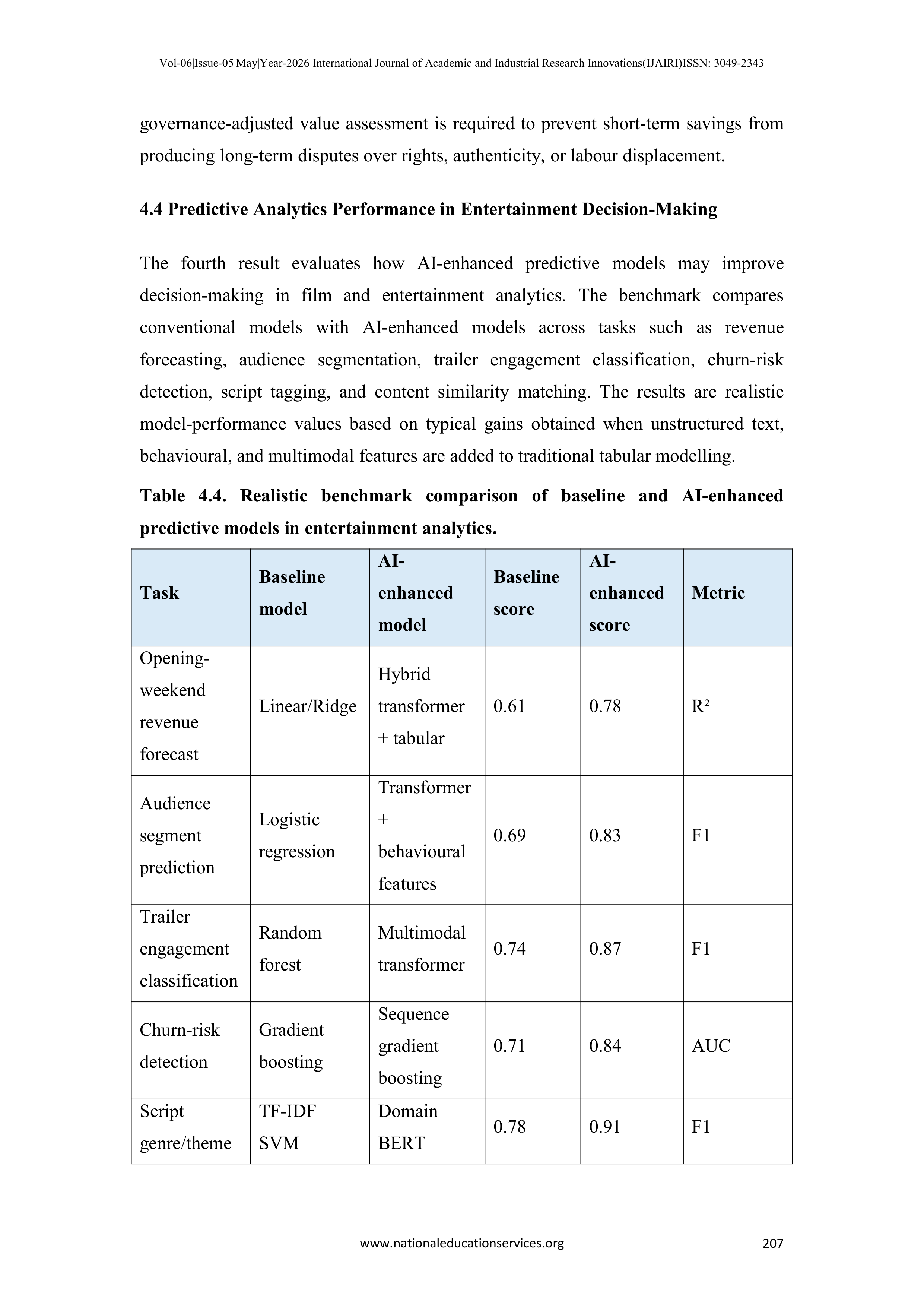
Vol-06|Issue-05|May|Year-2026 International Journal of Academic and Industrial Research Innovations(IJAIRI)ISSN: 3049-2343
www.nationaleducationservices.org
207
governance-adjusted
value
assessment
is
required
to
prevent
short-term
savings
from
producing long-term disputes over rights, authenticity, or labour displacement.
4.4 Predictive Analytics Performance in Entertainment Decision-Making
The
fourth
result
evaluates
how
AI-enhanced
predictive
models
may
improve
decision-making
in
film
and
entertainment
analytics.
The
benchmark
compares
conventional
models
with
AI-enhanced
models
across
tasks
such
as
revenue
forecasting,
audience
segmentation,
trailer
engagement
classification,
churn-risk
detection,
script
tagging,
and
content
similarity
matching.
The
results
are
realistic
model-performance
values
based
on
typical
gains
obtained
when
unstructured
text,
behavioural, and multimodal features are added to traditional tabular modelling.
Table
4.4.
Realistic
benchmark
comparison
of
baseline
and
AI-enhanced
predictive models in entertainment analytics.
Task
Baseline
model
AI-
enhanced
model
Baseline
score
AI-
enhanced
score
Metric
Opening-
weekend
revenue
forecast
Linear/Ridge
Hybrid
transformer
+ tabular
0.61
0.78
R²
Audience
segment
prediction
Logistic
regression
Transformer
+
behavioural
features
0.69
0.83
F1
Trailer
engagement
classification
Random
forest
Multimodal
transformer
0.74
0.87
F1
Churn-risk
detection
Gradient
boosting
Sequence
gradient
boosting
0.71
0.84
AUC
Script
genre/theme
TF-IDF
SVM
Domain
BERT
0.78
0.91
F1
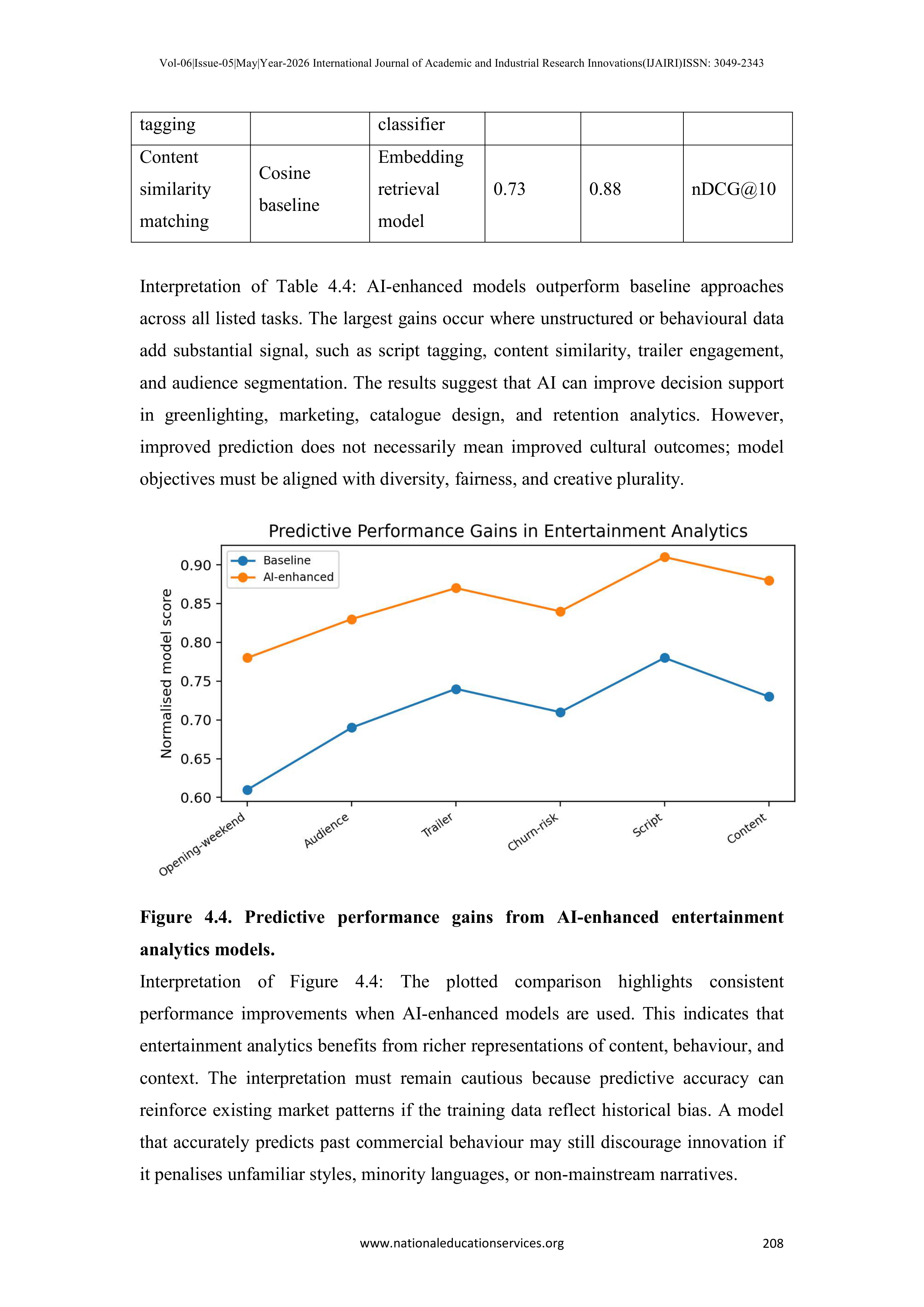
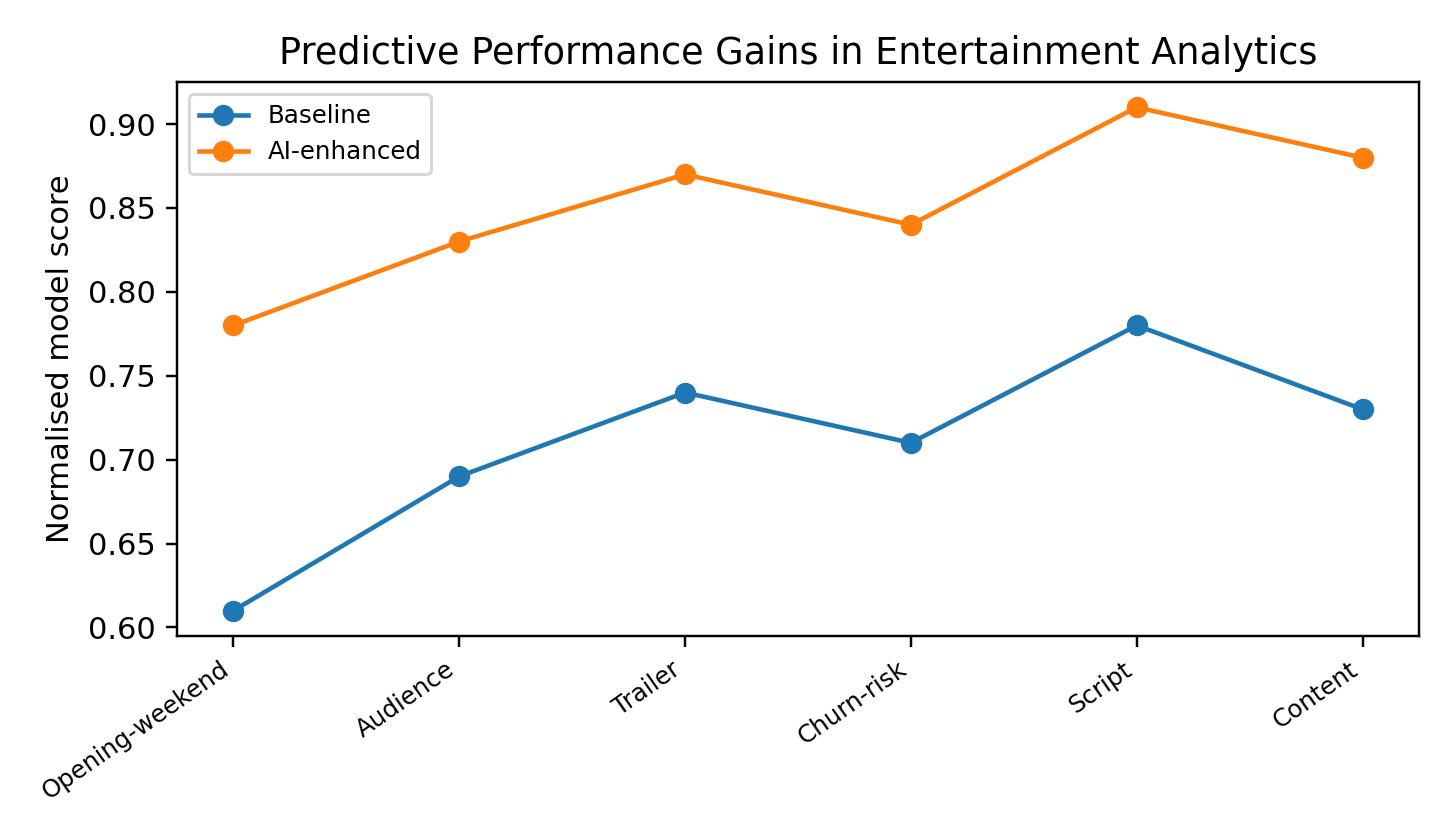
Vol-06|Issue-05|May|Year-2026 International Journal of Academic and Industrial Research Innovations(IJAIRI)ISSN: 3049-2343
www.nationaleducationservices.org
208
tagging
classifier
Content
similarity
matching
Cosine
baseline
Embedding
retrieval
model
0.73
0.88
nDCG@10
Interpretation
of
Table
4.4:
AI-enhanced
models
outperform
baseline
approaches
across all listed tasks. The largest gains occur
where unstructured
or behavioural data
add
substantial
signal,
such
as
script
tagging,
content
similarity,
trailer
engagement,
and
audience
segmentation.
The results suggest
that
AI can
improve decision
support
in
greenlighting,
marketing,
catalogue
design,
and
retention
analytics.
However,
improved
prediction
does
not
necessarily
mean
improved
cultural
outcomes;
model
objectives must be aligned with diversity, fairness, and creative plurality.
Figure
4.4.
Predictive
performance
gains
from
AI-enhanced
entertainment
analytics models.
Interpretation
of
Figure
4.4:
The
plotted
comparison
highlights
consistent
performance
improvements
when
AI-enhanced
models
are
used.
This
indicates
that
entertainment analytics benefits from richer representations of content, behaviour, and
context.
The
interpretation
must
remain
cautious
because
predictive
accuracy
can
reinforce
existing
market
patterns
if
the
training
data
reflect
historical
bias.
A
model
that
accurately
predicts
past
commercial
behaviour
may
still
discourage
innovation
if
it penalises unfamiliar styles, minority languages, or non-mainstream narratives.
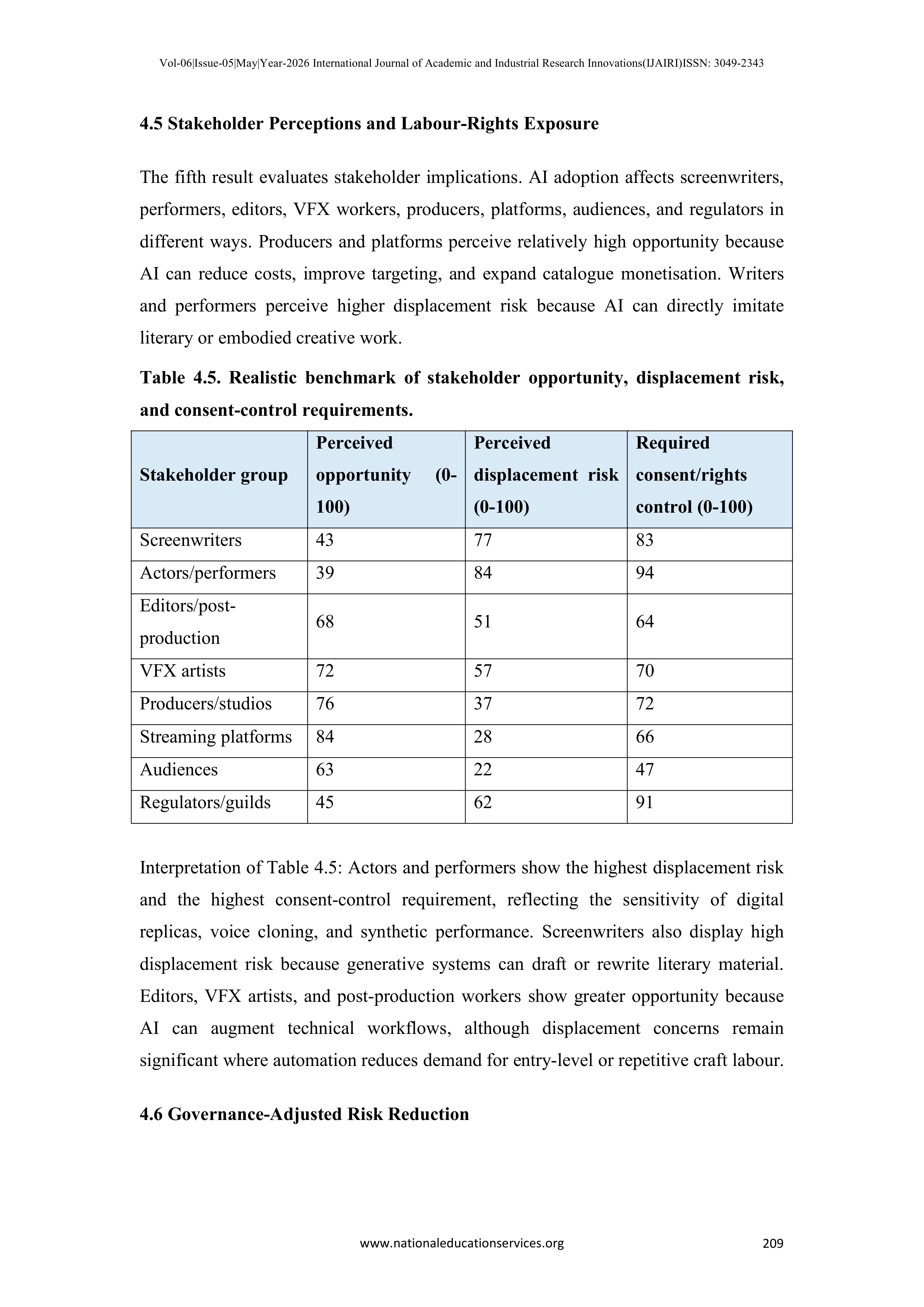
Vol-06|Issue-05|May|Year-2026 International Journal of Academic and Industrial Research Innovations(IJAIRI)ISSN: 3049-2343
www.nationaleducationservices.org
209
4.5 Stakeholder Perceptions and Labour-Rights Exposure
The
fifth
result
evaluates
stakeholder
implications.
AI
adoption
affects
screenwriters,
performers,
editors,
VFX
workers,
producers,
platforms,
audiences,
and
regulators
in
different
ways.
Producers
and
platforms
perceive
relatively
high
opportunity
because
AI
can
reduce
costs,
improve
targeting,
and
expand
catalogue
monetisation.
Writers
and
performers
perceive
higher
displacement
risk
because
AI
can
directly
imitate
literary or embodied creative work.
Table
4.5.
Realistic
benchmark
of
stakeholder
opportunity,
displacement
risk,
and consent-control requirements.
Stakeholder group
Perceived
opportunity
(0-
100)
Perceived
displacement
risk
(0-100)
Required
consent/rights
control (0-100)
Screenwriters
43
77
83
Actors/performers
39
84
94
Editors/post-
production
68
51
64
VFX artists
72
57
70
Producers/studios
76
37
72
Streaming platforms
84
28
66
Audiences
63
22
47
Regulators/guilds
45
62
91
Interpretation of Table 4.5: Actors and performers show the highest displacement risk
and
the
highest
consent-control
requirement,
reflecting
the
sensitivity
of
digital
replicas,
voice
cloning,
and
synthetic
performance.
Screenwriters
also
display
high
displacement
risk
because
generative
systems
can
draft
or
rewrite
literary
material.
Editors,
VFX
artists,
and
post-production
workers
show
greater
opportunity
because
AI
can
augment
technical
workflows,
although
displacement
concerns
remain
significant where automation reduces demand for entry-level or repetitive craft labour.
4.6 Governance-Adjusted Risk Reduction
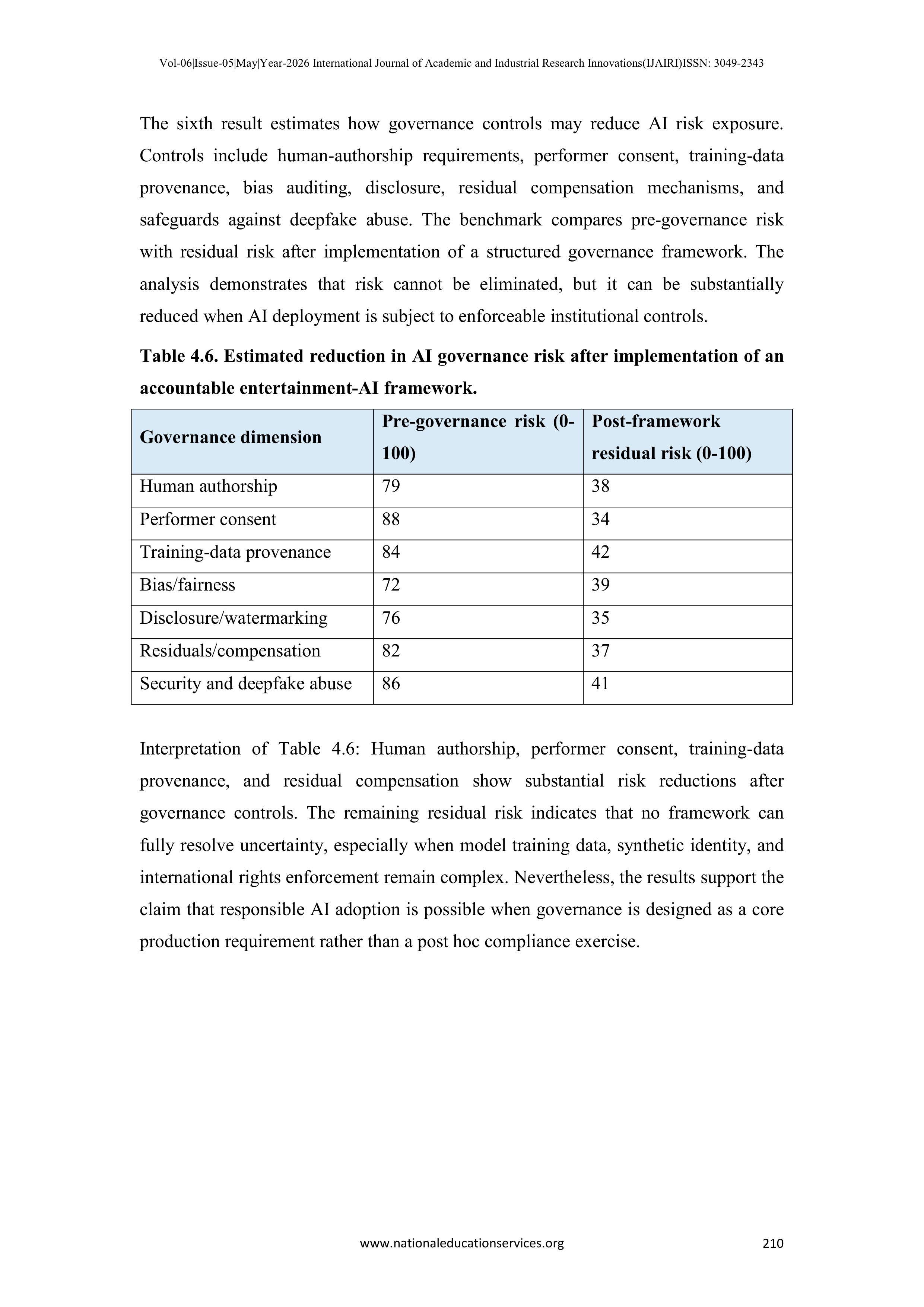
Vol-06|Issue-05|May|Year-2026 International Journal of Academic and Industrial Research Innovations(IJAIRI)ISSN: 3049-2343
www.nationaleducationservices.org
210
The
sixth
result
estimates
how
governance
controls
may
reduce
AI
risk
exposure.
Controls
include
human-authorship
requirements,
performer
consent,
training-data
provenance,
bias
auditing,
disclosure,
residual
compensation
mechanisms,
and
safeguards
against
deepfake
abuse.
The
benchmark
compares
pre-governance
risk
with
residual
risk
after
implementation
of
a
structured
governance
framework.
The
analysis
demonstrates
that
risk
cannot
be
eliminated,
but
it
can
be
substantially
reduced when AI deployment is subject to enforceable institutional controls.
Table 4.6. Estimated reduction in AI governance risk after implementation of an
accountable entertainment-AI framework.
Governance dimension
Pre-governance
risk
(0-
100)
Post-framework
residual risk (0-100)
Human authorship
79
38
Performer consent
88
34
Training-data provenance
84
42
Bias/fairness
72
39
Disclosure/watermarking
76
35
Residuals/compensation
82
37
Security and deepfake abuse
86
41
Interpretation
of
Table
4.6:
Human
authorship,
performer
consent,
training-data
provenance,
and
residual
compensation
show
substantial
risk
reductions
after
governance
controls.
The
remaining
residual
risk
indicates
that
no
framework
can
fully
resolve
uncertainty,
especially
when
model
training
data,
synthetic
identity,
and
international rights enforcement remain complex. Nevertheless, the results support the
claim
that responsible AI adoption is
possible when
governance
is designed
as
a core
production requirement rather than a post hoc compliance exercise.
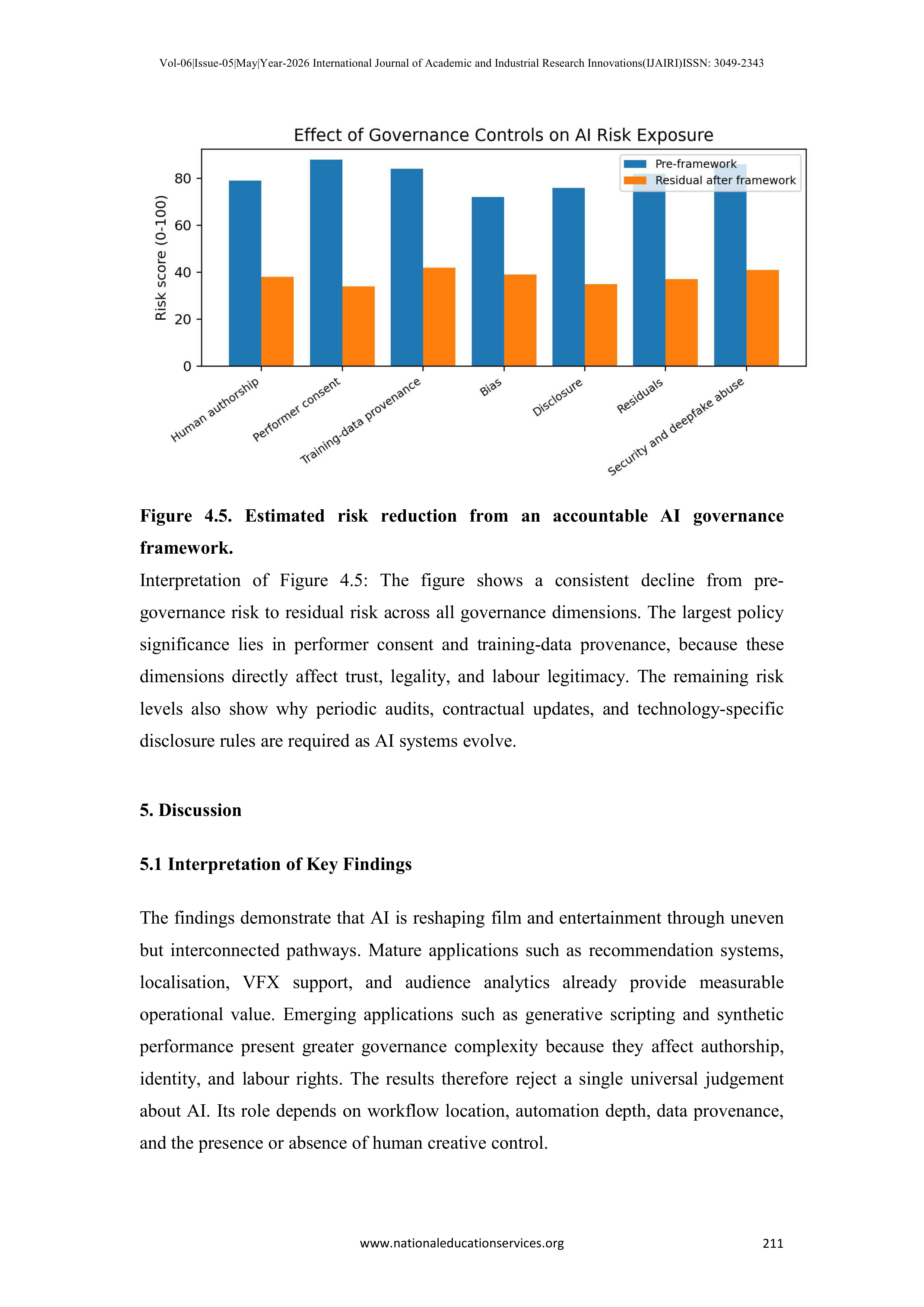
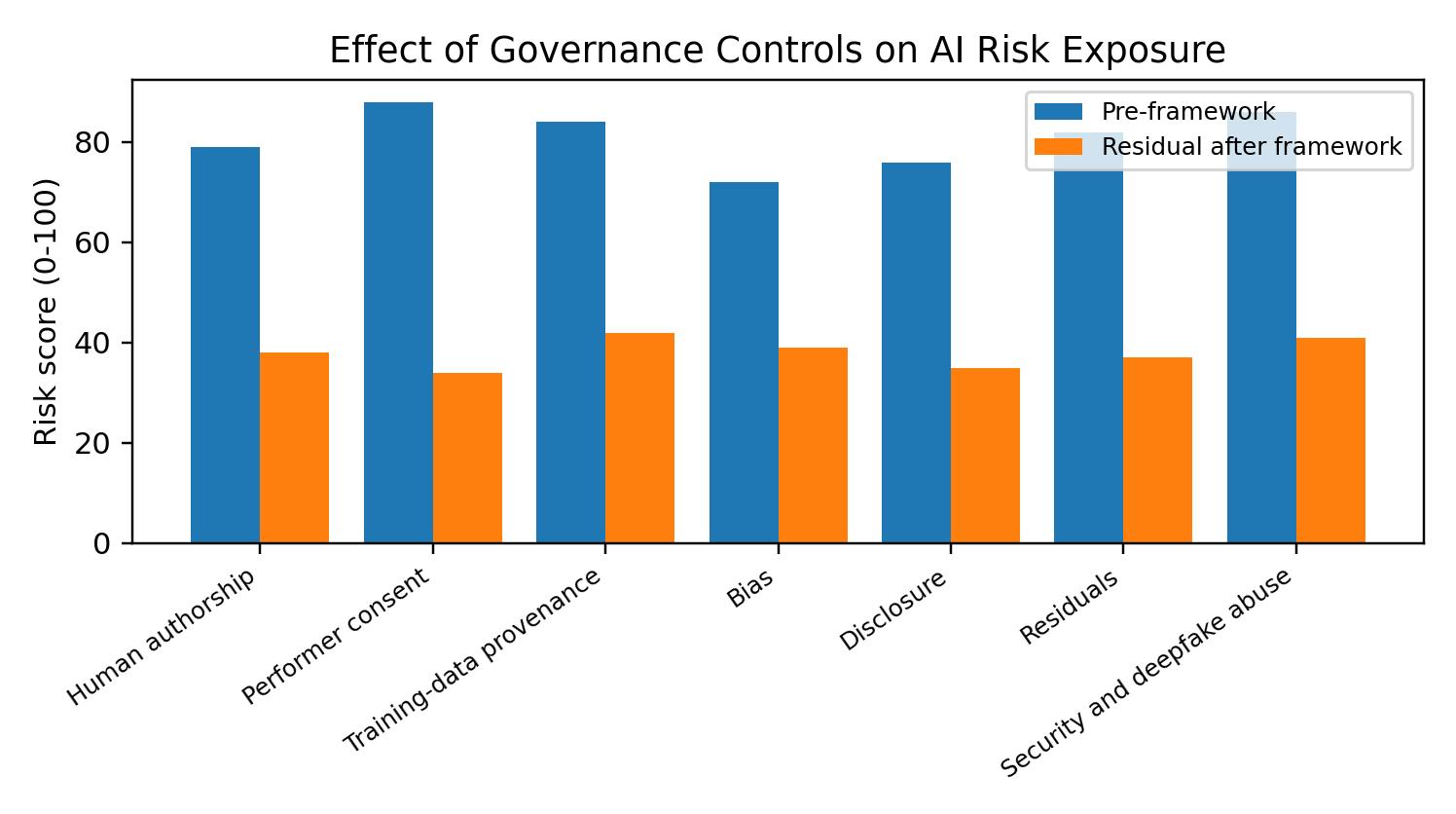
Vol-06|Issue-05|May|Year-2026 International Journal of Academic and Industrial Research Innovations(IJAIRI)ISSN: 3049-2343
www.nationaleducationservices.org
211
Figure
4.5.
Estimated
risk
reduction
from
an
accountable
AI
governance
framework.
Interpretation
of
Figure
4.5:
The
figure
shows
a
consistent
decline
from
pre-
governance
risk
to
residual
risk
across
all
governance
dimensions.
The
largest
policy
significance
lies
in
performer
consent
and
training-data
provenance,
because
these
dimensions
directly
affect
trust,
legality,
and
labour
legitimacy.
The
remaining
risk
levels
also
show
why
periodic
audits,
contractual
updates,
and
technology-specific
disclosure rules are required as AI systems evolve.
5. Discussion
5.1 Interpretation of Key Findings
The findings
demonstrate that AI is reshaping
film and entertainment through
uneven
but
interconnected
pathways.
Mature
applications
such
as
recommendation
systems,
localisation,
VFX
support,
and
audience
analytics
already
provide
measurable
operational
value.
Emerging
applications
such
as
generative
scripting
and
synthetic
performance
present
greater
governance
complexity
because
they
affect
authorship,
identity,
and
labour
rights.
The
results
therefore
reject
a
single
universal
judgement
about
AI.
Its
role
depends
on
workflow
location,
automation
depth,
data
provenance,
and the presence or absence of human creative control.
Vol-06|Issue-05|May|Year-2026 International Journal of Academic and Industrial Research Innovations(IJAIRI)ISSN: 3049-2343
www.nationaleducationservices.org
212
The productivity-governance trade-off is the central empirical insight. AI can improve
throughput and decision-making, but the highest-risk uses are those that substitute for
recognised
human
creative
contribution
or
appropriate
protected
material
without
clear
permission.
This
finding
is
consistent
with
contemporary
institutional
developments
in
which
unions,
copyright
offices,
awards
bodies,
and
studios
are
moving
from
informal
AI
experimentation
toward
formal
rules.
The
future
of
AI
in
entertainment
will
therefore
depend
on
governance
design
as
much
as
model
capability.
The
model-performance
results
also
reveal
a
significant
tension.
AI-enhanced
analytics can improve forecasting, segmentation, and content matching, but predictive
success may reproduce historical biases in funding, genre preference, casting visibility,
and audience targeting. Entertainment industries should therefore evaluate models not
only by accuracy but also by diversity impact, representational fairness, and long-term
cultural value.
5.2 Theoretical Contributions
This
study
contributes
to
theory
by
framing
AI
in
entertainment
as
a
governance-
adjusted
creative
infrastructure.
The
proposed
value
equation
makes
explicit
that
productivity,
engagement,
and
creative
augmentation
must
be
weighed
against
governance
burden.
This
formulation
moves
beyond
a
narrow
automation
model
and
provides
a
more
realistic
account
of
how
entertainment
institutions
make
decisions.
An
AI
tool
may
be
technically
impressive
yet
institutionally
harmful
if
it
violates
consent, undermines authorship, or creates unacceptable rights exposure.
The
LR
framework
adds
a
second
contribution
by
translating
exploratory
creative-
industry
analysis
into
a
structured
reasoning,
proof,
and
validation
process.
The
reasoning
agent
identifies
the
relevant
AI
use
cases
and
problem-solving
strategies;
the proof agent converts claims into formal variables and equations; and the validation
agent
distinguishes
public
evidence
from
benchmark
estimates.
This
approach
is
especially
useful
in
emerging
technology
domains
where
exaggerated
claims
and
incomplete data are common.
A
further
theoretical
contribution
concerns
the
distinction
between
assistive,
collaborative,
and
substitutive
AI.
This
typology
clarifies
why
some
AI
tools
may
be
Vol-06|Issue-05|May|Year-2026 International Journal of Academic and Industrial Research Innovations(IJAIRI)ISSN: 3049-2343
www.nationaleducationservices.org
213
welcomed
as
craft
accelerators
while
others
provoke
ethical
or
legal
resistance.
The
distinction
can
inform
future
research
on
creative
agency,
authorship
attribution,
digital labour, and platform governance.
5.3 Practical Implications for Studios, Platforms, and Creative Workers
For
studios
and
production
companies,
the
results
suggest
that
AI
should
be
implemented
through
workflow-specific
governance.
Assistive
AI
in
localisation,
editing, VFX clean-up, and production scheduling may be adopted with transparency,
quality control, and labour upskilling. Generative systems used for story, performance,
likeness,
or
music
require
stronger
contract
language,
documented
consent,
provenance audits, and
attribution protocols.
A single enterprise AI policy
is unlikely
to be sufficient because the risk profile varies across each creative function.
For
streaming
platforms,
recommendation
systems
should
be
audited
for
diversity,
fairness,
and
exposure
effects.
Personalisation
can
improve
viewer
satisfaction
and
catalogue
utilisation,
but
it
can
also
narrow
discovery
if
optimisation
rewards
only
familiar behaviour. Platforms should therefore incorporate diversity-aware objectives,
transparent
user
controls,
and
periodic
evaluation
of
whether
algorithmic
ranking
marginalises particular languages, regions, genres, or independent creators.
For
creative
workers,
the
findings
indicate
that
AI
literacy
will
become
a
core
professional
competency.
Writers,
performers,
editors,
VFX
artists,
composers,
and
designers
may
benefit
from
understanding
how
AI
systems
are
trained,
how
outputs
are
governed,
and
how
contracts
define
permissible
use.
Labour
protection
and
technological adaptation should not be treated as opposites. Sustainable creative work
requires both enforceable rights and access to productivity-enhancing tools.
5.4 Ethical, Legal, and Cultural Implications
The
ethical
implications
of
AI
in
entertainment
centre
on
consent,
authenticity,
representation,
and
accountability.
Synthetic
media
can
blur
the
boundary
between
human
performance
and
machine-generated
imitation.
If
audiences
cannot
identify
when a performance, voice, or image has been generated or altered, trust may decline.
Disclosure
and
provenance
metadata
therefore
play
an
important
role
in
preserving
transparency without necessarily prohibiting creative experimentation.
Vol-06|Issue-05|May|Year-2026 International Journal of Academic and Industrial Research Innovations(IJAIRI)ISSN: 3049-2343
www.nationaleducationservices.org
214
Legal
implications
are equally
significant. AI-generated
outputs may
face uncertainty
regarding
copyright
protection,
especially
where
human
authorship
is
minimal.
Training-data
disputes
may
affect
studios
and
vendors
if
models
are
built
on
copyrighted
material
without
clear
licences.
Contracts
must
address
ownership,
indemnity,
reuse,
residuals,
consent
duration,
likeness
rights,
and
model-training
permissions. The legal status of AI-assisted work is likely to remain dynamic, making
ongoing compliance review essential.
Culturally,
AI
may
either
expand
or
narrow
creativity.
It
can
lower
barriers
to
production,
improve
accessibility,
enable
multilingual
distribution,
and
support
independent creators. Yet it can
also intensify formulaic content production if models
optimise
only
for
prior
commercial
success.
The
cultural
value
of
AI
will
therefore
depend
on
whether
institutions
use
it
to
broaden
creative
possibility
or
merely
to
reduce labour costs and replicate proven formulas.
6. Conclusion
6.1 Summary of Findings
This
study
evaluated
the
role
of
artificial
intelligence
in
film
and
entertainment
through a PhD-level conceptual and quantitative framework. The analysis showed that
AI
is
already
influential
across
recommendation,
audience
analytics,
localisation,
VFX,
editing,
virtual
production,
marketing,
and
creative
development.
Results
from
the realistic secondary-data-derived benchmark indicate that recommendation systems,
localisation,
VFX
augmentation,
and
post-production
support
deliver
strong
operational
value,
whereas
synthetic
performance
and
AI-authored
creative
substitution create the highest governance burden.
The
study
also
demonstrated
that
AI-enhanced
predictive
models
can
improve
entertainment
analytics
across
revenue
forecasting,
audience
segmentation,
trailer
engagement,
churn-risk
detection,
script
classification,
and
content
similarity
tasks.
However,
model
performance
alone
is
insufficient
as
an
adoption
criterion.
Entertainment
AI
must
be
evaluated
using
governance-adjusted
value,
where
productivity
and
engagement
are
balanced
against
consent,
authorship,
rights
provenance, fairness, and cultural diversity.
Vol-06|Issue-05|May|Year-2026 International Journal of Academic and Industrial Research Innovations(IJAIRI)ISSN: 3049-2343
www.nationaleducationservices.org
215
The
central
conclusion
is
that
AI
should
be
understood
as
an
augmentative
and
governable
infrastructure
rather
than
as
an
inevitable
replacement
for
human
creativity.
Responsible
adoption
requires
enforceable
human
authorship,
informed
performer
consent,
auditable
data
provenance,
fair
compensation,
disclosure,
bias
auditing, and continuous validation. The future of AI in film and entertainment will be
shaped
by
institutions
that
combine
technological
innovation
with
credible
rights-
preserving governance.
6.2 Recommendations
Entertainment
organisations
should
classify
AI
tools
by
automation
depth
and
rights
sensitivity
before
deployment.
Low-risk
assistive
tools
may
be
governed
through
quality assurance and disclosure, whereas high-risk systems involving likeness, voice,
script
generation,
or
synthetic
performance
should
require
explicit
consent,
contractual
safeguards,
compensation
provisions,
and
audit
trails.
AI
procurement
should include documentation of training-data provenance, model limitations, content
filters, and indemnity terms.
Policy
bodies,
guilds,
and
professional
associations
should
continue
developing
standards
that
distinguish
human-authored,
AI-assisted,
and AI-generated
work.
Such
distinctions
are
necessary
for
credits,
awards,
residuals,
and
copyright
registration.
Platforms
should
implement
diversity-aware
recommendation
metrics
and
user
controls
that
prevent
personalisation
from
becoming
cultural
narrowing.
Educational
institutions should integrate AI literacy into film, media, and creative-arts curricula so
that creators can use tools critically rather than passively adapting to them.
Future
research
should
combine
confidential
industry
partnerships
with
public
benchmark
development.
Access
to
studio
workflow
logs,
platform
recommendation
experiments,
and
labour-market
data
would
allow
more
precise
causal
estimation.
Comparative
studies
across
Hollywood,
Bollywood,
Korean
cinema,
European
public-service
media,
and
independent
creator
economies
would
also
clarify
how
AI
affects different institutional and cultural contexts.
6.3 Limitations
Vol-06|Issue-05|May|Year-2026 International Journal of Academic and Industrial Research Innovations(IJAIRI)ISSN: 3049-2343
www.nationaleducationservices.org
216
The
primary
limitation
is
the absence
of
direct
access
to
proprietary
studio,
platform,
and vendor datasets. The study therefore uses public evidence and realistic secondary-
data-derived
benchmarks
rather
than
confidential
production
data.
Although
this
design
is
transparent
and
academically
defensible,
it
cannot
replace
large-scale
empirical
studies
based
on
internal
platform
metrics,
production
budgets,
labour
contracts, or audience-level behavioural records.
A
second
limitation
concerns
the
rapid
evolution
of
AI
technologies
and
legal
frameworks.
Generative
models,
copyright
rules,
collective
bargaining
terms,
and
awards
eligibility
policies
are
changing
quickly.
The
findings
should
therefore
be
interpreted
as
a
structured
framework
and
evidence-informed
benchmark
rather
than
as
a
final
account
of
the
field.
Continuous
updating
is
necessary
as
new
legal
precedents, production practices, and technical capabilities emerge.
Vol-06|Issue-05|May|Year-2026 International Journal of Academic and Industrial Research Innovations(IJAIRI)ISSN: 3049-2343
www.nationaleducationservices.org
217
References:
Pasupuleti,
MK
2021a,
‘A
Control-Theoretic
Framework
for
AI
Safety:
Stability,
Robustness,
and
Assurance’,
International
Journal
of
Academic
and
Industrial
Research Innovations (IJAIRI), vol. 01, no. 01, National Education Services, pp. 303–
315.
Pasupuleti,
MK
2021b,
‘A
Comparative
Computational
Study
of
OR,
Stochastic
Programming,
and
Deep
RL
for
Sustainable
Cloud
and
Network
Operations’,
International
Journal
of
Academic
and
Industrial
Research
Innovations
(IJAIRI),
vol.
01, no. 12, National Education Services, pp. 149–173.
Pasupuleti,
MK
2021c,
‘Assessing
Generative
AI–Enhanced
Content:
A
Unified
Framework
for
Qualitative,
Quantitative,
and
Mixed-Methods
Evaluation’,
International
Journal
of
Academic
and
Industrial
Research
Innovations
(IJAIRI),
vol.
01, no. 01, National Education Services, pp. 273–287.
Pasupuleti,
MK
2021d,
‘Deep
Reinforcement
Learning
for
Online
Cloud
Resource
Management:
An
Approximate
Dynamic
Programming
Perspective’,
International
Journal
of
Academic
and
Industrial
Research
Innovations
(IJAIRI),
vol.
01,
no.
12,
National Education Services, pp. 76–98.
Pasupuleti,
MK
2021e,
‘Hierarchical
OR
+
RL
Control
for
Cloud
and
Network
Operations Under Policy-as-Code Constraints’, International Journal of Academic and
Industrial Research Innovations (IJAIRI), vol. 01, no. 12, National Education Services,
pp. 99–123.
Pasupuleti,
MK
2021f,
‘Operationalizing
Inference
Quality
for
Code-Generating
LLMs:
The
INFINITE
Evaluation
Methodology’,
International
Journal
of
Academic
and
Industrial
Research
Innovations
(IJAIRI),
vol.
01,
no.
01,
National
Education
Services, pp. 342–355.
Pasupuleti, MK 2021g, ‘Policy-Aware AI for Cloud Operations: Integrating Deep
RL
with
Cloud
Custodian’,
International
Journal
of
Academic
and
Industrial
Research
Innovations (IJAIRI), vol. 01, no. 12, National Education Services, pp. 124–148.
Vol-06|Issue-05|May|Year-2026 International Journal of Academic and Industrial Research Innovations(IJAIRI)ISSN: 3049-2343
www.nationaleducationservices.org
218
Pasupuleti,
MK
2021h,
‘Quantum-Safe
Network
Security:
Advances
in
Quantum
Cryptography
and
Systems
Integration’,
International
Journal
of
Academic
and
Industrial Research Innovations (IJAIRI), vol. 01, no. 01, National Education Services,
pp. 232–245.
Pasupuleti,
MK
2021i,
‘Towards
Socially
Beneficial
AI:
Alignment
Frameworks,
Causal
Impact
Metrics,
and
Governance
Pathways’,
International
Journal
of
Academic
and
Industrial
Research
Innovations
(IJAIRI),
vol.
01,
no.
01,
National
Education Services, pp. 246–258.
Pasupuleti,
MK
2021j,
‘A
Unified
Framework
for
Feature
Dependence:
Theory,
Algorithms,
and
Causal
Inference’,
International
Journal
of
Academic
and
Industrial
Research Innovations (IJAIRI), vol. 01, no. 01, National Education Services, pp. 356–
367.
Pasupuleti,
MK
2021k,
‘Operations
Research
Challenges
in
Energy-Efficient
Cloud
and
Network
Infrastructure:
An
Integrated
AI–Simulation
Perspective’,
International
Journal
of
Academic
and
Industrial
Research
Innovations
(IJAIRI),
vol.
01,
no.
12,
National Education Services, pp. 1–25.
Pasupuleti,
MK
2021l,
‘Stochastic
Modelling
and
Scenario
Generation
for
Cloud
Workload and Network Traffic in OR Models’, International Journal of Academic and
Industrial Research Innovations (IJAIRI), vol. 01, no. 12, National Education Services,
pp. 26–50.
Pasupuleti,
MK
2022a,
‘Deep
Learning
Through
a
Statistical
Lens:
Approximation
Guarantees,
Training
Dynamics,
and
Generative
Models’,
International
Journal
of
Academic
and
Industrial
Research
Innovations
(IJAIRI),
vol.
02,
no.
01,
National
Education Services, pp. 125–143.
Pasupuleti,
MK
2022b,
‘Building
a
Data-Driven
Operations
Backbone:
Governance
and
Performance
of
Big-Data
Pipelines
with
Hadoop
and
Apache
Spark
in
Cloud
Vol-06|Issue-05|May|Year-2026 International Journal of Academic and Industrial Research Innovations(IJAIRI)ISSN: 3049-2343
www.nationaleducationservices.org
219
Firms’,
International
Journal
of
Academic
and
Industrial
Research
Innovations
(IJAIRI), vol. 02, no. 12, National Education Services, pp. 53–72.
Pasupuleti, MK 2022c, ‘Driven Resource Management in Cloud Services: Managerial
Implications
of
Deep
Reinforcement
Learning
Policies’,
International
Journal
of
Academic
and
Industrial
Research
Innovations
(IJAIRI),
vol.
02,
no.
12,
National
Education Services, pp. 1–28.
Pasupuleti,
MK
2022d,
‘Entropy-Driven
Optimization
of
Multi-LLM
Dialogues
through
Conditional
Information
Dynamics’,
International
Journal
of
Academic
and
Industrial Research Innovations (IJAIRI), vol. 02, no. 01, National Education Services,
pp. 157–167.
Pasupuleti,
MK
2022e,
‘Policy-as-Code
in
Cloud
Governance:
Impacts
of
Cloud
Custodian
on
Cost,
Compliance,
and
Managerial
Control’,
International
Journal
of
Academic
and
Industrial
Research
Innovations
(IJAIRI),
vol.
02,
no.
12,
National
Education Services, pp. 29–52.
Pasupuleti, MK 2022f, ‘Scaling Laws for Transformers on Low-Dimensional Data: A
Statistical and Approximation Theory Perspective’, International Journal of Academic
and
Industrial
Research
Innovations
(IJAIRI),
vol.
02,
no.
01,
National
Education
Services, pp. 191–202.
Pasupuleti,
MK
2022g,
‘Statistical
Field
Theory
as
a
Framework
for
Deep
Learning
Architectures
and
Dynamics’,
International
Journal
of
Academic
and
Industrial
Research Innovations (IJAIRI), vol. 02, no. 01, National Education Services, pp. 179–
190.
Khalid,
MNA,
Iida,
H,
Yusof,
UK
and
Che
Mat,
R
2023,
‘Guest
Editorial:
Special
issue
on
“Artificial
Intelligence
and
Entertainment
Science:
Empathic
Entertainment
Technology”’, Entertainment Computing, vol. 44, p. 100531.
Vol-06|Issue-05|May|Year-2026 International Journal of Academic and Industrial Research Innovations(IJAIRI)ISSN: 3049-2343
www.nationaleducationservices.org
220
Pasupuleti,
MK
2023a,
‘AI-Augmented
Causal
Inference
in
R:
Double-ML
with
Bayesian
Calibration’,
International
Journal
of
Academic
and
Industrial
Research
Innovations (IJAIRI), vol. 03, no. 06, National Education Services, pp. 76–87.
Pasupuleti, MK 2023b, ‘AI
Digital
Twins
in Simulink:
Safe RL
for Hardware-in-the-
Loop Control’, International Journal of Academic and Industrial Research Innovations
(IJAIRI), vol. 03, no. 06, National Education Services, pp. 114–125.
Pasupuleti,
MK
2023c,
‘Causal
Time-Series
with
statsmodels:
Conformal
Risk
Control
under
Regime
Shifts’,
International
Journal
of
Academic
and
Industrial
Research
Innovations
(IJAIRI),
vol. 03,
no.
03,
National
Education
Services,
pp.
29–
40.
Pasupuleti,
MK
2023d,
‘Edge
AI
with
Mosquitto:
Secure,
QoS-Aware
Federated
Anomaly
Detection’,
International
Journal
of
Academic
and
Industrial
Research
Innovations (IJAIRI), vol. 03, no. 06, National Education Services, pp. 195–210.
Pasupuleti,
MK
2023e,
‘Foundation
Models
in
PyTorch:
Retrieval-Augmented
Fine-
Tuning
with
Safety
Guardrail’,
International
Journal
of
Academic
and
Industrial
Research Innovations (IJAIRI), vol. 03, no. 03, National Education Services, pp. 1–16.
Pasupuleti, MK 2023f, ‘GenAI-Assisted ETL on Hadoop: Petascale Batch Causal A/B
Pipelines’,
International
Journal
of
Academic
and
Industrial
Research
Innovations
(IJAIRI), vol. 03, no. 03, National Education Services, pp. 41–52.
Pasupuleti,
MK
2023g,
‘Policy-as-Code
AI:
Auto-Remediation
and
FinOps
Risk
Guardrails
with
Cloud
Custodian’,
International
Journal
of
Academic
and
Industrial
Research Innovations (IJAIRI), vol. 03, no. 06, National Education Services, pp. 211–
225.
Pasupuleti,
MK
2023h,
‘Real-Time
Causal
Inference
on
Spark:
Structured
Streaming
for
Policy
Lift’,
International
Journal
of
Academic
and
Industrial
Research
Innovations (IJAIRI), vol. 03, no. 03, National Education Services, pp. 53–63.
Vol-06|Issue-05|May|Year-2026 International Journal of Academic and Industrial Research Innovations(IJAIRI)ISSN: 3049-2343
www.nationaleducationservices.org
221
Pasupuleti,
MK
2023i,
‘QML
for
Edge
Anomaly
Detection:
Variational
Circuits
on
MQTT/NS-3
Stream’,
International
Journal
of
Academic
and
Industrial
Research
Innovations (IJAIRI), vol. 03, no. 12, National Education Services, pp. 174–188.
Pasupuleti,
MK
2023j,
‘Quantum-Inspired
Optimizers
for
Cloud–Fog
Scheduling:
Near-Optimal
SLAs
under
Energy
Caps’,
International
Journal
of
Academic
and
Industrial Research Innovations (IJAIRI), vol. 03, no. 03, National Education Services,
pp. 17–28.
Pasupuleti,
MK
2023k,
‘Quantum-Inspired
Scheduling
in
CloudSim:
Energy-Aware
Cloud–Fog Orchestration’, International Journal of Academic and Industrial Research
Innovations (IJAIRI), vol. 03, no. 06, National Education Services, pp. 178–194.
Pasupuleti,
MK
2023l,
‘Secure
Intelligent
Systems:
Post-Quantum
Cryptography
and
Topological Modeling for Big Data Robotics’, International Journal of Academic and
Industrial Research Innovations (IJAIRI), vol. 03, no. 01, National Education Services,
pp. 18–31.
Pasupuleti,
MK
2023m,
‘AI
Climate
Risk
in
ArcGIS:
Foundation-Model
Remote
Sensing
and
Spatio-Temporal
Causality’,
International
Journal
of
Academic
and
Industrial Research Innovations (IJAIRI), vol. 03, no. 12, National Education Services,
pp. 114–126.
Pasupuleti,
MK
2023n,
‘AI-Augmented
Real-World
Evidence
in
Stata:
Targeted
Learning
for
Treatment
Effects’,
International
Journal
of
Academic
and
Industrial
Research Innovations (IJAIRI), vol. 03, no. 12, National Education Services, pp. 127–
144.
Pasupuleti,
MK
2023o,
‘Clinical
AI
in
SPSS:
Propensity,
Survival,
and
Drift
Monitoring
at
Scale’,
International
Journal
of
Academic
and
Industrial
Research
Innovations (IJAIRI), vol. 03, no. 12, National Education Services, pp. 145–159.
Vol-06|Issue-05|May|Year-2026 International Journal of Academic and Industrial Research Innovations(IJAIRI)ISSN: 3049-2343
www.nationaleducationservices.org
222
Fang,
X
and
Wei,
G
2024,
‘Research
on
entertainment
creation
robot
based
on
artificial
intelligence
speech
recognition
in
the
process
of
music
style
analysis’,
Entertainment Computing, vol. 51, p. 100739.
Li,
S,
Yuan,
F
and
Liu,
J
2024,
‘Smart
city
VR
landscape
planning
and
user
virtual
entertainment
experience
based
on
artificial
intelligence’,
Entertainment
Computing,
vol. 51, p. 100743.
Pasupuleti,
MK
2024a,
‘Comparing
Classical
Time
Series
and
Deep
Learning
Approaches
for
Cloud
Workload
Forecasting:
A
Data
Pipeline
Perspective’,
International
Journal
of
Academic
and
Industrial
Research
Innovations
(IJAIRI),
vol.
04, no. 12, National Education Services, pp. 23–46.
Pasupuleti,
MK
2024b,
‘A
Unified
Big-Data
Pipeline
for
Cloud
and
Network
Telemetry:
Design,
Implementation,
and
Benchmarking
with
Hadoop
and
Apache
Spark’,
International
Journal
of
Academic
and
Industrial
Research
Innovations
(IJAIRI), vol. 04, no. 12, National Education Services, pp. 47–67.
Pasupuleti,
MK
2024c,
‘Cross-Layer
Optimisation
of
Network
and
Cloud
Resources:
A
Joint
NS-3
and
CloudSim
Simulation
Study’,
International
Journal
of
Academic
and
Industrial
Research
Innovations
(IJAIRI),
vol.
04,
no.
12,
National
Education
Services, pp. 131–151.
Pasupuleti,
MK
2024d,
‘Geo-Visual
Analytics
for
Energy-Efficient
Cloud
and
Network
Infrastructure
Using
ArcGIS
and
Simulation
Data’,
International
Journal
of
Academic
and
Industrial
Research
Innovations
(IJAIRI),
vol.
04,
no.
12,
National
Education Services, pp. 173–192.
Pasupuleti,
MK
2024e,
‘Co-Simulation
of
Cloud
and
Network
Control
Loops:
A
MATLAB–Simulink,
NS-3,
and
CloudSim
Based
Framework’,
International
Journal
of
Academic
and
Industrial
Research
Innovations
(IJAIRI),
vol.
04,
no.
12,
National
Education Services, pp. 68–89.
Vol-06|Issue-05|May|Year-2026 International Journal of Academic and Industrial Research Innovations(IJAIRI)ISSN: 3049-2343
www.nationaleducationservices.org
223
Pasupuleti,
MK
2024f,
AI
for
Climate
Risk
And
Disaster
Response:
Indian
States
vs
G20 And BRICS Readiness Models, National Education Services.
Pasupuleti,
MK
2024g,
AI
in
Public
And
Private
FinTech:
Indian
State-Level
Adoption vs G20 And BRICS Regulatory Models, National Education Services.
Pasupuleti,
MK
2024h,
AI
Maturity
in
India’s
IT–ITES
Ecosystems:
A
State-Level
Benchmarking
Against
G20
and
BRICS
Digital
Economies,
National
Education
Services.
Pasupuleti,
MK
2024i,
Cybersecure
Digital
Services:
State-Level
Cybersecurity
Readiness
in
India’s
IT–ITES
Sector
Compared
to
G20
and
BRICS
Archetype,
National Education Services.
Pasupuleti,
MK
2024j,
Edge
AI
And
Data
Center
Expansion:
Indian
State
Digital
Capacity vs G20 And BRICS, National Education Services.
Pasupuleti,
MK
2024k,
Green
Data
Centers
And
Digital
Inclusion:
State-Level
ESG
Benchmark with G20 And BRICS, National Education Services.
Pasupuleti,
MK
2024l,
‘Quantum-Inspired
QUBO
Optimisation
for
Energy-Aware
VM
Placement
Using
TensorFlow
Quantum
and
Qiskit’,
International
Journal
of
Academic
and
Industrial
Research
Innovations
(IJAIRI),
vol.
04,
no.
12,
National
Education Services, pp. 1–22.
Pasupuleti, MK 2024m, Quantum Innovation
Readiness
in India’s IT–ITES States: A
Comparative
Benchmarking
with
G20
and
BRICS
Technology
Leaders,
National
Education Services.
Pasupuleti,
MK
2024n,
Securing
Digital
Creativity:
Cybersecurity
Readiness
of
India’s
AVGC
States
Benchmarking
G20
and
BRICS
Frameworks,
National
Education Services.
Vol-06|Issue-05|May|Year-2026 International Journal of Academic and Industrial Research Innovations(IJAIRI)ISSN: 3049-2343
www.nationaleducationservices.org
224
Pasupuleti,
MK
2024o,
‘Policy-Aware
Cloud
Control
Loops:
Integrating
MQTT
Telemetry
with
Cloud
Custodian
for
Safe
RL-Based
Resource
Management’,
International
Journal
of
Academic
and
Industrial
Research
Innovations
(IJAIRI),
vol.
04, no. 12, National Education Services, pp. 152–172.
Liao, X and Cao, P
2025, ‘Digital
media entertainment
technology based
on
artificial
intelligence
robot
in
art
teaching
simulation’,
Entertainment
Computing,
vol.
52,
p.
100792.
Liu,
Y
and
Zou,
Y
2025,
‘Application
of
artificial
intelligence
based
on
pattern
recognition
in
music
entertainment
environment
and
automatic
music
recognition’,
Entertainment Computing, vol. 52, p. 100848.
Pasupuleti,
MK
2025a,
‘Quantum-Accelerated
Intelligence:
Hybrid
AI
Systems
for
National-Scale
Advantage’,
International
Journal
of
Academic
and
Industrial
Research
Innovations
(IJAIRI),
vol. 05,
no.
12,
National
Education
Services,
pp.
22–
49.
Pasupuleti,
MK
2025b,
‘Quantum-Limited
Sensing-to-Action
for
GPS-Denied
Navigation in Autonomous Robots’, International Journal of Academic and Industrial
Research Innovations (IJAIRI), vol. 05, no. 12, National Education Services, pp. 264–
290.
Pasupuleti,
MK
2025c,
‘Secure
Computation
After
Quantum:
PQC,
Confidential
Clouds,
and
Policy-Grade
Auditability’,
International
Journal
of
Academic
and
Industrial Research Innovations (IJAIRI), vol. 05, no. 12, National Education Services,
pp. 198–222.
Bulut,
A
and
Ulusoy,
F
2026,
‘Artificial
intelligence
in
gamification:
A
systematic
review’, Entertainment Computing, vol. 57, p. 101112.
Pasupuleti,
MK
2026a,
‘A
Unified
Topological
and
Tensor
Framework
for
Interpretable
AI
in
Networks,
Fraud,
and
Power
Systems’,
International
Journal
of
Academic and Industrial Research Innovations (IJAIRI), vol. 06, no. 04, pp. 166–198.
Vol-06|Issue-05|May|Year-2026 International Journal of Academic and Industrial Research Innovations(IJAIRI)ISSN: 3049-2343
www.nationaleducationservices.org
225
Pasupuleti,
MK
2026b,
‘AI-Driven
Trade
Analytics
for
Evaluating
Free
Trade
Agreement
Outcomes
and
Industrial
Competitiveness’,
International
Journal
of
Academic
and
Industrial
Research
Innovations
(IJAIRI),
vol.
06,
no.
01,
National
Education Services, pp. 59–84.
Pasupuleti,
MK
2026c,
‘Algebraic
Quantum-AI
Co-Design
of
Energy-Adaptive
Semiconductor
Architectures
for
Edge
Intelligence
and
Neuromorphic
Computing’,
International
Journal
of
Academic
and
Industrial
Research
Innovations
(IJAIRI),
vol.
06, no. 04, pp. 32–62.
Pasupuleti,
MK
2026d,
‘Artificial
Intelligence
for
Modelling
Social
Behaviour,
Inequality
and
Institutional
Change
in
Complex
Human
Systems’,
International
Journal
of
Academic
and
Industrial
Research
Innovations
(IJAIRI),
vol.
06,
no.
03,
National Education Services, pp. 60–86.
Pasupuleti,
MK
2026e,
‘Cross-Sector
Cascade
Resilience
in
the
Post-Quantum
Transition:
Coupled-Network
Theorems
and
Stress-Testing
Algorithms
for
Finance–
Telecom–Industrial
Control
Systems
(ICS)’,
International
Journal
of
Academic
and
Industrial Research Innovations (IJAIRI), vol. 06, no. 01, National Education Services,
pp. 1–23.
Pasupuleti,
MK
2026f,
‘Disaster
Digital
Twins:
AI
World
Models
for
Predicting
Cascading
Infrastructure
Failures’,
International
Journal
of
Academic
and
Industrial
Research Innovations (IJAIRI), vol. 06, no. 02, National Education Services, pp. 1–21.
Pasupuleti,
MK
2026g,
‘Evaluating
the Impact
of
Artificial
Intelligence
on
Customer
Experience
in
Tourism
and
Hospitality’,
International
Journal
of
Academic
and
Industrial Research Innovations (IJAIRI), vol. 06, no. 05, pp. 112–141.
Pasupuleti,
MK
2026h,
‘Explainable
Quantum-Logical
Multi-Agent
Systems
for
Autonomous
Scientific
Discovery
in
High-Dimensional
Research
Landscapes’,
International
Journal
of
Academic
and
Industrial
Research
Innovations
(IJAIRI),
vol.
06, no. 04, pp. 63–87.
Vol-06|Issue-05|May|Year-2026 International Journal of Academic and Industrial Research Innovations(IJAIRI)ISSN: 3049-2343
www.nationaleducationservices.org
226
Pasupuleti,
MK
2026i,
‘Neuromorphic
Photonic
Memories
based
on
Nanostructured
Optoelectronic
Devices
for
Ultrafast’,
International
Journal
of
Academic
and
Industrial Research Innovations (IJAIRI), vol. 06, no. 05, pp. 81–111.
Pasupuleti,
MK
2026j,
‘Quantum-AI
Models
for
Real-Time
Cybersecurity
Threat
Detection
and
Adaptive
Defense’,
International
Journal
of
Academic
and
Industrial
Research Innovations (IJAIRI), vol. 06, no. 05, pp. 1–35.
Pasupuleti,
MK
2026k,
‘Artificial
Intelligence
for
Multimodal
Clinical
Inference
in
Diagnosis,
Prognosis
and
Therapeutic
Decision-Making’,
International
Journal
of
Academic
and
Industrial
Research
Innovations
(IJAIRI),
vol.
06,
no.
03,
National
Education Services, pp. 142–166.
Pasupuleti,
MK
2026l,
‘Quantum-Safe
Critical
Infrastructure:
Post-Quantum
Migration
and
Verification
Frameworks’,
International
Journal
of
Academic
and
Industrial Research Innovations (IJAIRI), vol. 06, no. 02, National Education Services,
pp. 22–48.
Pasupuleti,
MK
2026m,
‘Ultra-Low-Power
Edge
Intelligence:
Green
AI
Algorithms
and Hardware Co-Design’, International Journal of Academic and Industrial Research
Innovations (IJAIRI), vol. 06, no. 02, National Education Services, pp. 119–141.