Engineering, Technology & Applied Science Research
Vol. 9, No. 4, 2019, 4377-4383
4377
www.etasr.com
Eli-Chukwu: Applications of Artificial Intelligence in Agriculture
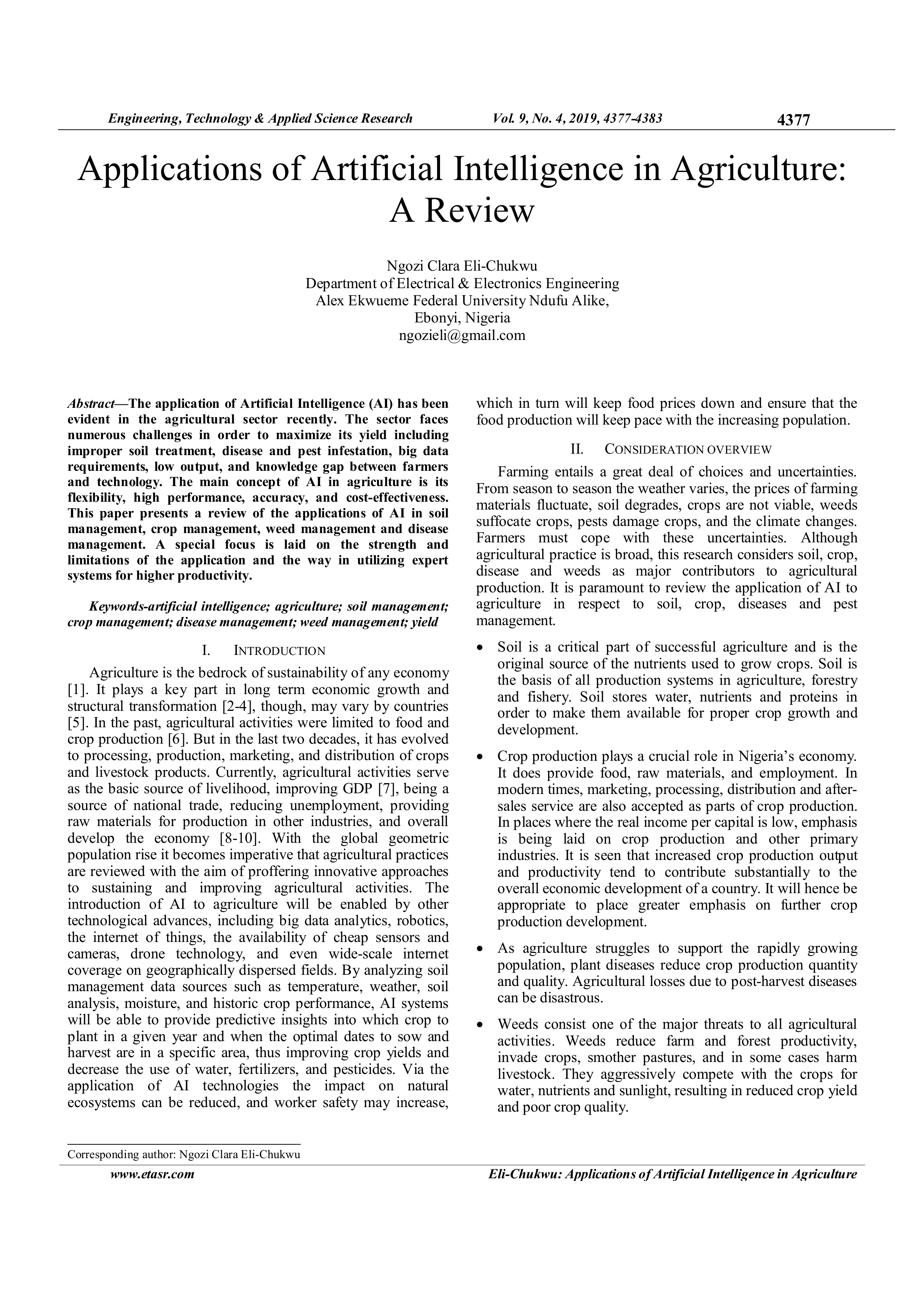
Applications of Artificial Intelligence in Agriculture:
A Review
Ngozi Clara Eli-Chukwu
Department of Electrical & Electronics Engineering
Alex Ekwueme Federal University Ndufu Alike,
Ebonyi, Nigeria
ngozieli@gmail.com
Abstract
—The application of Artificial Intelligence (AI) has been
evident in the agricultural sector recently. The sector faces
numerous challenges in order to maximize its yield including
improper soil treatment, disease and pest infestation, big data
requirements, low output, and knowledge gap between farmers
and technology. The main concept of AI in agriculture is its
flexibility, high performance, accuracy, and cost-effectiveness.
This paper presents a review of the applications of AI in soil
management, crop management, weed management and disease
management. A special focus is laid on the strength and
limitations of the application and the way in utilizing expert
systems for higher productivity.
Keywords-artificial intelligence; agriculture; soil management;
crop management; disease management; weed management; yield
I.
I
NTRODUCTION
Agriculture is the bedrock of sustainability of any economy
[1]. It plays a key part in long term economic growth and
structural transformation [2-4], though, may vary by countries
[5]. In the past, agricultural activities were limited to food and
crop production [6]. But in the last two decades, it has evolved
to processing, production, marketing, and distribution of crops
and livestock products. Currently, agricultural activities serve
as the basic source of livelihood, improving GDP [7], being a
source of national trade, reducing unemployment, providing
raw materials for production in other industries, and overall
develop the economy [8-10]. With the global geometric
population rise it becomes imperative that agricultural practices
are reviewed with the aim of proffering innovative approaches
to sustaining and improving agricultural activities. The
introduction of AI to agriculture will be enabled by other
technological advances, including big data analytics, robotics,
the internet of things, the availability of cheap sensors and
cameras, drone technology, and even wide-scale internet
coverage on geographically dispersed fields. By analyzing soil
management data sources such as temperature, weather, soil
analysis, moisture, and historic crop performance, AI systems
will be able to provide predictive insights into which crop to
plant in a given year and when the optimal dates to sow and
harvest are in a specific area, thus improving crop yields and
decrease the use of water, fertilizers, and pesticides. Via the
application of AI technologies the impact on natural
ecosystems can be reduced, and worker safety may increase,
which in turn will keep food prices down and ensure that the
food production will keep pace with the increasing population.
II.
C
ONSIDERATION OVERVIEW
Farming entails a great deal of choices and uncertainties.
From season to season the weather varies, the prices of farming
materials fluctuate, soil degrades, crops are not viable, weeds
suffocate crops, pests damage crops, and the climate changes.
Farmers must cope with these uncertainties. Although
agricultural practice is broad, this research considers soil, crop,
disease and weeds as major contributors to agricultural
production. It is paramount to review the application of AI to
agriculture in respect to soil, crop, diseases and pest
management.
•
Soil is a critical part of successful agriculture and is the
original source of the nutrients used to grow crops. Soil is
the basis of all production systems in agriculture, forestry
and fishery. Soil stores water, nutrients and proteins in
order to make them available for proper crop growth and
development.
•
Crop production plays a crucial role in Nigeria’s economy.
It does provide food, raw materials, and employment. In
modern times, marketing, processing, distribution and after-
sales service are also accepted as parts of crop production.
In places where the real income per capital is low, emphasis
is being laid on crop production and other primary
industries. It is seen that increased crop production output
and productivity tend to contribute substantially to the
overall economic development of a country. It will hence be
appropriate to place greater emphasis on further crop
production development.
•
As agriculture struggles to support the rapidly growing
population, plant diseases reduce crop production quantity
and quality. Agricultural losses due to post-harvest diseases
can be disastrous.
•
Weeds consist one of the major threats to all agricultural
activities. Weeds reduce farm and forest productivity,
invade crops, smother pastures, and in some cases harm
livestock. They aggressively compete with the crops for
water, nutrients and sunlight, resulting in reduced crop yield
and poor crop quality.
Corresponding author: Ngozi Clara Eli-Chukwu
Engineering, Technology & Applied Science Research
Vol. 9, No. 4, 2019, 4377-4383
4378
www.etasr.com
Eli-Chukwu: Applications of Artificial Intelligence in Agriculture
III.
S
OIL MANAGEMENT
Soil management is an integral part of agricultural
activities. A sound knowledge of various soil types and
conditions will enhance crop yield and conserve soil resources.
It is the use of operations, practices and treatments to improve
soil performance. Urban soils may contain pollutants which can
be investigated with a traditional soil survey approach [11].
The application of compost and manure improve soil porosity
and aggregation. A better aggregation indicates the addition of
organic materials that play an important role in preventing soil
crust formation. It is possible to adopt alternative tillage
systems to prevent soil physical degradation. The application of
organic materials is essential to improve soil quality [12].
Production of vegetables and other edible crops is often
significantly affected by several soil-borne pathogens that
require control through soil management [13]. Sensitivity to
soil degradation is implicit in the assessment of the
sustainability of land management practices, with recognition
of the fact that soils vary in their ability to resist change and
recover [14].
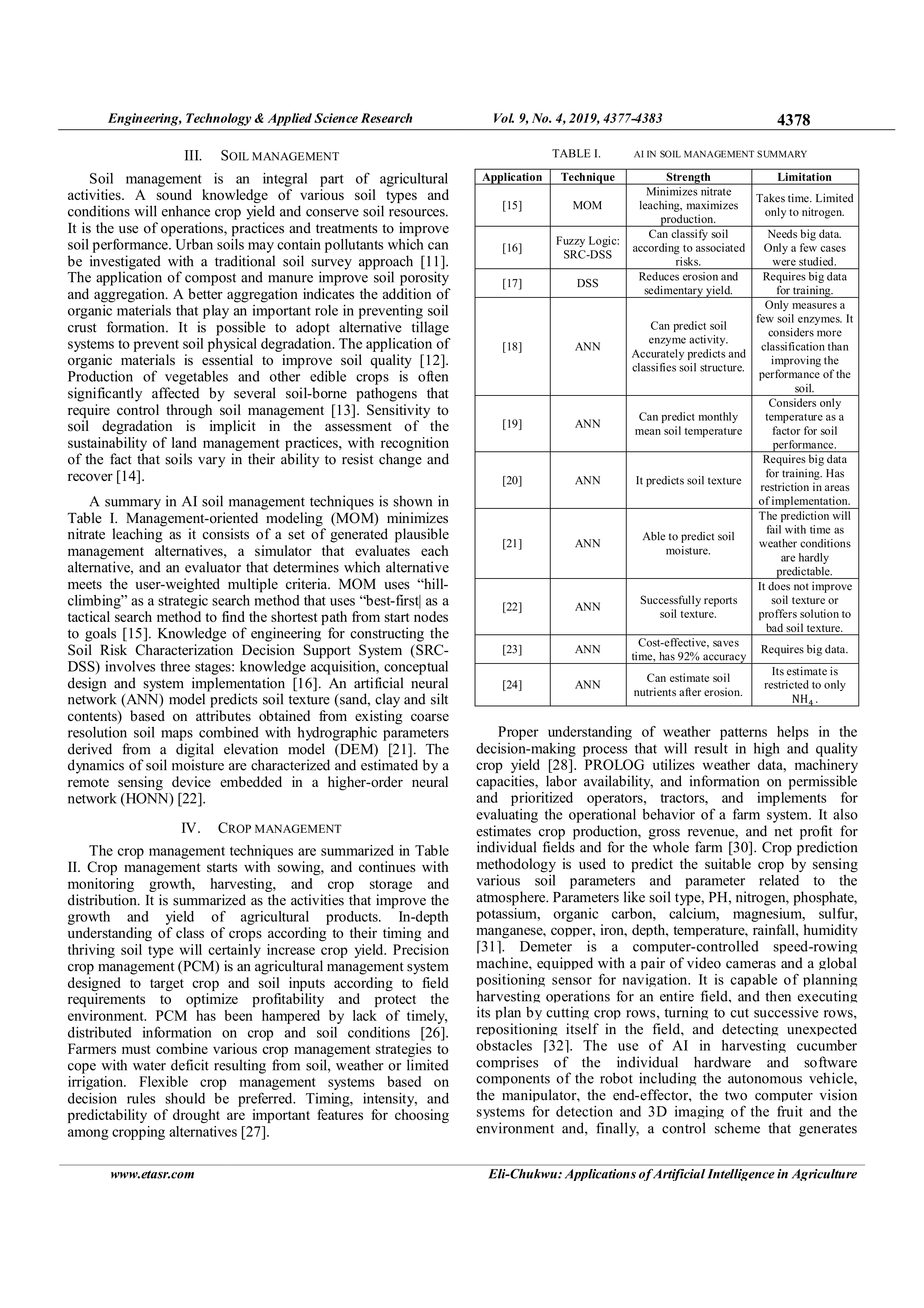
A summary in AI soil management techniques is shown in
Table I. Management-oriented modeling (MOM) minimizes
nitrate leaching as it consists of a set of generated plausible
management alternatives, a simulator that evaluates each
alternative, and an evaluator that determines which alternative
meets the user-weighted multiple criteria. MOM uses “hill-
climbing” as a strategic search method that uses “best-first| as a
tactical search method to find the shortest path from start nodes
to goals [15]. Knowledge of engineering for constructing the
Soil Risk Characterization Decision Support System (SRC-
DSS) involves three stages: knowledge acquisition, conceptual
design and system implementation [16]. An artificial neural
network (ANN) model predicts soil texture (sand, clay and silt
contents) based on attributes obtained from existing coarse
resolution soil maps combined with hydrographic parameters
derived from a digital elevation model (DEM) [21]. The
dynamics of soil moisture are characterized and estimated by a
remote sensing device embedded in a higher-order neural
network (HONN) [22].
IV.
C
ROP MANAGEMENT
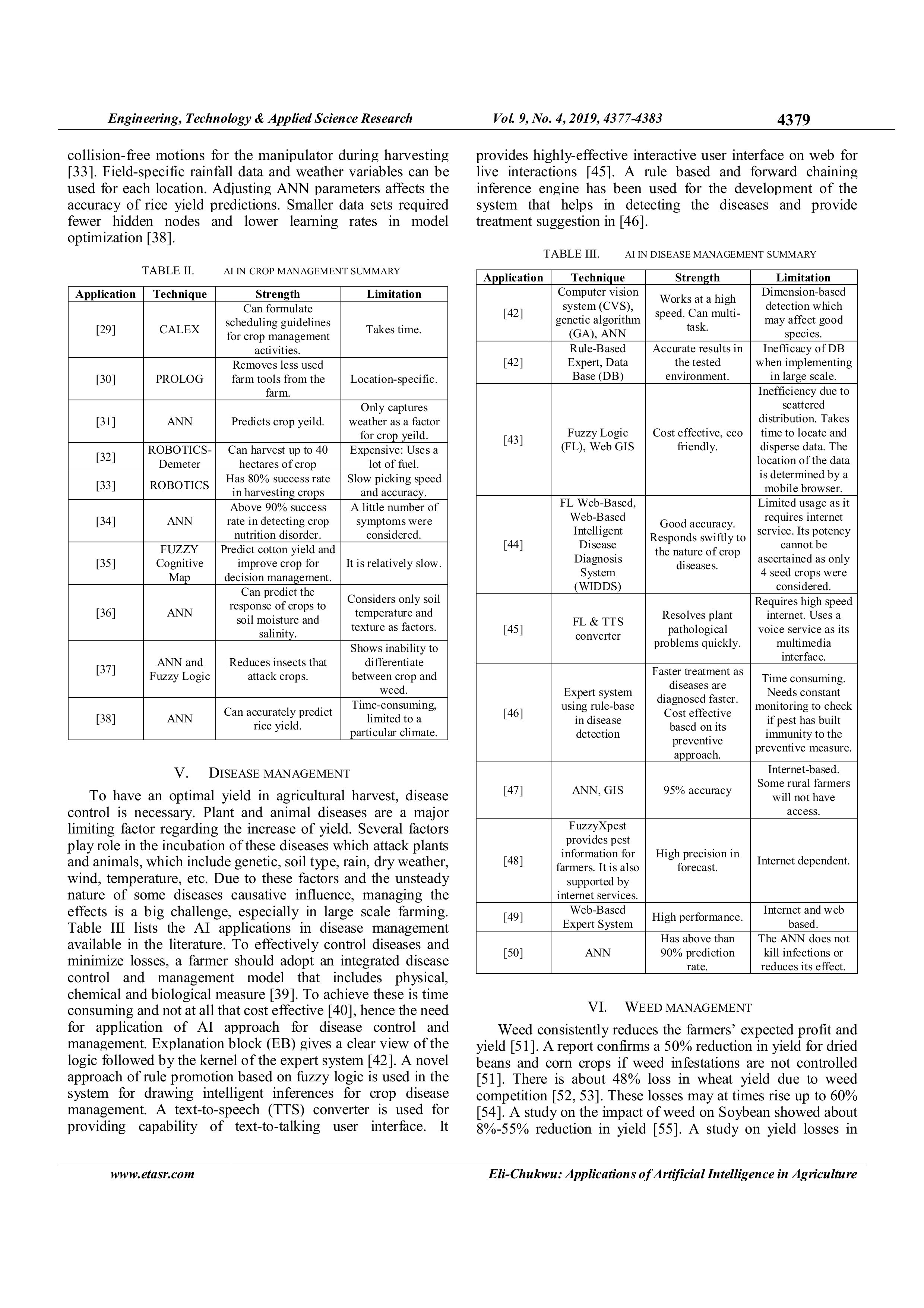
The crop management techniques are summarized in Table
II. Crop management starts with sowing, and continues with
monitoring growth, harvesting, and crop storage and
distribution. It is summarized as the activities that improve the
growth
and
yield
of
agricultural
products.
In-depth
understanding of class of crops according to their timing and
thriving soil type will certainly increase crop yield. Precision
crop management (PCM) is an agricultural management system
designed to target crop and soil inputs according to field
requirements to optimize profitability and protect the
environment. PCM has been hampered by lack of timely,
distributed information on crop and soil conditions [26].
Farmers must combine various crop management strategies to
cope with water deficit resulting from soil, weather or limited
irrigation. Flexible crop management systems based on
decision rules should be preferred. Timing, intensity, and
predictability of drought are important features for choosing
among cropping alternatives [27].
TABLE I.
AI IN SOIL MANAGEMENT SUMMARY
Application
Technique
Strength
Limitation
[15]
MOM
Minimizes nitrate
leaching, maximizes
production.
Takes time. Limited
only to nitrogen.
[16]
Fuzzy Logic:
SRC-DSS
Can classify soil
according to associated
risks.
Needs big data.
Only a few cases
were studied.
[17]
DSS
Reduces erosion and
sedimentary yield.
Requires big data
for training.
[18]
ANN
Can predict soil
enzyme activity.
Accurately predicts and
classifies soil structure.
Only measures a
few soil enzymes. It
considers more
classification than
improving the
performance of the
soil.
[19]
ANN
Can predict monthly
mean soil temperature
Considers only
temperature as a
factor for soil
performance.
[20]
ANN
It predicts soil texture
Requires big data
for training. Has
restriction in areas
of implementation.
[21]
ANN
Able to predict soil
moisture.
The prediction will
fail with time as
weather conditions
are hardly
predictable.
[22]
ANN
Successfully reports
soil texture.
It does not improve
soil texture or
proffers solution to
bad soil texture.
[23]
ANN
Cost-effective, saves
time, has 92% accuracy
Requires big data.
[24]
ANN
Can estimate soil
nutrients after erosion.
Its estimate is
restricted to only
NH
.
Proper understanding of weather patterns helps in the
decision-making process that will result in high and quality
crop yield [28]. PROLOG utilizes weather data, machinery
capacities, labor availability, and information on permissible
and prioritized operators, tractors, and implements for
evaluating the operational behavior of a farm system. It also
estimates crop production, gross revenue, and net profit for
individual fields and for the whole farm [30]. Crop prediction
methodology is used to predict the suitable crop by sensing
various soil parameters and parameter related to the
atmosphere. Parameters like soil type, PH, nitrogen, phosphate,
potassium, organic carbon, calcium, magnesium, sulfur,
manganese, copper, iron, depth, temperature, rainfall, humidity
[31]. Demeter is a computer-controlled speed-rowing
machine, equipped with a pair of video cameras and a global
positioning sensor for navigation. It is capable of planning
harvesting operations for an entire field, and then executing
its plan by cutting crop rows, turning to cut successive rows,
repositioning itself in the field, and detecting unexpected
obstacles [32]. The use of AI in harvesting cucumber
comprises of the individual hardware and software
components of the robot including the autonomous vehicle,
the manipulator, the end-effector, the two computer vision
systems for detection and 3D imaging of the fruit and the
environment and, finally, a control scheme that generates
Engineering, Technology & Applied Science Research
Vol. 9, No. 4, 2019, 4377-4383
4379
www.etasr.com
Eli-Chukwu: Applications of Artificial Intelligence in Agriculture
collision-free motions for the manipulator during harvesting
[33]. Field-specific rainfall data and weather variables can be
used for each location. Adjusting ANN parameters affects the
accuracy of rice yield predictions. Smaller data sets required
fewer hidden nodes and lower learning rates in model
optimization [38].
TABLE II.
AI IN CROP MANAGEMENT SUMMARY
Application
Technique
Strength
Limitation
[29]
CALEX
Can formulate
scheduling guidelines
for crop management
activities.
Takes time.
[30]
PROLOG
Removes less used
farm tools from the
farm.
Location-specific.
[31]
ANN
Predicts crop yeild.
Only captures
weather as a factor
for crop yeild.
[32]
ROBOTICS-
Demeter
Can harvest up to 40
hectares of crop
Expensive: Uses a
lot of fuel.
[33]
ROBOTICS
Has 80% success rate
in harvesting crops
Slow picking speed
and accuracy.
[34]
ANN
Above 90% success
rate in detecting crop
nutrition disorder.
A little number of
symptoms were
considered.
[35]
FUZZY
Cognitive
Map
Predict cotton yield and
improve crop for
decision management.
It is relatively slow.
[36]
ANN
Can predict the
response of crops to
soil moisture and
salinity.
Considers only soil
temperature and
texture as factors.
[37]
ANN and
Fuzzy Logic
Reduces insects that
attack crops.
Shows inability to
differentiate
between crop and
weed.
[38]
ANN
Can accurately predict
rice yield.
Time-consuming,
limited to a
particular climate.
V.
D
ISEASE MANAGEMENT
To have an optimal yield in agricultural harvest, disease
control is necessary. Plant and animal diseases are a major
limiting factor regarding the increase of yield. Several factors
play role in the incubation of these diseases which attack plants
and animals, which include genetic, soil type, rain, dry weather,
wind, temperature, etc. Due to these factors and the unsteady
nature of some diseases causative influence, managing the
effects is a big challenge, especially in large scale farming.
Table III lists the AI applications in disease management
available in the literature. To effectively control diseases and
minimize losses, a farmer should adopt an integrated disease
control and management model that includes physical,
chemical and biological measure [39]. To achieve these is time
consuming and not at all that cost effective [40], hence the need
for application of AI approach for disease control and
management. Explanation block (EB) gives a clear view of the
logic followed by the kernel of the expert system [42]. A novel
approach of rule promotion based on fuzzy logic is used in the
system for drawing intelligent inferences for crop disease
management. A text-to-speech (TTS) converter is used for
providing capability of text-to-talking user interface. It
provides highly-effective interactive user interface on web for
live interactions [45]. A rule based and forward chaining
inference engine has been used for the development of the
system that helps in detecting the diseases and provide
treatment suggestion in [46].
TABLE III.
AI IN DISEASE MANAGEMENT SUMMARY
Application
Technique
Strength
Limitation
[42]
Computer vision
system (CVS),
genetic algorithm
(GA), ANN
Works at a high
speed. Can multi-
task.
Dimension-based
detection which
may affect good
species.
[42]
Rule-Based
Expert, Data
Base (DB)
Accurate results in
the tested
environment.
Inefficacy of DB
when implementing
in large scale.
[43]
Fuzzy Logic
(FL), Web GIS
Cost effective, eco
friendly.
Inefficiency due to
scattered
distribution. Takes
time to locate and
disperse data. The
location of the data
is determined by a
mobile browser.
[44]
FL Web-Based,
Web-Based
Intelligent
Disease
Diagnosis
System
(WIDDS)
Good accuracy.
Responds swiftly to
the nature of crop
diseases.
Limited usage as it
requires internet
service. Its potency
cannot be
ascertained as only
4 seed crops were
considered.
[45]
FL & TTS
converter
Resolves plant
pathological
problems quickly.
Requires high speed
internet. Uses a
voice service as its
multimedia
interface.
[46]
Expert system
using rule-base
in disease
detection
Faster treatment as
diseases are
diagnosed faster.
Cost effective
based on its
preventive
approach.
Time consuming.
Needs constant
monitoring to check
if pest has built
immunity to the
preventive measure.
[47]
ANN, GIS
95% accuracy
Internet-based.
Some rural farmers
will not have
access.
[48]
FuzzyXpest
provides pest
information for
farmers. It is also
supported by
internet services.
High precision in
forecast.
Internet dependent.
[49]
Web-Based
Expert System
High performance.
Internet and web
based.
[50]
ANN
Has above than
90% prediction
rate.
The ANN does not
kill infections or
reduces its effect.
VI.
W
EED MANAGEMENT
Weed consistently reduces the farmers’ expected profit and
yield [51]. A report confirms a 50% reduction in yield for dried
beans and corn crops if weed infestations are not controlled
[51]. There is about 48% loss in wheat yield due to weed
competition [52, 53]. These losses may at times rise up to 60%
[54]. A study on the impact of weed on Soybean showed about
8%-55% reduction in yield [55]. A study on yield losses in
Engineering, Technology & Applied Science Research
Vol. 9, No. 4, 2019, 4377-4383
4380
www.etasr.com
Eli-Chukwu: Applications of Artificial Intelligence in Agriculture
sesame crops accounts them to about 50%-75% [56]. The
fluctuation in yield losses may be attributed to the length of
exposure of the crops to the weeds [57, 58] and spatial
heterogeneity of weeds [59]. Beyond these, weed has both
positive and negative effects to the ecosystem. According to the
relative Weed Science Society of America (WSSA) report,
weed effects include flooding during hurricane, some species
of weeds can pave their way during rampant fire, some cause
irreparable liver damage if consumed, and they muscle out
plants or crops by competing for water, nutrients and sunlight.
Some weeds are poisonous and cause allergic reactions or even
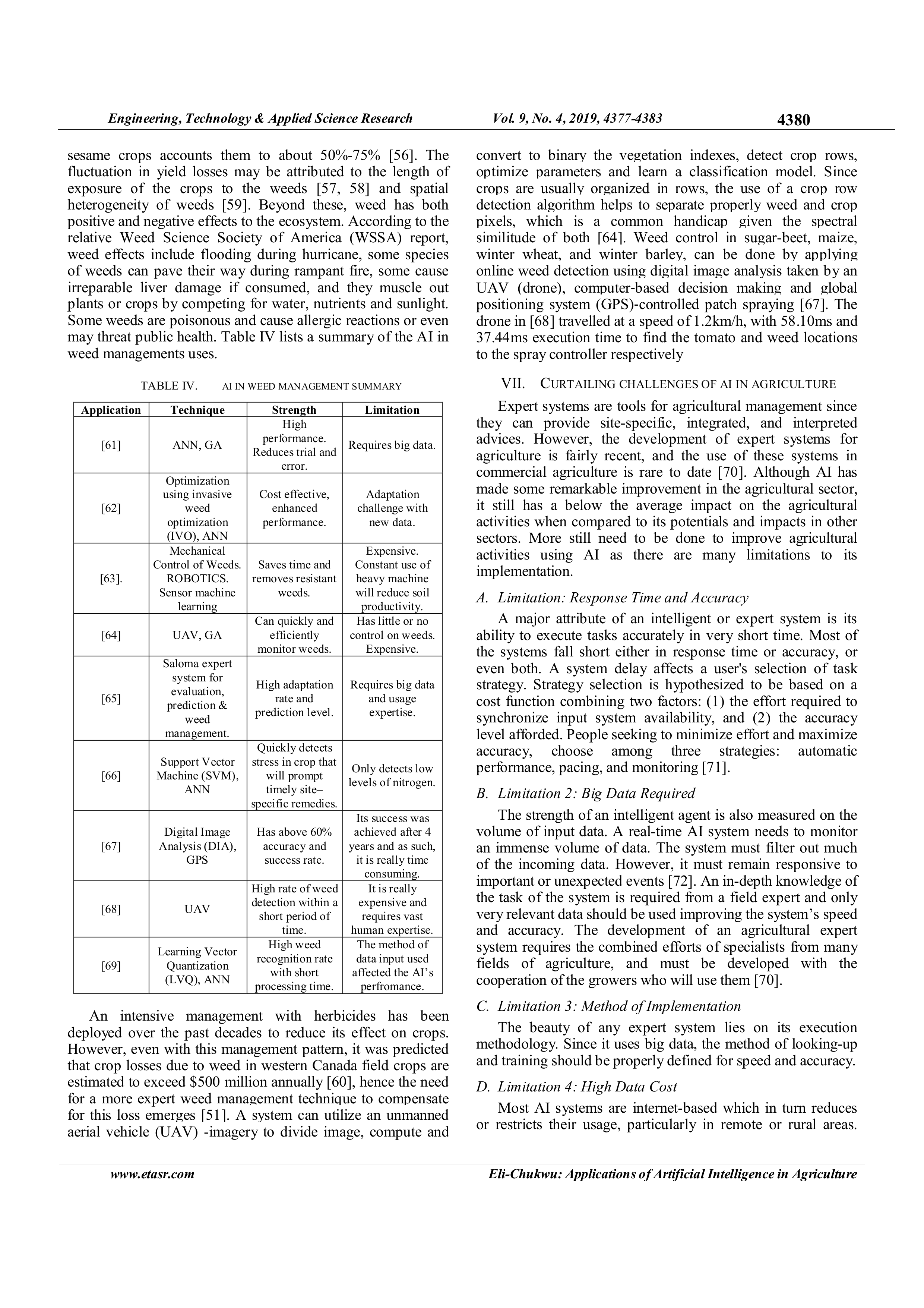
may threat public health. Table IV lists a summary of the AI in
weed managements uses.
TABLE IV.
AI IN WEED MANAGEMENT SUMMARY
Application
Technique
Strength
Limitation
[61]
ANN, GA
High
performance.
Reduces trial and
error.
Requires big data.
[62]
Optimization
using invasive
weed
optimization
(IVO), ANN
Cost effective,
enhanced
performance.
Adaptation
challenge with
new data.
[63].
Mechanical
Control of Weeds.
ROBOTICS.
Sensor machine
learning
Saves time and
removes resistant
weeds.
Expensive.
Constant use of
heavy machine
will reduce soil
productivity.
[64]
UAV, GA
Can quickly and
efficiently
monitor weeds.
Has little or no
control on weeds.
Expensive.
[65]
Saloma expert
system for
evaluation,
prediction &
weed
management.
High adaptation
rate and
prediction level.
Requires big data
and usage
expertise.
[66]
Support Vector
Machine (SVM),
ANN
Quickly detects
stress in crop that
will prompt
timely site–
specific remedies.
Only detects low
levels of nitrogen.
[67]
Digital Image
Analysis (DIA),
GPS
Has above 60%
accuracy and
success rate.
Its success was
achieved after 4
years and as such,
it is really time
consuming.
[68]
UAV
High rate of weed
detection within a
short period of
time.
It is really
expensive and
requires vast
human expertise.
[69]
Learning Vector
Quantization
(LVQ), ANN
High weed
recognition rate
with short
processing time.
The method of
data input used
affected the AI’s
perfromance.
An intensive management with herbicides has been
deployed over the past decades to reduce its effect on crops.
However, even with this management pattern, it was predicted
that crop losses due to weed in western Canada field crops are
estimated to exceed $500 million annually [60], hence the need
for a more expert weed management technique to compensate
for this loss emerges [51]. A system can utilize an unmanned
aerial vehicle (UAV) -imagery to divide image, compute and
convert to binary the vegetation indexes, detect crop rows,
optimize parameters and learn a classification model. Since
crops are usually organized in rows, the use of a crop row
detection algorithm helps to separate properly weed and crop
pixels, which is a common handicap given the spectral
similitude of both [64]. Weed control in sugar-beet, maize,
winter wheat, and winter barley, can be done by applying
online weed detection using digital image analysis taken by an
UAV (drone), computer
‐
based decision making and global
positioning system (GPS)
‐
controlled patch spraying [67]. The
drone in [68] travelled at a speed of 1.2km/h, with 58.10ms and
37.44ms execution time to find the tomato and weed locations
to the spray controller respectively
VII.
C
URTAILING CHALLENGES OF AI IN AGRICULTURE
Expert systems are tools for agricultural management since
they can provide site-specific, integrated, and interpreted
advices. However, the development of expert systems for
agriculture is fairly recent, and the use of these systems in
commercial agriculture is rare to date [70]. Although AI has
made some remarkable improvement in the agricultural sector,
it still has a below the average impact on the agricultural
activities when compared to its potentials and impacts in other
sectors. More still need to be done to improve agricultural
activities using AI as there are many limitations to its
implementation.
A.
Limitation: Response Time and Accuracy
A major attribute of an intelligent or expert system is its
ability to execute tasks accurately in very short time. Most of
the systems fall short either in response time or accuracy, or
even both. A system delay affects a user's selection of task
strategy. Strategy selection is hypothesized to be based on a
cost function combining two factors: (1) the effort required to
synchronize input system availability, and (2) the accuracy
level afforded. People seeking to minimize effort and maximize
accuracy,
choose
among
three
strategies:
automatic
performance, pacing, and monitoring [71].
B.
Limitation 2: Big Data Required
The strength of an intelligent agent is also measured on the
volume of input data. A real-time AI system needs to monitor
an immense volume of data. The system must filter out much
of the incoming data. However, it must remain responsive to
important or unexpected events [72]. An in-depth knowledge of
the task of the system is required from a field expert and only
very relevant data should be used improving the system’s speed
and accuracy. The development of an agricultural expert
system requires the combined efforts of specialists from many
fields of agriculture, and must be developed with the
cooperation of the growers who will use them [70].
C.
Limitation 3: Method of Implementation
The beauty of any expert system lies on its execution
methodology. Since it uses big data, the method of looking-up
and training should be properly defined for speed and accuracy.
D.
Limitation 4: High Data Cost
Most AI systems are internet-based which in turn reduces
or restricts their usage, particularly in remote or rural areas.
Engineering, Technology & Applied Science Research
Vol. 9, No. 4, 2019, 4377-4383
4381
www.etasr.com
Eli-Chukwu: Applications of Artificial Intelligence in Agriculture
The government can support farmers by designing a web
service enabling device with lower tariff to uniquely work with
the AI systems for farmers. Also, a form of “how to use”
orientation (training and re-training) will really help farmers
adapt to the use of AI on the farm.
E.
Limitation 5: Flexibility
Flexibility is a strong attribute of any sound AI system. It is
perceived that much progress has been made in applying AI
techniques to particular isolated tasks, but the important theme
at the leading edge of the AI-based robotics technology seems
to be the interfacing of the subsystems into an integrated
environment. This requires flexibility of the subsystems
themselves [73]. It should also have expansive capabilities to
accommodate more user data from the field expert.
VIII.
T
HE FUTURE OF AI IN AGRICULTURE
Global population is expected to reach more than nine
billions by 2050 which will require an increase in agricultural
production by 70% in order to fulfil the demand. Only about
10% of this increased production may come from unused lands
and the rest should be fulfilled by current production
intensification. In this context, the use of latest technological
solutions to make farming more efficient remains one great
necessity. Present strategies to intensify agricultural production
require high energy inputs and market demands high quality
food. [74]. Robotics and autonomous systems (RAS) are set to
transform global industries. These technologies will have great
impact on large sectors of the economy with relatively low
productivity such as agro-food (food production from the farm
to the retail shelf). The UK agro-food chain generates over
£108bn p.a., with 3.7m employees in a truly international
industry yielding £20bn of exports in 2016 [75].
R
EFERENCES
[1]
M. A. Kekane, “Indian agriculture-status, importance and role in Indian
economy”, International Journal of Agriculture and Food Science
Technology, Vol. 4, No. 4, pp. 343-346, 2013
[2]
B. F. Johnston, P. Kilby, Agriculture and Structural Transformation:
Economic Strategies in Late-Developing Countries, Oxford University
Press, 1975
[3]
S. Kuznets, “Modern economic growth: Findings and reflections”,
American Economic Association, Vol. 63, No. 3, pp. 247–258, 1973
[4]
M. Syrquin, “Patterns on Structural Change”, in: Handbook of
Development Economics, Vol. 1, Elsevier, 1988
[5]
R. Dekle, G. Vandenbroucke, “A quantitative analysis of China’s
structural transformation”, Journal of Economic Dynamics and Control,
Vol. 36, No. 1, pp. 119-135, 2012
[6]
M. Fan, J. Shen, L. Yuan, R. Jiang, X. Chen, W. J. Davies, F. Zhang,
“Improving crop productivity and resource use efficiency to ensure food
security and environmental quality in China”, Journal of Experimental
Botany, Vol. 63, No. 1, pp. 13-24, 2012
[7]
O. Oyakhilomen, R. G. Zibah, “Agricultural production and economic
growth in Nigeria: Implication for rural poverty alleviation”, Quarterly
Journal of International Agriculture, Vol. 53, No. 3, pp. 207-223, 2014
[8]
T. O. Awokuse, “Does Agriculture Really Matter for Economic Growth
in Developing Countries?”, The American Agricultural Economics
Association Annual Meeting, Milwaukee, Newark, USA, July 28, 2009
[9]
O. Badiene, Sustaining and Accelerating Africa’s Agricultural Growth
Recovery in the Context of Changing Global Food Prices, IFPRI Policy
Brief 9, 2008
[10]
S. Block, C. Timmer, Agriculture and Economic Growth: Conceptual
Issues and the Kenyan Experience, Harvard Institute for International
Development, 1994
[11]
C. R. D. Kimpe, J. L. Morel, “Urban soil management: A growing
concern”, Soil Science, Vol. 165, No. 1, pp. 31-40, 2000
[12]
M. Pagliai, N. Vignozzi, S. Pellegrini, “Soil structure and the effect of
management practices”, Soil and Tillage Research, Vol. 79, No. 2, pp.
131-143, 2004
[13]
G. S. Abawi, T. L. Widmer, “Impact of soil health management
practices on soilborne pathogens, nematodes and root diseases of
vegetable crops”, Applied Soil Ecology, Vol. 15, No. 1, pp. 37-47, 2000
[14]
J. K. Syers, Managing Soil for Long-Term Productivity, The Royal
Society, 1997
[15]
M. Li, R. Yost, “Management-oriented modelling: Optimizing nitrogen
management with artificial intelligence”, Agricultural Systems, Vol. 65,
No. 1, pp. 1-27, 2000
[16]
E. M. Lopez, M. Garcia, M. Schuhmacher, J. L. Domingo, “A fuzzy
expert system for soil characterization”, Environment International, Vol.
34, No. 7, pp. 950-958, 2008
[17]
H. Montas, C. A. Madramootoo, “A Decision Support System for Soil
Conservation Planning”, Computers and Electronics in Agriculture, Vol.
7, No. 3, pp. 187-202, 1992
[18]
S. Tajik, S. Ayoubi, F. Nourbakhsh, “Prediction of soil enzymes activity
by digital terrain analysis: Comparing artificial neural network and
multiple linear regression models”, Environmental Engineering Science,
Vol. 29, No. 8, pp. 798-806, 2012
[19]
E. R. Levine, D. S. Kimes, V. G. Sigillito, “Classifying soil structure
using neural networks”, Ecological Modelling, Vol. 92, No. 1, pp. 101-
108, 1996
[20]
M. Bilgili, “The use of artificial neural network for forecasting the
monthly mean soil temperature in Adana, Turkey”, Turkish Journal of
Agriculture and Forestry, Vol. 35, No. 1, pp. 83-93, 2011
[21]
Z. Zhao, T. L. Chow, H. W. Rees, Q. Yang, Z. Xing, F. R. Meng,
“Predict soil texture distributions using an artificial neural network
model”, Computers and Electronics in Agriculture, Vol. 65, No. 1, pp.
36-48, 2009
[22]
A. Elshorbagy, K. Parasuraman, “On the relevance of using artificial
neural networks for estimating soil moisture content”, Journal of
Hydrology, Vol. 362, No. 1-2, pp. 1-18, 2008
[23]
D. H. Chang, S. Islam, “Estimation of soil physical properties using
remote sensing and artificial neural network”, Remote Sensing of
Enviroment, Vol. 74, No. 3, pp. 534-544, 2000
[24]
T. Behrens, H. Forster, T. Scholten, U. Steinrucken, E. D. Spies, M.
Goldschmitt, “Digital soil mapping using artificial neural networks”,
Journal of Plant Nutrition and Soil Science, Vol. 168, No. 1, pp. 21-33,
2005
[25]
M. Kim, J. E. Gilley, “Artificial neural network estimation of soil
erosion and nutrient concentrations in runoff from land application
areas”, Computers and Electronics in Agriculture, Vol. 64, No. 2, pp.
268-275, 2008
[26]
M. S. Moran, Y. Inoue, E. M. Barnes, “Opportunities and limitations for
image-based remote sensing in precision crop management”, Remote
Sensing of Enviroment, Vol. 61, No. 3, pp. 319-346, 1997
[27]
P. Debaeke, A. Aboudrare, “Adaptation of crop management to water-
limited environments”, European Journal of Agronomy, Vol. 21, No. 4,
pp. 433-446, 2004
[28]
C. Aubry, F. Papy, A. Capillon, “Modelling decision-making processes
for annual crop management”, Agricultural Systems, Vol. 56, No. 1, pp.
45-65, 1998
[29]
R. E. Plant, “An artificial intelligence based method for scheduling crop
management actions”, Agricultural Systems, Vol. 31, No. 1, pp. 127-
155, 1989
[30]
H. Lal, J. W. Jones, R. M. Peart, W. D. Shoup, “FARMSYS-A whole-
farm machinery management decision support system”, Agricultural
Systems, Vol. 38, No. 3, pp. 257-273, 1992
[31]
S. S. Snehal, S. V. Sandeep, “Agricultural crop yield prediction using
artificial neural network approach”, International Journal of Innovative
Engineering, Technology & Applied Science Research
Vol. 9, No. 4, 2019, 4377-4383
4382
www.etasr.com
Eli-Chukwu: Applications of Artificial Intelligence in Agriculture
Research in Electrical, Electronics, Instrumentation and Control
Engineering, Vol. 2, No. 1, pp. 683-686, 2014
[32]
T. Pilarski, M. Happold, H. Pangels, M. Ollis, K. Fitzpatrick, A. Stentz,
The Demeter System for Automated Harvesting, Springer, 2002
[33]
E. J. V. Henten, J. Hemming, B. A. J. V. Tuijl, J. G. Kornet, J.
Meuleman, J. Bontsema, E. A. V. Os, An Autonomous Robot for
Harvesting Cucumbers in Greenhouses, Springer, 2002
[34]
H. Song, Y. He, “Crop Nutrition Diagnosis Expert System Based on
Artificial
Neural
Networks”,
3rd
International
Conference
on
Information Technology and Applications, Sydney, Australia, July 4–7,
2005
[35]
E. I. Papageorgiou, A. T. Markinos, T. A. Gemtos, “Fuzzy cognitive
map based approach for predicting crop production as a basis for
decision support system in precision agriculture application”, Applied
Soft Computing, Vol. 11, No. 4, pp. 3643-3657, 2011
[36]
X. Dai, Z. Huo, H. Wang, “Simulation of response of crop yield to soil
moisture and salinity with artificial neural network”, Field Crops
Research, Vol. 121, No. 3, pp. 441-449, 2011
[37]
C. C. Yang, S. O. Prasher, J. A. Landry, H. S. Ramaswamy,
“Development of herbicide application map using artificial neural
network and fuzzy logic”, Agricultural Systems, Vol. 76, No. 2, pp. 561-
574, 2003
[38]
B. Ji, Y. Sun, S. Yang, J. Wan, “Artificial neural networks for rice yield
prediction in mountainous regions”, Journal of Agricultural Science,
Vol. 145, No. 3, pp. 249-261, 2007
[39]
BEA, Value Added by Industry as a Percentage of Gross Domestic
Product, available at: https://apps.bea.gov/iTable/iTable.cfm?ReqID=51
&step=1#reqid=51&step=51&isuri=1&5114=a&5102=5, 2018
[40]
Weed Science Society of America, Facts About Weeds, available at:
http://wssa.net/wp-content/uploads/WSSA-Fact-SheetFinal.pdf
[41]
J. Fang, C. Zhang, S. Wang, “Application of Genetic Algorithm (GA)
Trained Artificial Neural Network to Identify Tomatoes with
Physiological Diseases”, International Conference on Computer and
Computing Technologies in Agriculture, Wuyishan, China, August 18-
20, 2007
[42]
K. Balleda, D. Satyanvesh, N. V. S. S. P. Sampath, K. T. N. Varma, P.
K. Baruah, “Agpest: An Efficient Rule-Based Expert System to Prevent
Pest Diseases of Rice & Wheat Crops”, 8th International Conference on
Intelligent Systems and Control, Coimbatore, India, January 10–11,
2014
[43]
J. Jesus, T. Panagopoulos, A. Neves, “Fuzzy Logic and Geographic
Information Systems for Pest Control in Olive Culture”, 4th
IASME/WSEAS International Conference on Energy, Environment,
Ecosystems & Sustainable Development, Algarve, Portugal, June 11–13,
2008
[44]
S. Kolhe, R. Kamal, H. S. Saini, G. K. Gupta, “A web-based intelligent
disease-diagnosis system using a new fuzzy-logic based approach for
drawing the interferences in crops”, Computers and Electronics in
Agriculture, Vol. 76, No. 1, pp. 16-27, 2011
[45]
S. Kolhe, R. Kamal, H. S. Saini, G. K. Gupta, “An intelligent
multimedia interface for fuzzy-logic based inference in crops”, Expert
Systems with Applications, Vol. 38, No. 12, pp. 14592-14601, 2011
[46]
M. Y. Munirah, M. Rozlini, Y. M. Siti, “An Expert System
Development: Its Application on Diagnosing Oyster Mushroom
Diseases”, 13th International Conference on Control, Automation and
Systems, Gwangju, South Korea, October 20-23, 2013
[47]
G. Liu, X. Yang, Y. Ge, Y. Miao, “An Artificial Neural Network–Based
Expert System for Fruit Tree Disease and Insect Pest Diagnosis”,
International Conference on Networking, Sensing and Control,
Lauderdale, USA, April 23–25, 2006
[48]
F. Siraj, N. Arbaiy, “Integrated Pest Management System Using Fuzzy
Expert System”, Knowledge Management International Conference &
Exhibition, Kuala Lumpur, Malaysia, June 6–8, 2006
[49]
P. Virparia, “A Web Based Fuzzy Expert System for Insect Pest
Management in Groundnut Crop ‘Prajna’”, Journal Of Pure & Applied
Sciences, Vol. 15, pp. 36-41, 2007
[50]
X. Wang, M. Zhang, J. Zhu, S. Geng, “Spectral prediction of
phytophthora infestans infection on tomatoes using artificial neural
network”, International Journal of Remote Sensing, Vol. 29, No. 6, pp.
1693-1706, 2006
[51]
K. N. Harker, “Survey of yield losses due to weeds in central Alberta”,
Canadian Journal of Plant Science, Vol. 81, No. 2, pp. 339–342, 2001
[52]
M. Khan, N. Haq, “Wheat crop yield loss assessment due to weeds”,
National Agricultural Research Cen intensification tre, Vol. 18, No. 4,
pp. 449–453, 2002
[53]
S. Fahad, S. Hussain, B. S. Chauhan, S. Saud, C. Wu, S. Hassan, M.
Tanveer, A. Jan, J. Huang, “Weed growth and crop yield loss in wheat as
influenced by row spacing and weed emergence times”, Crop Protection,
Vol. 71, pp. 101–108, 2015
[54]
A. N. Rao, S. P. Wani, J. K. Ladha, Weed Management Research in
India-An Analysis of the Past and Outlook for Future, ICAR, 2014
[55]
A. Datta, H. Ullah, N. Tursun, T. Pornprom, S. Z. Knezevic, B. S.
Chauhan, “Managing weeds using crop competition in soybean [Glycine
max(L.) Merr.]”, Crop Protection, Vol. 95, pp. 60–68, 2017
[56]
T. Mruthul, Chemical weed management in sesame (Sesamum indicum
L.), MSc Thesis, College of Agriculture, Raichur, University of
Agricultural Sciences, 2015
[57]
C. J. Swanton, R. Nkoa, R. E. Blackshaw, “Experimental methods for
crop-weed competition studies”, Weed Science Society of America, Vol.
63, No. 1, pp. 2–11, 2015
[58]
P. Jha, V. Kumar, R. K. Godara, B. S. Chauhan, “Weed management
using crop competition in the United States: A Review”, Crop
Protection, Vol. 95, pp. 31–37, 2017
[59]
P. Milberg, E. Hallgren, “Yield loss due to weeds in cereals and its
large-scale variability in Sweden”, Field Crops Research, Vol. 86, No.
2–3, pp. 199–209, 2004
[60]
C. J. Swanton, K. N. Harker, R. L. Anderson, “Crop losses due to weeds
in Canada”, Weed Technology, Vol. 7, No. 2, pp. 537–542, 1993
[61]
A. M. Tobal, S. A. Mokhtar, “Weeds identification using evolutionary
artificial intelligence algorithm”, Journal of Computer Science, Vol. 10,
No. 8, pp. 1355-1361, 2014
[62]
P. Moallem, N. Razmjooy, “A multi-layer perception neural network
trained by invasive weed optimization for potato color image
segmentation”, Trends in Applied Sciences Research, Vol. 7, No. 6, pp.
445-455, 2012
[63]
M. Brazeau, “Fighting Weeds: Can we Reduce, or Even Eliminate,
Herbicides
by
Utilizing
Robotics
and
AI”,
available
at:
https://geneticliteracyproject.org/2018/12/12/fighting-weeds-can-we-
reduce-or-even-eliminate-herbicide-use-through-robotics-and-ai/, 2018
[64]
M. P. Ortiz, P. A. Gutierrez, J. M. Pena, J. T. Sanchez, F. L. Granados,
C. H. Martinez, “Machine Learning Paradigms for Weed Mapping Via
Unmanned Aerial Vehicles”, Symposium Series on Computational
Intelligence, Athens, Greece, December 6–9, 2016
[65]
L. Stigliani, C. Resina, “Seloma: Expert system for weed management in
herbicide-intensive crops”, Weed Technology, Vol. 7, No. 3, pp. 550-
559, 1993
[66]
Y. Karimi, S. O. Prasher, R. M. Patel, S. H. Kim, “Application of
support vector machine technology for weed and nitrogen stress
detection in corn”, Computers and Electronics in Agriculture, Vol. 51,
No. 1-2, pp. 99-109, 2006
[67]
R. Gerhards, S. Christensen, “Real-time weed detection, decision-
making and patch-spraying in maize, sugarbeet, winter wheat and winter
barley”, Wiley Online Library, Vol. 43, No. 6, pp. 385-392, 2003
[68]
F. L. Granados, “Weed detection for site-specific weed management:
Mapping and real-time approaches”, Weed Research, Vol. 51, No. 1, pp.
1-11, 2011
[69]
C. C. Yang, S. O. Prasher, J. Laundry, H. S. Ramaswamy,
“Development of neural networks for weed recognition in corn fields”,
American Society of Agricultural and Biological Engineers, Vol. 45, No.
3, pp. 859-864, 2002
[70]
E. G. Rajotte, T. Bowser, J. W. Travis, R. M. Crassweller, W. Musser,
D. Laughland, C. Sachs, “Implementation and Adoption of an
Agricultural Expert System: The Penn State Apple Orchard Consultant”,
Engineering, Technology & Applied Science Research
Vol. 9, No. 4, 2019, 4377-4383
4383
www.etasr.com
Eli-Chukwu: Applications of Artificial Intelligence in Agriculture
in: International Symposium on Computer Modelling in Fruit Research
and Orchard Management, ISHS, 1992
[71]
S. L. Teal, A. I. Rudnicky, “A Performance Model of System Delay and
User Strategy Selection”, Conference on Human Factors in Computing
Systems, California, USA, May 3-7, 1992
[72]
R. Washington, B. H. Roth, “Input Data Management in Real-Time AI
System”, 11th International Joint Conference on Artificial Intelligence,
Michigan, USA, August 20-25, 1989
[73]
P. Mowforth, I. Bratko, AI and Robotics: Flexibility and Integration,
Cambridge University Press, 1987
[74]
D. G. Panpatte, Artificial Intelligence in Agriculture: An Emerging Era
of Research, Anand Agricultural University, 2018
[75]
T. Duckett, S. Pearson, S. Blackmore, B. Grieve, Agricultural Robotics:
The Future of Robotic Agriculture, UK-RAS, 2018