REVIEW
Open Access
© The Author(s) 2025.
Open Access
This article is licensed under a Creative Commons Attribution-NonCommercial-NoDerivatives 4.0 International
License, which permits any non-commercial use, sharing, distribution and reproduction in any medium or format, as long as you give appropriate
credit to the original author(s) and the source, provide a link to the Creative Commons licence, and indicate if you modified the licensed material.
You do not have permission under this licence to share adapted material derived from this article or parts of it. The images or other third party
material in this article are included in the article’s Creative Commons licence, unless indicated otherwise in a credit line to the material. If material
is not included in the article’s Creative Commons licence and your intended use is not permitted by statutory regulation or exceeds the permitted
use, you will need to obtain permission directly from the copyright holder. To view a copy of this licence, visit
http://creativecommons.org/licens
es/by-nc-nd/4.0/
.
Dadaboyev
et al. Discover Global Society
(2025) 3:99
https://doi.org/10.1007/s44282-025-00246-w
*Correspondence:
Sherzodbek Murodilla Ugli
Dadaboyev
dadaboyev.sh08@gmail.com;
sh.dadaboyev@centralasian.uz
1
Business School, Central Asian
University, Tashkent, Uzbekistan
Role of artificial intelligence in employee
recruitment: systematic review and future
research directions
Sherzodbek Murodilla Ugli Dadaboyev
1*
, Jasmina Abdullayeva
1
, Naval Abbosova
1
, Afina Suleymenova
1
and
Komila Mamadjanova
1
1 Introduction
Artificial intelligence (AI) is rapidly changing the landscape of human resource manage-
ment (HRM), particularly in hiring processes. By automating tasks such as candidate
sourcing, interview scheduling, and performance assessment, AI technologies offer the
potential to enhance the effectiveness and productivity of recruitment, for instance, by
automating time-consuming tasks like candidate sourcing, initial resume parsing, and
interview scheduling [
37
]. The drive to overcome common challenges like human bias in
manual screening, inefficiencies, and the high costs of traditional recruiting methods is
fueling AI adoption [
39
]. As businesses strive to maintain a competitive edge in a rapidly
Discover Global Society
Abstract
Artificial intelligence (AI) is increasingly used in recruitment processes to enhance
efficiency and improve hiring decisions. This systematic literature review examines
the opportunities and challenges of AI in employee recruitment across various
organizational settings. Analyzing 49 peer-reviewed articles sourced from the Web
of Science database published between 2018 and 2025, this review summarizes the
current knowledge of AI's impact, highlighting its potential to increase productivity
(e.g., through automated resume parsing and chatbot-led initial screening), improve
candidate quality (e.g., via predictive analytics for job-fit and AI-assisted video
interview analysis), and potentially reduce human bias by standardizing initial
evaluations, though it also addresses critical ethical considerations such as the
risk of algorithmic bias stemming from training data. However, it also addresses
ethical considerations, including algorithmic bias and the need for transparency.
The review concludes with recommendations for future research focused on legal
frameworks, industry-specific applications, and mitigating the risks associated with AI
in recruitment.
Keywords
Artificial intelligence (AI), Recruitment, Hiring, PRISMA, Systematic literature
review
Content courtesy of Springer Nature, terms of use apply. Rights reserved.
Page 2 of 16
Dadaboyev
et al. Discover Global Society
(2025) 3:99
evolving job market, the promise of AI to accelerate hiring and improve decision-mak-
ing has become increasingly appealing.
Yet, alongside these advantages, significant ethical, legal, and practical considerations
arise. AI systems must ensure fairness and transparency to prevent bias [
33
]. A crucial
concern is the potential for algorithmic bias, where AI systems unintentionally perpetu-
ate pre-existing biases found within historical data [
8
]. The accuracy and transparency of
algorithmic decisions are also questioned, leading some HR professionals to hesitate in
adopting AI technologies [
34
]. These concerns highlight the necessity of robust ethical
regulations and legal frameworks to govern the use of AI in hiring.
This systematic literature review aims to synthesize the current knowledge regarding
AI's application in recruitment, emphasizing its benefits, limitations, and opportuni-
ties. To provide insights for future research, the review identifies key trends and gaps
in the existing literature through an in-depth analysis of the field. This review reveals
several potential benefits of AI in recruitment, including increased productivity (e.g.,
by streamlining workflows through automated screening), enhanced intellectual capi-
tal (e.g., through data-driven identification of top talent using predictive analytics), and
potentially reduced human bias in initial stages [
44
]. AI technologies can automate com-
plex tasks, freeing HR managers to focus on more strategic initiatives. Furthermore, AI
can leverage data-driven insights to identify and attract top talent, thereby improving
intellectual capital [
39
]. The ability of AI to mitigate bias in hiring can also foster a more
inclusive and diverse workforce [
50
].
However, the review also underscores several drawbacks associated with AI in recruit-
ment. Ensuring fairness and transparency in AI systems requires careful development
and implementation, raising significant ethical considerations [
33
]. Algorithmic bias
remains a major concern, as AI systems may inadvertently replicate existing biases pres-
ent in historical data [
8
]. Moreover, concerns regarding the accuracy and transparency
of algorithmic decisions may hinder the widespread adoption of AI technologies by HR
professionals [
34
].
While AI in recruitment is a burgeoning field, existing reviews may not fully capture
the most recent advancements and ethical discussions, or provide a comprehensive syn-
thesis of future research priorities. This systematic review aims to address this gap by
providing a comprehensive overview of the current state of the literature, identifying key
research gaps, and outlining promising directions for future investigation.
2 Methodology
To synthesize the diverse findings from existing research on the application of artifi-
cial intelligence in hiring, this review paper employed a qualitative research design,
specifically, a systematic literature review. This methodological approach was strategi-
cally chosen to identify broad trends, assess the multifaceted impacts, and understand
the challenges and constraints associated with incorporating AI into modern recruiting
processes.
2.1 Search strategy
To identify relevant research articles, we utilized the Web of Science database, as this
platform encompasses extensive data from various fields of scholarly works, including
but not limited to management, psychology, and computer science. The following search
Content courtesy of Springer Nature, terms of use apply. Rights reserved.
Page 3 of 16
Dadaboyev
et al. Discover Global Society
(2025) 3:99
query was used: TS = ("Artificial Intelligence" OR "Machine Learning" OR "Deep Learn-
ing") AND TS = (" Recruitment" OR "Hiring"). The goal of the search string was to collect
all studies that explored the effects of AI on recruiting within the organizational setting.
One possible drawback of this strategy might be that it only relies on the Web of Science
database, which may have excluded numerous pertinent studies in other databases.
2.2 Inclusion and exclusion criteria
To ensure the relevance and focus of this review, we developed and applied predeter-
mined inclusion and exclusion criteria. Only studies that explicitly addressed the use of
AI
within
the context of hiring were selected for inclusion. Conversely, studies examin-
ing AI applications in unrelated fields, such as healthcare, education, or those that did
not explicitly address AI's role in hiring, were excluded from the review.
2.3 Data extraction and synthesis
The PRISMA model was used to rigorously document the systematic search and selec-
tion procedure, providing a transparent account of each step from the initial search to
the final selection of studies [
30
]. The PRISMA instructions assessed the available arti-
cles for eligibility, considering their titles and abstracts. Potentially eligible articles' full
texts have been gathered and reviewed according to precise inclusion and exclusion
criteria. Data was collected using a prescribed form for research, which matched. The
following content was taken out: details about the study (a) author, year of publication,
journal title, (b) characteristics of AI usage (technology type and purpose); (c) study
technique (e.g., experiment, case study); (d) essential conclusions about how AI affects
recruitment; and (e) study limitations. The extracted data were then synthesized to iden-
tify common themes, trends, and contradictions in the literature. A narrative synthesis
approach was used to summarize the findings, providing a comprehensive overview of
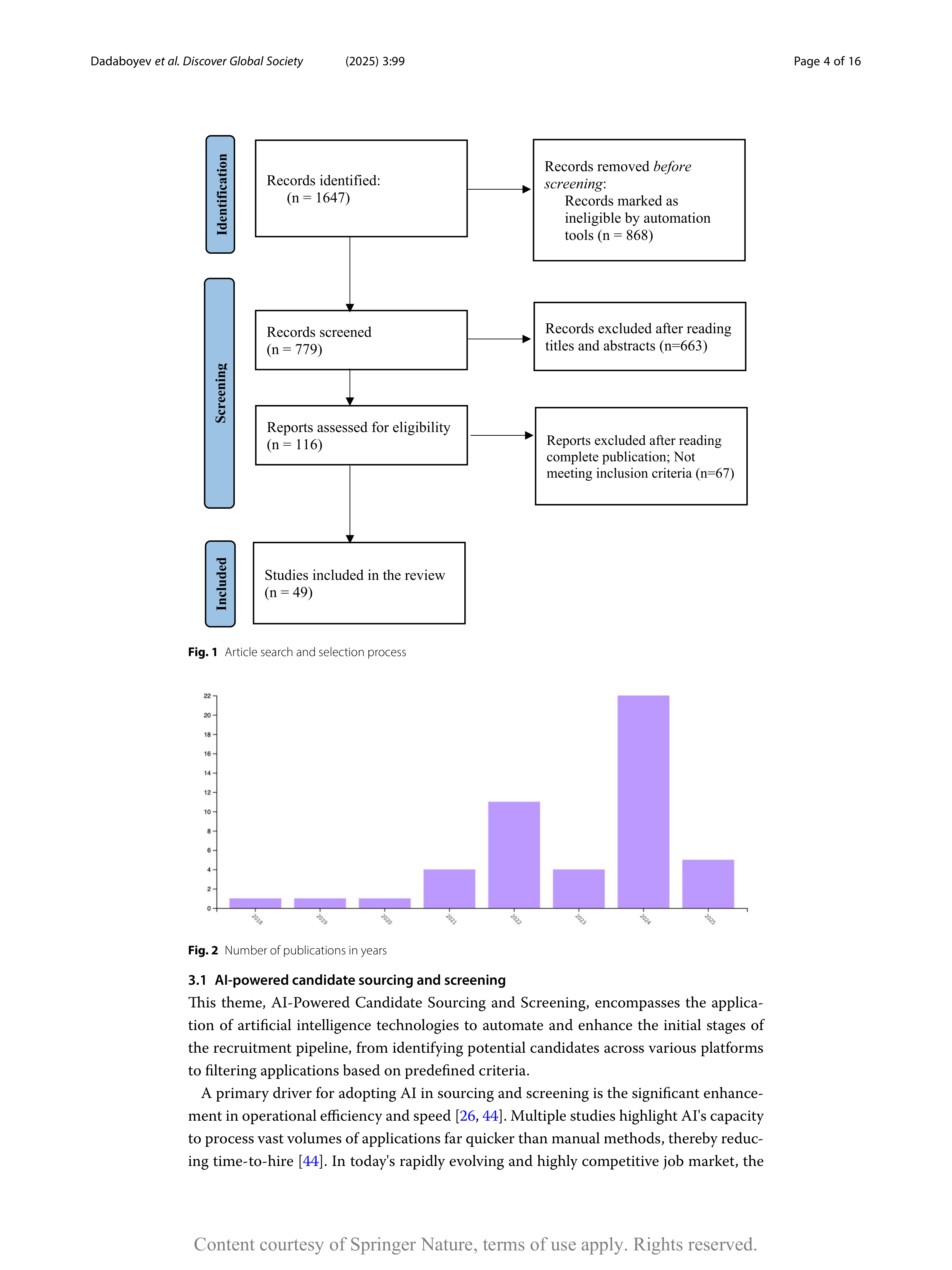
the current state of knowledge. Figure
1
presents the PRISMA flow diagram, illustrat-
ing the systematic process of study identification, screening, eligibility assessment, and
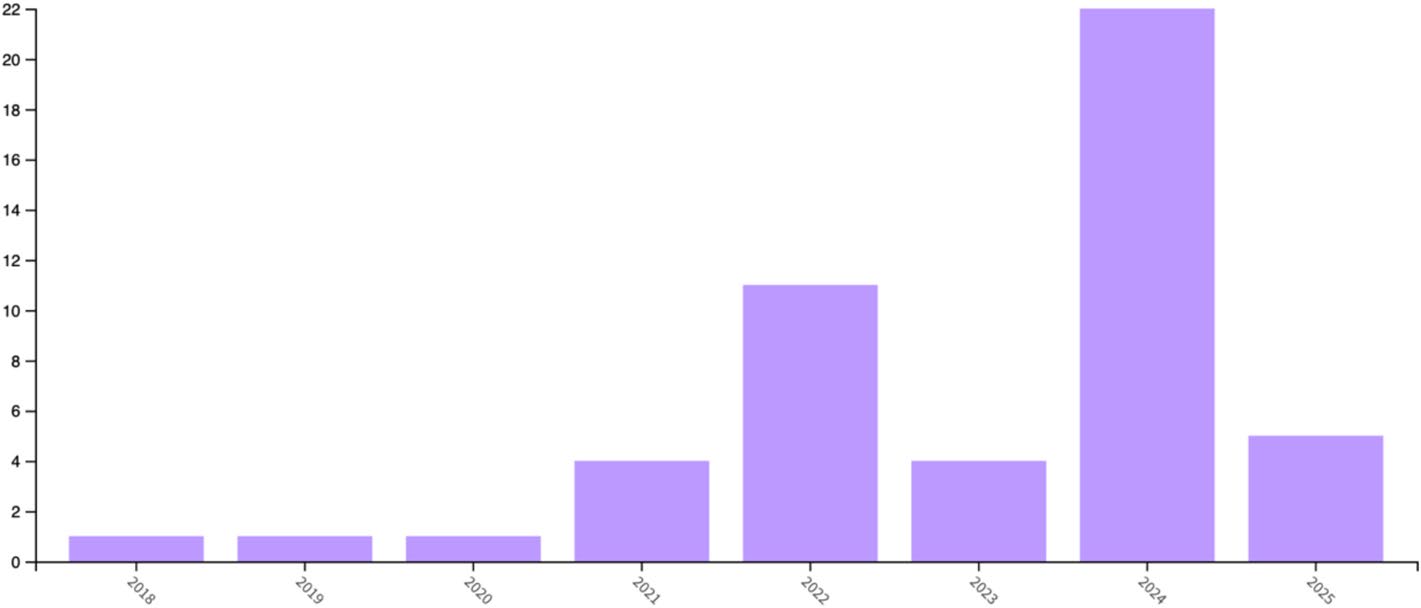
inclusion. Figure
2
depicts the temporal distribution of the included studies, highlighting
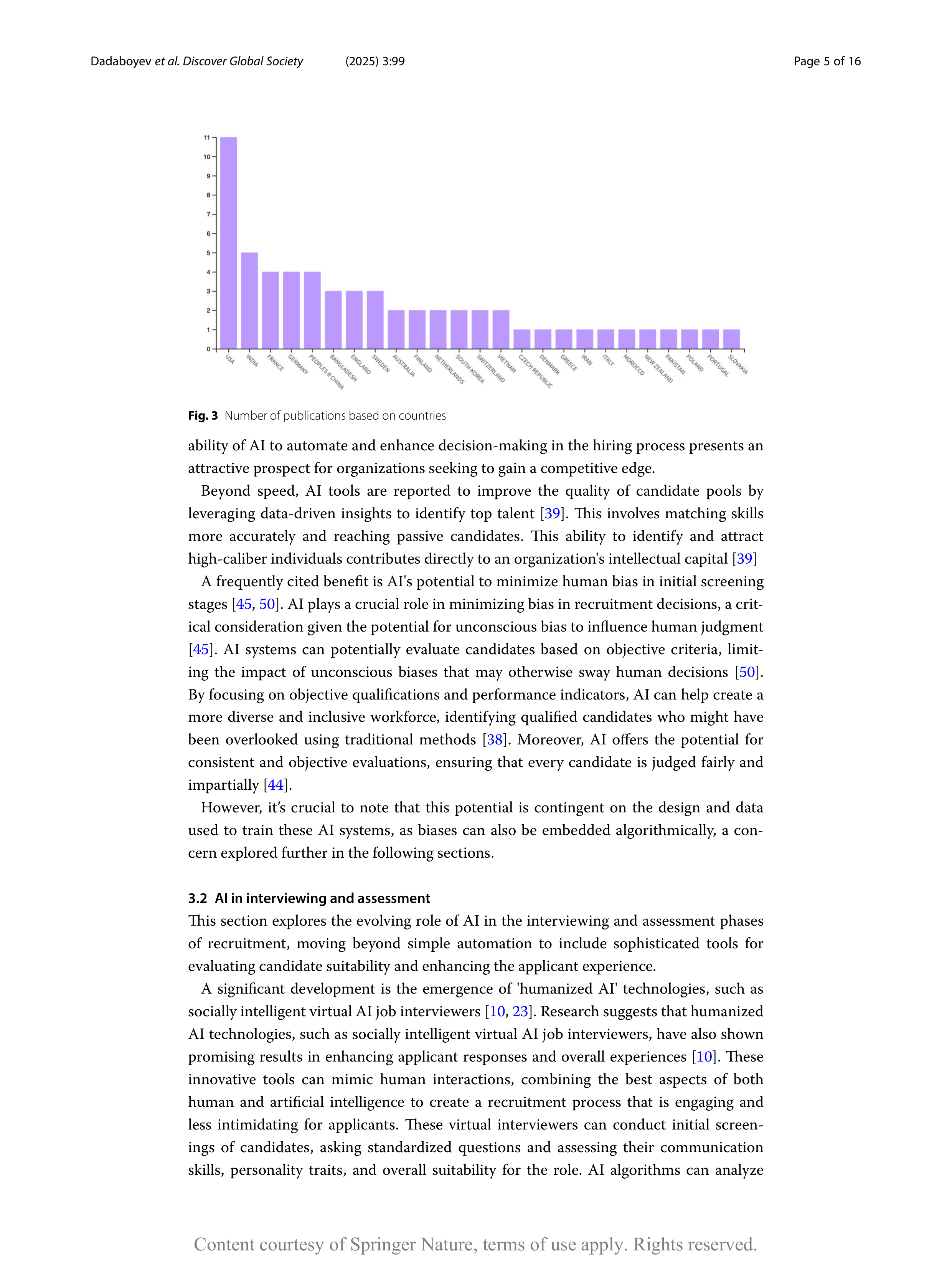
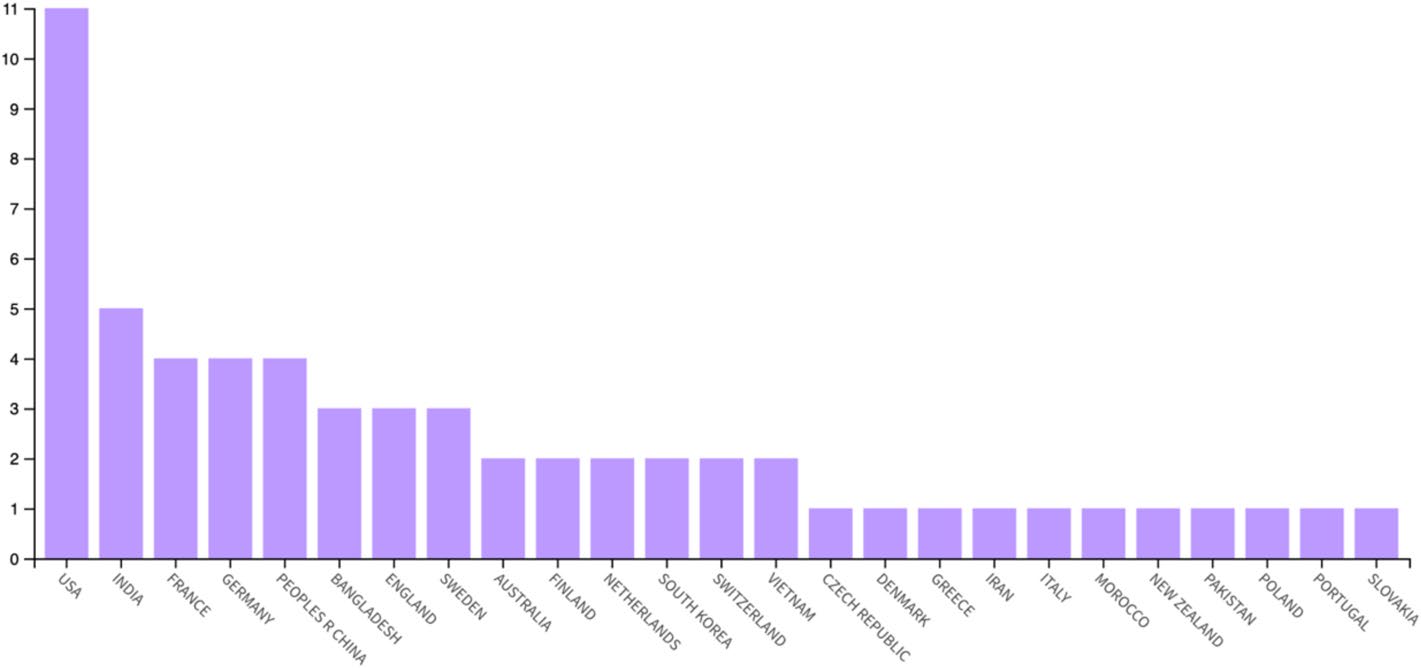
the growing research interest in this area. Figure
3
illustrates the geographical distribu-
tion of the included studies, providing insights into the global research landscape on AI
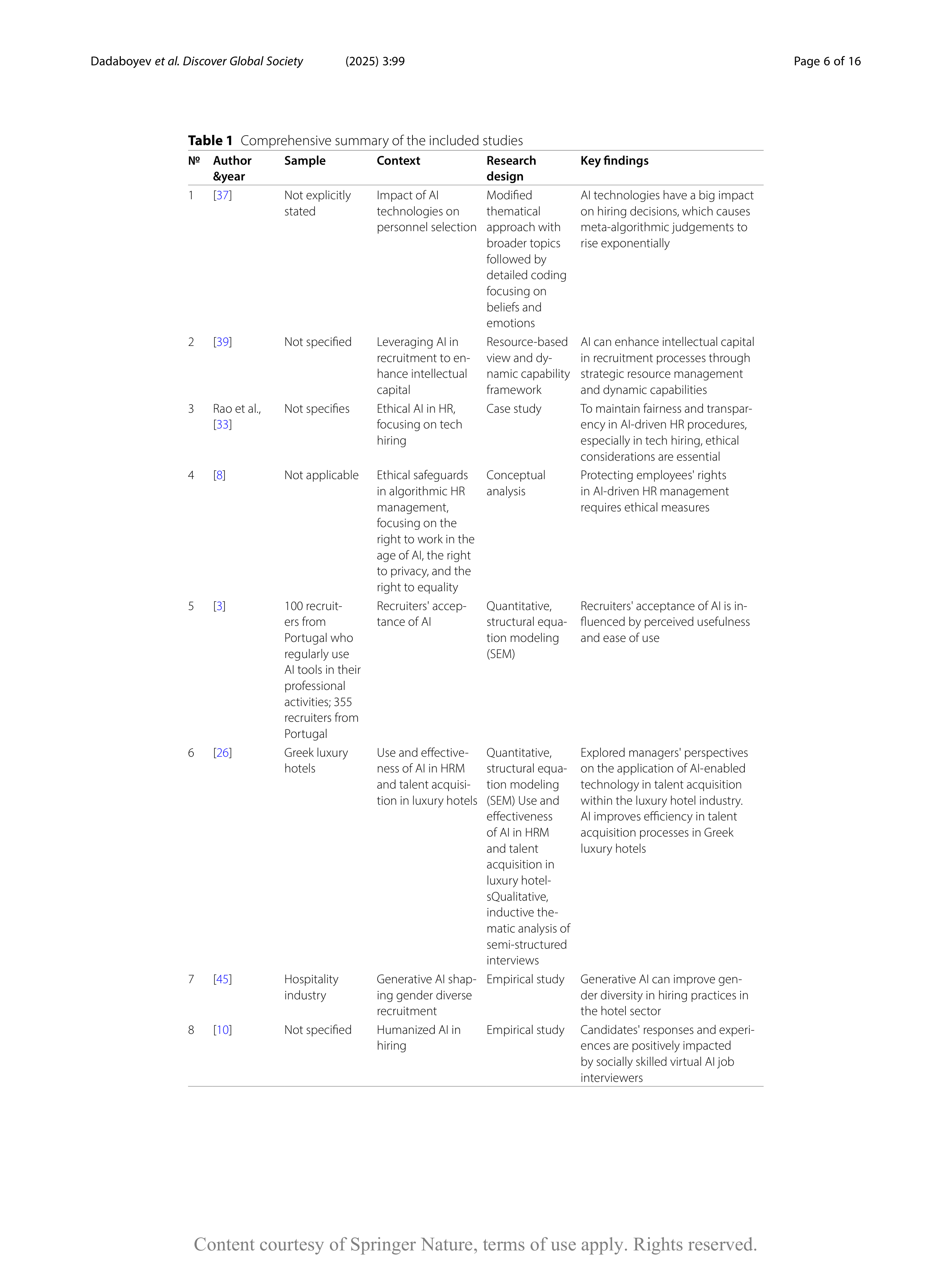
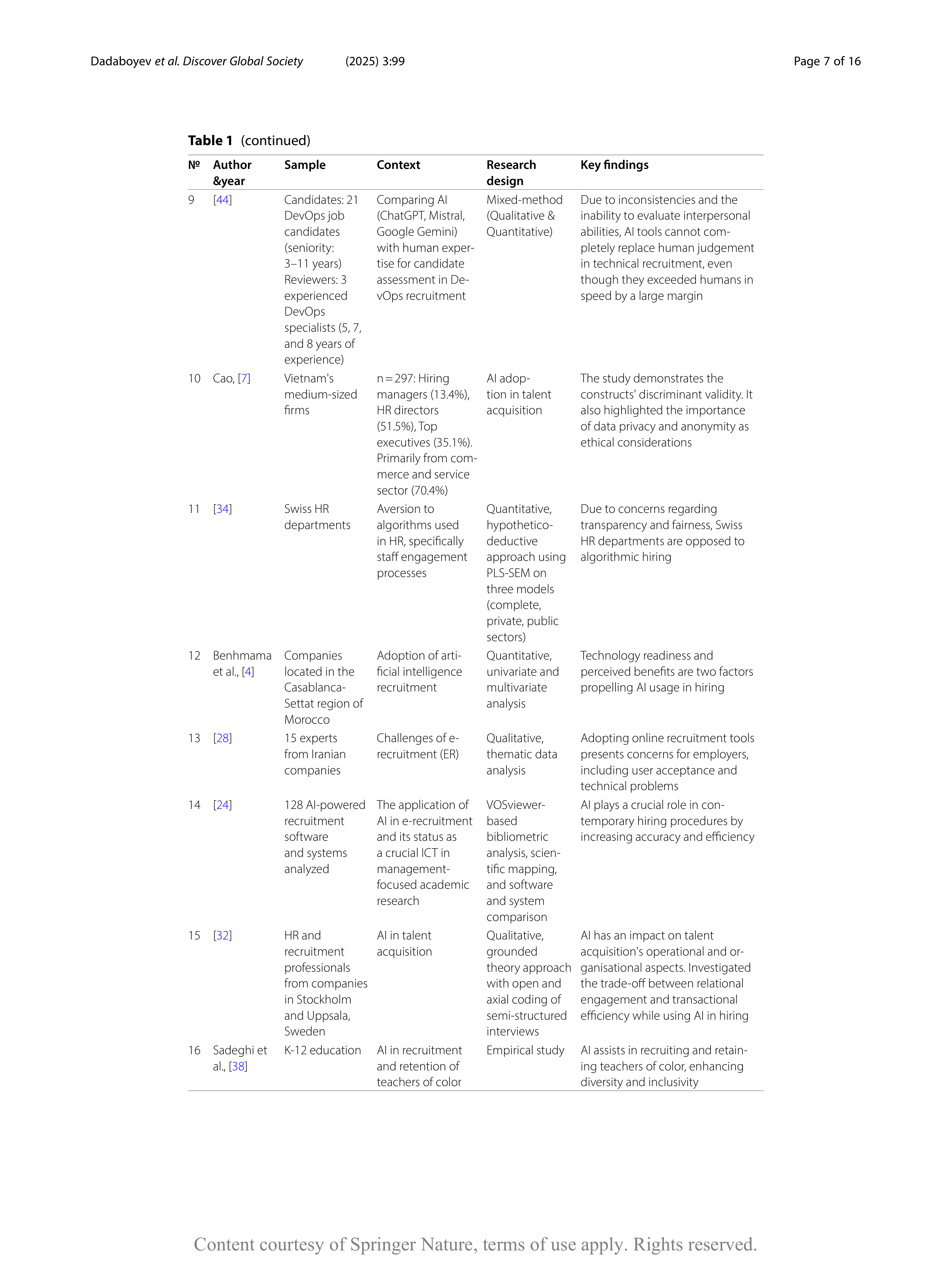
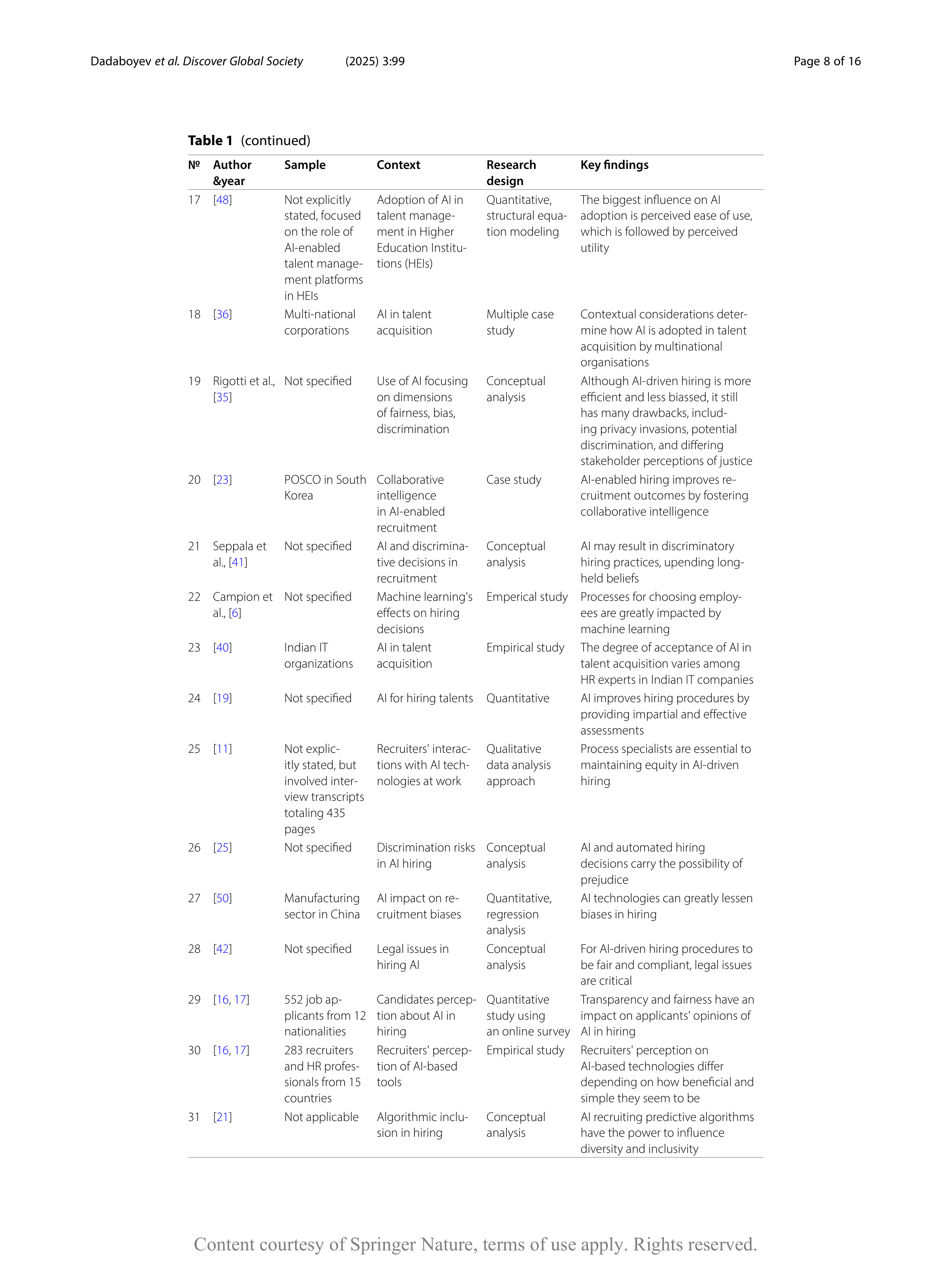
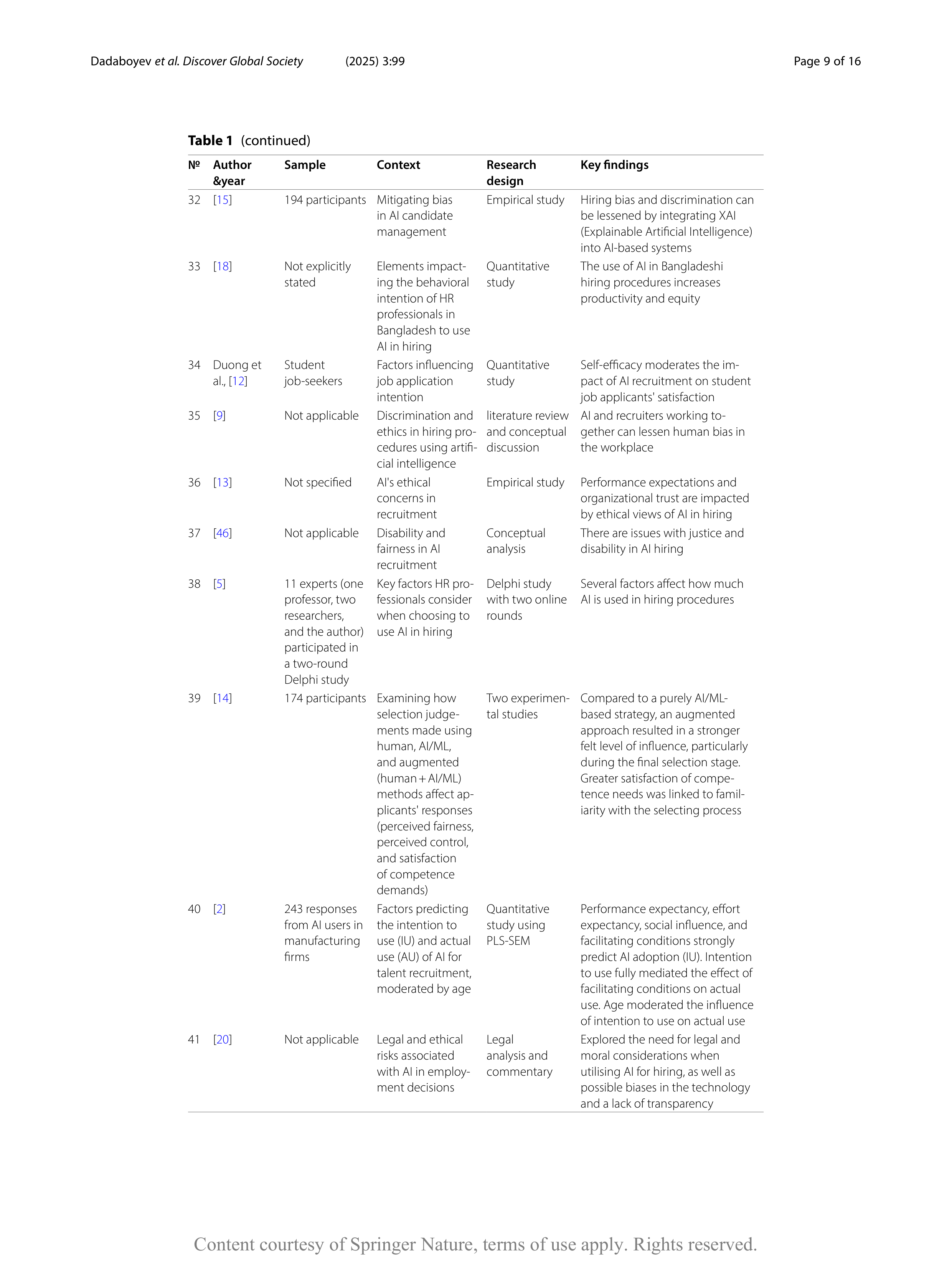
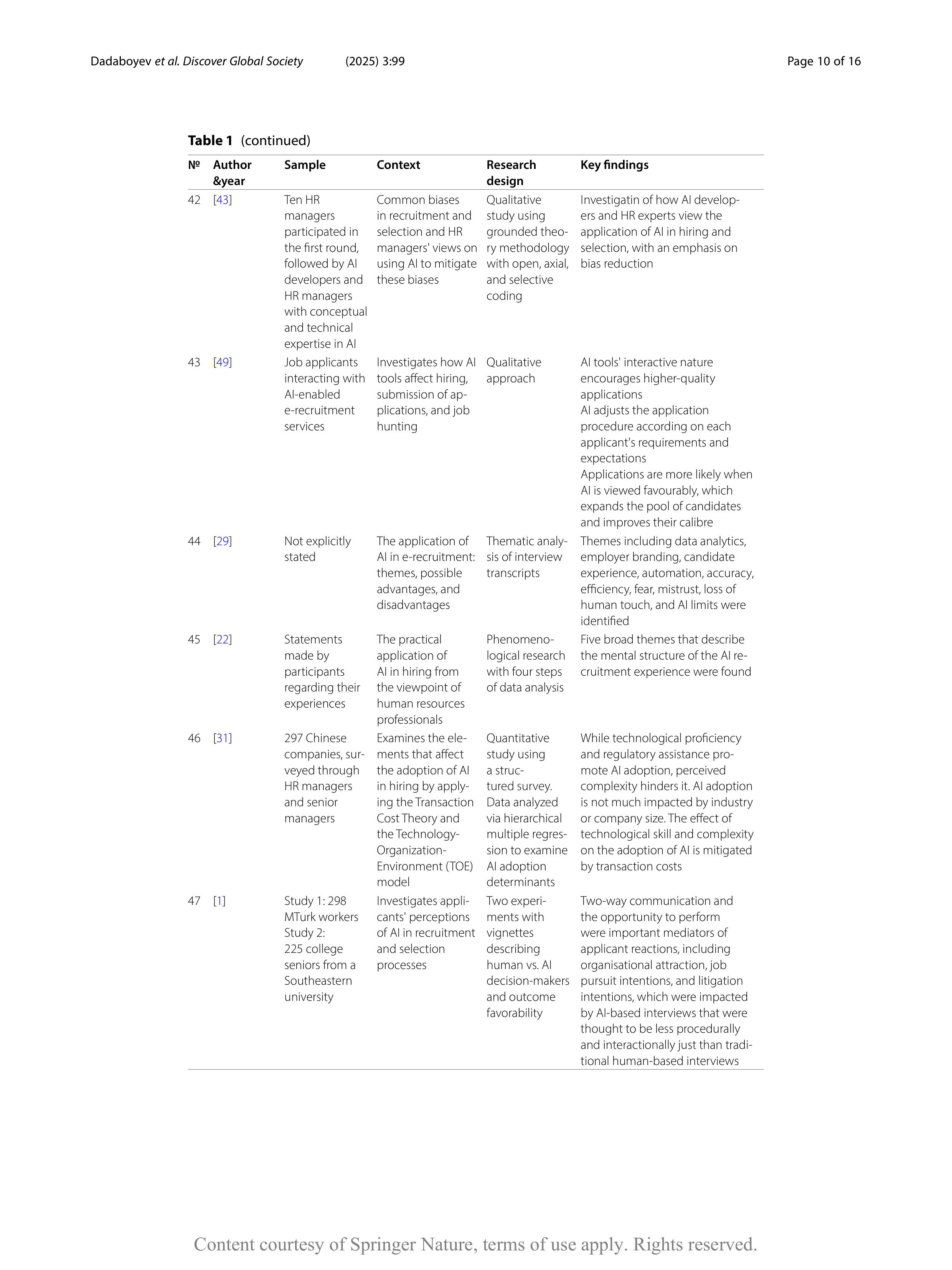
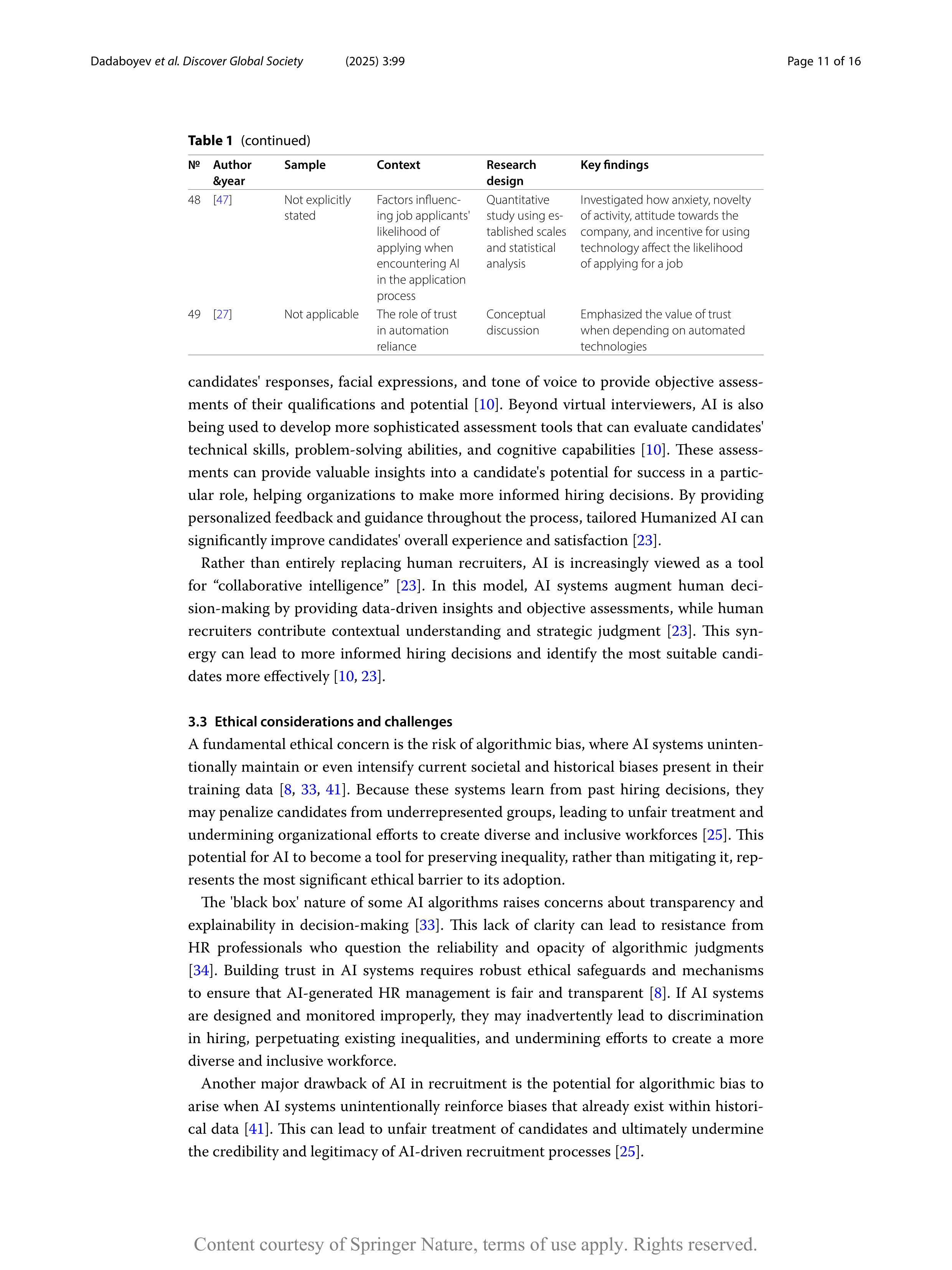
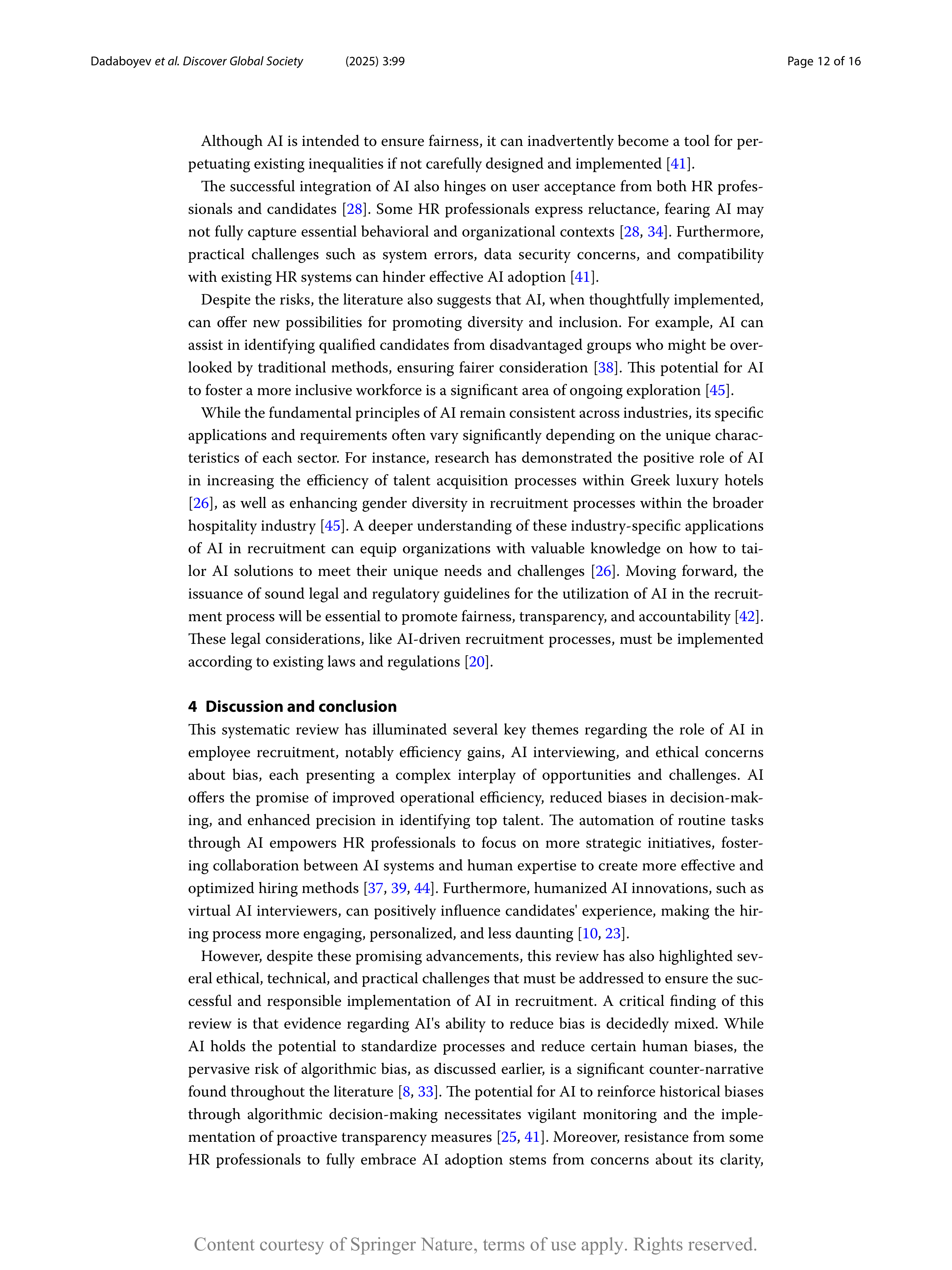
in recruitment. Finally, Table
1
provides a comprehensive summary of the included stud-
ies, detailing their author/years, samples, contexts, research designs, and key findings.
3 Results: key themes in AI-driven recruitment
Existing research on the use of AI in recruitment processes has been conducted in vari-
ous contexts and across various industry sectors. For example, a study investigating
the application of AI in talent acquisition within Greek luxury hotels revealed signifi-
cant increases in efficiency [
26
]. Generative AI has also been proven to enhance gender
diversity in recruitment processes in the hospitality industry, a finding highlighted by
Thakur et al. [
45
]. Humanized AI technologies, such as virtual AI job interviews, have
positively impacted applicants' reactions and experiences, making the recruitment pro-
cess more interactive and less intimidating [
10
]. Case studies, such as the one conducted
at POSCO in South Korea, underscore the potential benefits of collaborative intelligence
driven by AI-enabled recruitment, leading to improved hiring processes and more effec-
tive talent acquisition strategies [
23
].
Content courtesy of Springer Nature, terms of use apply. Rights reserved.
Page 4 of 16
Dadaboyev
et al. Discover Global Society
(2025) 3:99
3.1 AI-powered candidate sourcing and screening
This theme, AI-Powered Candidate Sourcing and Screening, encompasses the applica-
tion of artificial intelligence technologies to automate and enhance the initial stages of
the recruitment pipeline, from identifying potential candidates across various platforms
to filtering applications based on predefined criteria.
A primary driver for adopting AI in sourcing and screening is the significant enhance-
ment in operational efficiency and speed [
26
,
44
]. Multiple studies highlight AI's capacity
to process vast volumes of applications far quicker than manual methods, thereby reduc-
ing time-to-hire [
44
]. In today's rapidly evolving and highly competitive job market, the
Fig. 2
Number of publications in years
Fig. 1
Article search and selection process
Content courtesy of Springer Nature, terms of use apply. Rights reserved.
Page 5 of 16
Dadaboyev
et al. Discover Global Society
(2025) 3:99
ability of AI to automate and enhance decision-making in the hiring process presents an
attractive prospect for organizations seeking to gain a competitive edge.
Beyond speed, AI tools are reported to improve the quality of candidate pools by
leveraging data-driven insights to identify top talent [
39
]. This involves matching skills
more accurately and reaching passive candidates. This ability to identify and attract
high-caliber individuals contributes directly to an organization's intellectual capital [
39
]
A frequently cited benefit is AI's potential to minimize human bias in initial screening
stages [
45
,
50
]. AI plays a crucial role in minimizing bias in recruitment decisions, a crit-
ical consideration given the potential for unconscious bias to influence human judgment
[
45
]. AI systems can potentially evaluate candidates based on objective criteria, limit-
ing the impact of unconscious biases that may otherwise sway human decisions [
50
].
By focusing on objective qualifications and performance indicators, AI can help create a
more diverse and inclusive workforce, identifying qualified candidates who might have
been overlooked using traditional methods [
38
]. Moreover, AI offers the potential for
consistent and objective evaluations, ensuring that every candidate is judged fairly and
impartially [
44
].
However, it’s crucial to note that this potential is contingent on the design and data
used to train these AI systems, as biases can also be embedded algorithmically, a con-
cern explored further in the following sections.
3.2 AI in interviewing and assessment
This section explores the evolving role of AI in the interviewing and assessment phases
of recruitment, moving beyond simple automation to include sophisticated tools for
evaluating candidate suitability and enhancing the applicant experience.
A significant development is the emergence of 'humanized AI' technologies, such as
socially intelligent virtual AI job interviewers [
10
,
23
]. Research suggests that humanized
AI technologies, such as socially intelligent virtual AI job interviewers, have also shown
promising results in enhancing applicant responses and overall experiences [
10
]. These
innovative tools can mimic human interactions, combining the best aspects of both
human and artificial intelligence to create a recruitment process that is engaging and
less intimidating for applicants. These virtual interviewers can conduct initial screen-
ings of candidates, asking standardized questions and assessing their communication
skills, personality traits, and overall suitability for the role. AI algorithms can analyze
Fig. 3
Number of publications based on countries
Content courtesy of Springer Nature, terms of use apply. Rights reserved.
Page 6 of 16
Dadaboyev
et al. Discover Global Society
(2025) 3:99
№
Author
&year
Sample
Context
Research
design
Key findings
1
[
37
]
Not explicitly
stated
Impact of AI
technologies on
personnel selection
Modified
thematical
approach with
broader topics
followed by
detailed coding
focusing on
beliefs and
emotions
AI technologies have a big impact
on hiring decisions, which causes
meta-algorithmic judgements to
rise exponentially
2
[
39
]
Not specified
Leveraging AI in
recruitment to en-
hance intellectual
capital
Resource-based
view and dy-
namic capability
framework
AI can enhance intellectual capital
in recruitment processes through
strategic resource management
and dynamic capabilities
3
Rao et al.,
[
33
]
Not specifies
Ethical AI in HR,
focusing on tech
hiring
Case study
To maintain fairness and transpar-
ency in AI-driven HR procedures,
especially in tech hiring, ethical
considerations are essential
4
[
8
]
Not applicable
Ethical safeguards
in algorithmic HR
management,
focusing on the
right to work in the
age of AI, the right
to privacy, and the
right to equality
Conceptual
analysis
Protecting employees' rights
in AI-driven HR management
requires ethical measures
5
[
3
]
100 recruit-
ers from
Portugal who
regularly use
AI tools in their
professional
activities; 355
recruiters from
Portugal
Recruiters' accep-
tance of AI
Quantitative,
structural equa-
tion modeling
(SEM)
Recruiters' acceptance of AI is in-
fluenced by perceived usefulness
and ease of use
6
[
26
]
Greek luxury
hotels
Use and effective-
ness of AI in HRM
and talent acquisi-
tion in luxury hotels
Quantitative,
structural equa-
tion modeling
(SEM) Use and
effectiveness
of AI in HRM
and talent
acquisition in
luxury hotel-
sQualitative,
inductive the-
matic analysis of
semi-structured
interviews
Explored managers' perspectives
on the application of AI-enabled
technology in talent acquisition
within the luxury hotel industry.
AI improves efficiency in talent
acquisition processes in Greek
luxury hotels
7
[
45
]
Hospitality
industry
Generative AI shap-
ing gender diverse
recruitment
Empirical study
Generative AI can improve gen-
der diversity in hiring practices in
the hotel sector
8
[
10
]
Not specified
Humanized AI in
hiring
Empirical study
Candidates' responses and experi-
ences are positively impacted
by socially skilled virtual AI job
interviewers
Table 1
Comprehensive summary of the included studies
Content courtesy of Springer Nature, terms of use apply. Rights reserved.
Page 7 of 16
Dadaboyev
et al. Discover Global Society
(2025) 3:99
№
Author
&year
Sample
Context
Research
design
Key findings
9
[
44
]
Candidates: 21
DevOps job
candidates
(seniority:
3–11 years)
Reviewers: 3
experienced
DevOps
specialists (5, 7,
and 8 years of
experience)
Comparing AI
(ChatGPT, Mistral,
Google Gemini)
with human exper-
tise for candidate
assessment in De-
vOps recruitment
Mixed-method
(Qualitative &
Quantitative)
Due to inconsistencies and the
inability to evaluate interpersonal
abilities, AI tools cannot com-
pletely replace human judgement
in technical recruitment, even
though they exceeded humans in
speed by a large margin
10
Cao, [
7
]
Vietnam's
medium-sized
firms
n = 297: Hiring
managers (13.4%),
HR directors
(51.5%), Top
executives (35.1%).
Primarily from com-
merce and service
sector (70.4%)
AI adop-
tion in talent
acquisition
The study demonstrates the
constructs' discriminant validity. It
also highlighted the importance
of data privacy and anonymity as
ethical considerations
11
[
34
]
Swiss HR
departments
Aversion to
algorithms used
in HR, specifically
staff engagement
processes
Quantitative,
hypothetico-
deductive
approach using
PLS-SEM on
three models
(complete,
private, public
sectors)
Due to concerns regarding
transparency and fairness, Swiss
HR departments are opposed to
algorithmic hiring
12
Benhmama
et al., [
4
]
Companies
located in the
Casablanca-
Settat region of
Morocco
Adoption of arti-
ficial intelligence
recruitment
Quantitative,
univariate and
multivariate
analysis
Technology readiness and
perceived benefits are two factors
propelling AI usage in hiring
13
[
28
]
15 experts
from Iranian
companies
Challenges of e-
recruitment (ER)
Qualitative,
thematic data
analysis
Adopting online recruitment tools
presents concerns for employers,
including user acceptance and
technical problems
14
[
24
]
128 AI-powered
recruitment
software
and systems
analyzed
The application of
AI in e-recruitment
and its status as
a crucial ICT in
management-
focused academic
research
VOSviewer-
based
bibliometric
analysis, scien-
tific mapping,
and software
and system
comparison
AI plays a crucial role in con-
temporary hiring procedures by
increasing accuracy and efficiency
15
[
32
]
HR and
recruitment
professionals
from companies
in Stockholm
and Uppsala,
Sweden
AI in talent
acquisition
Qualitative,
grounded
theory approach
with open and
axial coding of
semi-structured
interviews
AI has an impact on talent
acquisition's operational and or-
ganisational aspects. Investigated
the trade-off between relational
engagement and transactional
efficiency while using AI in hiring
16
Sadeghi et
al., [
38
]
K-12 education
AI in recruitment
and retention of
teachers of color
Empirical study
AI assists in recruiting and retain-
ing teachers of color, enhancing
diversity and inclusivity
Table 1
(continued)
Content courtesy of Springer Nature, terms of use apply. Rights reserved.
Page 8 of 16
Dadaboyev
et al. Discover Global Society
(2025) 3:99
№
Author
&year
Sample
Context
Research
design
Key findings
17
[
48
]
Not explicitly
stated, focused
on the role of
AI-enabled
talent manage-
ment platforms
in HEIs
Adoption of AI in
talent manage-
ment in Higher
Education Institu-
tions (HEIs)
Quantitative,
structural equa-
tion modeling
The biggest influence on AI
adoption is perceived ease of use,
which is followed by perceived
utility
18
[
36
]
Multi-national
corporations
AI in talent
acquisition
Multiple case
study
Contextual considerations deter-
mine how AI is adopted in talent
acquisition by multinational
organisations
19
Rigotti et al.,
[
35
]
Not specified
Use of AI focusing
on dimensions
of fairness, bias,
discrimination
Conceptual
analysis
Although AI-driven hiring is more
efficient and less biassed, it still
has many drawbacks, includ-
ing privacy invasions, potential
discrimination, and differing
stakeholder perceptions of justice
20
[
23
]
POSCO in South
Korea
Collaborative
intelligence
in AI-enabled
recruitment
Case study
AI-enabled hiring improves re-
cruitment outcomes by fostering
collaborative intelligence
21
Seppala et
al., [
41
]
Not specified
AI and discrimina-
tive decisions in
recruitment
Conceptual
analysis
AI may result in discriminatory
hiring practices, upending long-
held beliefs
22
Campion et
al., [
6
]
Not specified
Machine learning's
effects on hiring
decisions
Emperical study
Processes for choosing employ-
ees are greatly impacted by
machine learning
23
[
40
]
Indian IT
organizations
AI in talent
acquisition
Empirical study
The degree of acceptance of AI in
talent acquisition varies among
HR experts in Indian IT companies
24
[
19
]
Not specified
AI for hiring talents
Quantitative
AI improves hiring procedures by
providing impartial and effective
assessments
25
[
11
]
Not explic-
itly stated, but
involved inter-
view transcripts
totaling 435
pages
Recruiters' interac-
tions with AI tech-
nologies at work
Qualitative
data analysis
approach
Process specialists are essential to
maintaining equity in AI-driven
hiring
26
[
25
]
Not specified
Discrimination risks
in AI hiring
Conceptual
analysis
AI and automated hiring
decisions carry the possibility of
prejudice
27
[
50
]
Manufacturing
sector in China
AI impact on re-
cruitment biases
Quantitative,
regression
analysis
AI technologies can greatly lessen
biases in hiring
28
[
42
]
Not specified
Legal issues in
hiring AI
Conceptual
analysis
For AI-driven hiring procedures to
be fair and compliant, legal issues
are critical
29
[
16
,
17
]
552 job ap-
plicants from 12
nationalities
Candidates percep-
tion about AI in
hiring
Quantitative
study using
an online survey
Transparency and fairness have an
impact on applicants' opinions of
AI in hiring
30
[
16
,
17
]
283 recruiters
and HR profes-
sionals from 15
countries
Recruiters' percep-
tion of AI-based
tools
Empirical study
Recruiters' perception on
AI-based technologies differ
depending on how beneficial and
simple they seem to be
31
[
21
]
Not applicable
Algorithmic inclu-
sion in hiring
Conceptual
analysis
AI recruiting predictive algorithms
have the power to influence
diversity and inclusivity
Table 1
(continued)
Content courtesy of Springer Nature, terms of use apply. Rights reserved.
Page 9 of 16
Dadaboyev
et al. Discover Global Society
(2025) 3:99
№
Author
&year
Sample
Context
Research
design
Key findings
32
[
15
]
194 participants
Mitigating bias
in AI candidate
management
Empirical study
Hiring bias and discrimination can
be lessened by integrating XAI
(Explainable Artificial Intelligence)
into AI-based systems
33
[
18
]
Not explicitly
stated
Elements impact-
ing the behavioral
intention of HR
professionals in
Bangladesh to use
AI in hiring
Quantitative
study
The use of AI in Bangladeshi
hiring procedures increases
productivity and equity
34
Duong et
al., [
12
]
Student
job-seekers
Factors influencing
job application
intention
Quantitative
study
Self-efficacy moderates the im-
pact of AI recruitment on student
job applicants' satisfaction
35
[
9
]
Not applicable
Discrimination and
ethics in hiring pro-
cedures using artifi-
cial intelligence
literature review
and conceptual
discussion
AI and recruiters working to-
gether can lessen human bias in
the workplace
36
[
13
]
Not specified
AI's ethical
concerns in
recruitment
Empirical study
Performance expectations and
organizational trust are impacted
by ethical views of AI in hiring
37
[
46
]
Not applicable
Disability and
fairness in AI
recruitment
Conceptual
analysis
There are issues with justice and
disability in AI hiring
38
[
5
]
11 experts (one
professor, two
researchers,
and the author)
participated in
a two-round
Delphi study
Key factors HR pro-
fessionals consider
when choosing to
use AI in hiring
Delphi study
with two online
rounds
Several factors affect how much
AI is used in hiring procedures
39
[
14
]
174 participants
Examining how
selection judge-
ments made using
human, AI/ML,
and augmented
(human + AI/ML)
methods affect ap-
plicants' responses
(perceived fairness,
perceived control,
and satisfaction
of competence
demands)
Two experimen-
tal studies
Compared to a purely AI/ML-
based strategy, an augmented
approach resulted in a stronger
felt level of influence, particularly
during the final selection stage.
Greater satisfaction of compe-
tence needs was linked to famil-
iarity with the selecting process
40
[
2
]
243 responses
from AI users in
manufacturing
firms
Factors predicting
the intention to
use (IU) and actual
use (AU) of AI for
talent recruitment,
moderated by age
Quantitative
study using
PLS-SEM
Performance expectancy, effort
expectancy, social influence, and
facilitating conditions strongly
predict AI adoption (IU). Intention
to use fully mediated the effect of
facilitating conditions on actual
use. Age moderated the influence
of intention to use on actual use
41
[
20
]
Not applicable
Legal and ethical
risks associated
with AI in employ-
ment decisions
Legal
analysis and
commentary
Explored the need for legal and
moral considerations when
utilising AI for hiring, as well as
possible biases in the technology
and a lack of transparency
Table 1
(continued)
Content courtesy of Springer Nature, terms of use apply. Rights reserved.
Page 10 of 16
Dadaboyev
et al. Discover Global Society
(2025) 3:99
№
Author
&year
Sample
Context
Research
design
Key findings
42
[
43
]
Ten HR
managers
participated in
the first round,
followed by AI
developers and
HR managers
with conceptual
and technical
expertise in AI
Common biases
in recruitment and
selection and HR
managers' views on
using AI to mitigate
these biases
Qualitative
study using
grounded theo-
ry methodology
with open, axial,
and selective
coding
Investigatin of how AI develop-
ers and HR experts view the
application of AI in hiring and
selection, with an emphasis on
bias reduction
43
[
49
]
Job applicants
interacting with
AI-enabled
e-recruitment
services
Investigates how AI
tools affect hiring,
submission of ap-
plications, and job
hunting
Qualitative
approach
AI tools' interactive nature
encourages higher-quality
applications
AI adjusts the application
procedure according on each
applicant's requirements and
expectations
Applications are more likely when
AI is viewed favourably, which
expands the pool of candidates
and improves their calibre
44
[
29
]
Not explicitly
stated
The application of
AI in e-recruitment:
themes, possible
advantages, and
disadvantages
Thematic analy-
sis of interview
transcripts
Themes including data analytics,
employer branding, candidate
experience, automation, accuracy,
efficiency, fear, mistrust, loss of
human touch, and AI limits were
identified
45
[
22
]
Statements
made by
participants
regarding their
experiences
The practical
application of
AI in hiring from
the viewpoint of
human resources
professionals
Phenomeno-
logical research
with four steps
of data analysis
Five broad themes that describe
the mental structure of the AI re-
cruitment experience were found
46
[
31
]
297 Chinese
companies, sur-
veyed through
HR managers
and senior
managers
Examines the ele-
ments that affect
the adoption of AI
in hiring by apply-
ing the Transaction
Cost Theory and
the Technology-
Organization-
Environment (TOE)
model
Quantitative
study using
a struc-
tured survey.
Data analyzed
via hierarchical
multiple regres-
sion to examine
AI adoption
determinants
While technological proficiency
and regulatory assistance pro-
mote AI adoption, perceived
complexity hinders it. AI adoption
is not much impacted by industry
or company size. The effect of
technological skill and complexity
on the adoption of AI is mitigated
by transaction costs
47
[
1
]
Study 1: 298
MTurk workers
Study 2:
225 college
seniors from a
Southeastern
university
Investigates appli-
cants' perceptions
of AI in recruitment
and selection
processes
Two experi-
ments with
vignettes
describing
human vs. AI
decision-makers
and outcome
favorability
Two-way communication and
the opportunity to perform
were important mediators of
applicant reactions, including
organisational attraction, job
pursuit intentions, and litigation
intentions, which were impacted
by AI-based interviews that were
thought to be less procedurally
and interactionally just than tradi-
tional human-based interviews
Table 1
(continued)
Content courtesy of Springer Nature, terms of use apply. Rights reserved.
Page 11 of 16
Dadaboyev
et al. Discover Global Society
(2025) 3:99
candidates' responses, facial expressions, and tone of voice to provide objective assess-
ments of their qualifications and potential [
10
]. Beyond virtual interviewers, AI is also
being used to develop more sophisticated assessment tools that can evaluate candidates'
technical skills, problem-solving abilities, and cognitive capabilities [
10
]. These assess-
ments can provide valuable insights into a candidate's potential for success in a partic-
ular role, helping organizations to make more informed hiring decisions. By providing
personalized feedback and guidance throughout the process, tailored Humanized AI can
significantly improve candidates' overall experience and satisfaction [
23
].
Rather than entirely replacing human recruiters, AI is increasingly viewed as a tool
for “collaborative intelligence” [
23
]. In this model, AI systems augment human deci-
sion-making by providing data-driven insights and objective assessments, while human
recruiters contribute contextual understanding and strategic judgment [
23
]. This syn-
ergy can lead to more informed hiring decisions and identify the most suitable candi-
dates more effectively [
10
,
23
].
3.3 Ethical considerations and challenges
A fundamental ethical concern is the risk of algorithmic bias, where AI systems uninten-
tionally maintain or even intensify current societal and historical biases present in their
training data [
8
,
33
,
41
]. Because these systems learn from past hiring decisions, they
may penalize candidates from underrepresented groups, leading to unfair treatment and
undermining organizational efforts to create diverse and inclusive workforces [
25
]. This
potential for AI to become a tool for preserving inequality, rather than mitigating it, rep-
resents the most significant ethical barrier to its adoption.
The 'black box' nature of some AI algorithms raises concerns about transparency and
explainability in decision-making [
33
]. This lack of clarity can lead to resistance from
HR professionals who question the reliability and opacity of algorithmic judgments
[
34
]. Building trust in AI systems requires robust ethical safeguards and mechanisms
to ensure that AI-generated HR management is fair and transparent [
8
]. If AI systems
are designed and monitored improperly, they may inadvertently lead to discrimination
in hiring, perpetuating existing inequalities, and undermining efforts to create a more
diverse and inclusive workforce.
Another major drawback of AI in recruitment is the potential for algorithmic bias to
arise when AI systems unintentionally reinforce biases that already exist within histori-
cal data [
41
]. This can lead to unfair treatment of candidates and ultimately undermine
the credibility and legitimacy of AI-driven recruitment processes [
25
].
№
Author
&year
Sample
Context
Research
design
Key findings
48
[
47
]
Not explicitly
stated
Factors influenc-
ing job applicants'
likelihood of
applying when
encountering AI
in the application
process
Quantitative
study using es-
tablished scales
and statistical
analysis
Investigated how anxiety, novelty
of activity, attitude towards the
company, and incentive for using
technology affect the likelihood
of applying for a job
49
[
27
]
Not applicable
The role of trust
in automation
reliance
Conceptual
discussion
Emphasized the value of trust
when depending on automated
technologies
Table 1
(continued)
Content courtesy of Springer Nature, terms of use apply. Rights reserved.
Page 12 of 16
Dadaboyev
et al. Discover Global Society
(2025) 3:99
Although AI is intended to ensure fairness, it can inadvertently become a tool for per-
petuating existing inequalities if not carefully designed and implemented [
41
].
The successful integration of AI also hinges on user acceptance from both HR profes-
sionals and candidates [
28
]. Some HR professionals express reluctance, fearing AI may
not fully capture essential behavioral and organizational contexts [
28
,
34
]. Furthermore,
practical challenges such as system errors, data security concerns, and compatibility
with existing HR systems can hinder effective AI adoption [
41
].
Despite the risks, the literature also suggests that AI, when thoughtfully implemented,
can offer new possibilities for promoting diversity and inclusion. For example, AI can
assist in identifying qualified candidates from disadvantaged groups who might be over-
looked by traditional methods, ensuring fairer consideration [
38
]. This potential for AI
to foster a more inclusive workforce is a significant area of ongoing exploration [
45
].
While the fundamental principles of AI remain consistent across industries, its specific
applications and requirements often vary significantly depending on the unique charac-
teristics of each sector. For instance, research has demonstrated the positive role of AI
in increasing the efficiency of talent acquisition processes within Greek luxury hotels
[
26
], as well as enhancing gender diversity in recruitment processes within the broader
hospitality industry [
45
]. A deeper understanding of these industry-specific applications
of AI in recruitment can equip organizations with valuable knowledge on how to tai-
lor AI solutions to meet their unique needs and challenges [
26
]. Moving forward, the
issuance of sound legal and regulatory guidelines for the utilization of AI in the recruit-
ment process will be essential to promote fairness, transparency, and accountability [
42
].
These legal considerations, like AI-driven recruitment processes, must be implemented
according to existing laws and regulations [
20
].
4 Discussion and conclusion
This systematic review has illuminated several key themes regarding the role of AI in
employee recruitment, notably efficiency gains, AI interviewing, and ethical concerns
about bias, each presenting a complex interplay of opportunities and challenges. AI
offers the promise of improved operational efficiency, reduced biases in decision-mak-
ing, and enhanced precision in identifying top talent. The automation of routine tasks
through AI empowers HR professionals to focus on more strategic initiatives, foster-
ing collaboration between AI systems and human expertise to create more effective and
optimized hiring methods [
37
,
39
,
44
]. Furthermore, humanized AI innovations, such as
virtual AI interviewers, can positively influence candidates' experience, making the hir-
ing process more engaging, personalized, and less daunting [
10
,
23
].
However, despite these promising advancements, this review has also highlighted sev-
eral ethical, technical, and practical challenges that must be addressed to ensure the suc-
cessful and responsible implementation of AI in recruitment. A critical finding of this
review is that evidence regarding AI's ability to reduce bias is decidedly mixed. While
AI holds the potential to standardize processes and reduce certain human biases, the
pervasive risk of algorithmic bias, as discussed earlier, is a significant counter-narrative
found throughout the literature [
8
,
33
]. The potential for AI to reinforce historical biases
through algorithmic decision-making necessitates vigilant monitoring and the imple-
mentation of proactive transparency measures [
25
,
41
]. Moreover, resistance from some
HR professionals to fully embrace AI adoption stems from concerns about its clarity,
Content courtesy of Springer Nature, terms of use apply. Rights reserved.
Page 13 of 16
Dadaboyev
et al. Discover Global Society
(2025) 3:99
understandability, and reliability. Addressing these technical challenges, including data
security, system integration difficulties, and ensuring user acceptance, is crucial to facili-
tate wider adoption and maximize the benefits of AI implementation [
28
,
34
].
This review has also underscored the importance of considering industry-specific
nuances when adopting AI-based recruitment solutions. Different industries face unique
challenges and opportunities, and AI technologies must be tailored to meet their spe-
cific requirements. For example, the hospitality industry has successfully leveraged AI to
improve hiring efficiency and optimize gender diversity, highlighting the need for adapt-
able AI solutions that can be customized to address specific industry needs [
26
,
45
].
These findings emphasize the need for organizations to personalize their AI solutions to
align with their unique field-related demands and maximize their return on investment.
Furthermore, this review has identified the critical need to establish a strong legal and
administrative framework to effectively regulate AI applications in recruitment. Clear
and well-defined rules will empower organizations to manage ethical risks proactively,
ensuring transparency in decision-making and actively mitigating algorithmic discrimi-
nation to foster trust among users and stakeholders [
20
,
42
]. Legal clarity will also enable
recruiters and organizational leaders to confidently and ethically adopt AI technologies
while minimizing fears and resistance associated with AI management uncertainties.
4.1 Implications
For practitioners, this review highlights the need for careful due diligence when select-
ing AI recruitment tools, emphasizing systems that offer transparency and allow for bias
audits. For policymakers, the findings underscore the urgency of developing clear legal
and ethical guidelines to govern AI use in hiring, ensuring fairness and protecting appli-
cant rights [
20
,
42
].
Theoretically, our findings suggest that existing models of technology acceptance may
need to be augmented to incorporate the unique ethical and trust dimensions associated
with AI in high-stakes decision-making processes like recruitment.
4.2 Identified limitations and future research directions
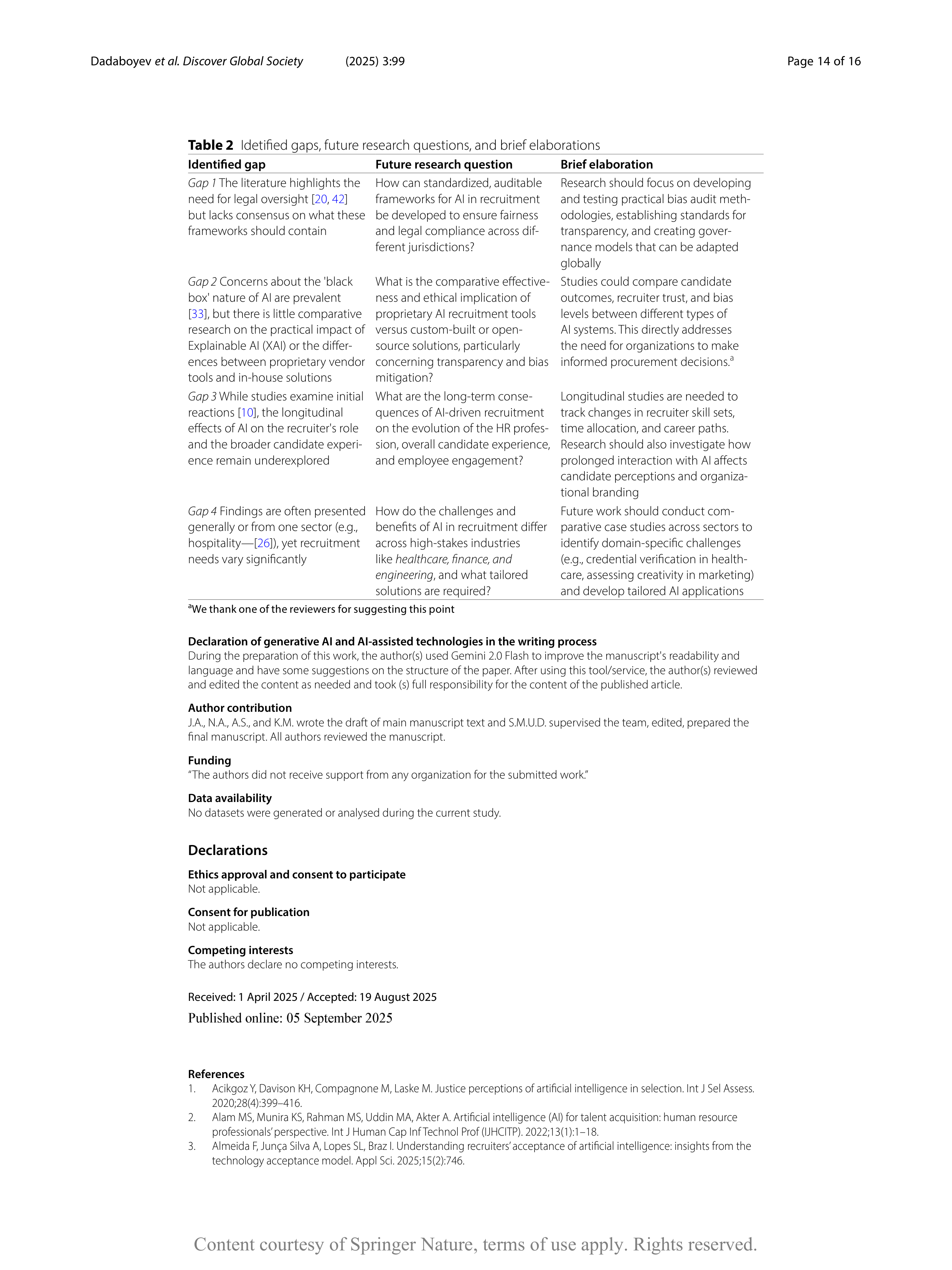
M Our systematic review of the literature reveals several critical gaps. To address these,
we propose a research agenda focused on key areas such as
ethical governance and legal
frameworks
,
technological transparency and efficacy
,
the human-AI interface
, and
indus-
try-specific contexts
. Table
2
provides the idetified gaps, future research questions, and
brief elaborations.
4.3 Concluding remarks
This systematic review synthesizes two sides of AI in recruitment: a promising tech-
nology for efficiency and fairness, yet with significant challenges. While AI offers the
potential to lessen certain human biases, this outcome is not guaranteed and is often
neutralized by the unescapable risk of algorithmic bias. Future progress centers on
focused efforts in key areas, like establishing robust ethical and legal governance,
demanding greater technological transparency, understanding the long-term human-AI
interaction, and developing industry-specific solutions. The successful and ethical adop-
tion of AI in recruitment requires a collaborative approach, integrating technological
capabilities with human judgment and robust regulatory frameworks.
Content courtesy of Springer Nature, terms of use apply. Rights reserved.

Page 14 of 16
Dadaboyev
et al. Discover Global Society
(2025) 3:99
Declaration of generative AI and AI-assisted technologies in the writing process
During the preparation of this work, the author(s) used Gemini 2.0 Flash to improve the manuscript's readability and
language and have some suggestions on the structure of the paper. After using this tool/service, the author(s) reviewed
and edited the content as needed and took (s) full responsibility for the content of the published article.
Author contribution
J.A., N.A., A.S., and K.M. wrote the draft of main manuscript text and S.M.U.D. supervised the team, edited, prepared the
final manuscript. All authors reviewed the manuscript.
Funding
“The authors did not receive support from any organization for the submitted work.”
Data availability
No datasets were generated or analysed during the current study.
Declarations
Ethics approval and consent to participate
Not applicable.
Consent for publication
Not applicable.
Competing interests
The authors declare no competing interests.
Received: 1 April 2025 / Accepted: 19 August 2025
References
1.
Acikgoz Y, Davison KH, Compagnone M, Laske M. Justice perceptions of artificial intelligence in selection. Int J Sel Assess.
2020;28(4):399–416.
2.
Alam MS, Munira KS, Rahman MS, Uddin MA, Akter A. Artificial intelligence (AI) for talent acquisition: human resource
professionals’ perspective. Int J Human Cap Inf Technol Prof (IJHCITP). 2022;13(1):1–18.
3.
Almeida F, Junça Silva A, Lopes SL, Braz I. Understanding recruiters’ acceptance of artificial intelligence: insights from the
technology acceptance model. Appl Sci. 2025;15(2):746.
Table 2
Idetified gaps, future research questions, and brief elaborations
Identified gap
Future research question
Brief elaboration
Gap 1
The literature highlights the
need for legal oversight [
20
,
42
]
but lacks consensus on what these
frameworks should contain
How can standardized, auditable
frameworks for AI in recruitment
be developed to ensure fairness
and legal compliance across dif-
ferent jurisdictions?
Research should focus on developing
and testing practical bias audit meth-
odologies, establishing standards for
transparency, and creating gover-
nance models that can be adapted
globally
Gap 2
Concerns about the 'black
box' nature of AI are prevalent
[
33
], but there is little comparative
research on the practical impact of
Explainable AI (XAI) or the differ-
ences between proprietary vendor
tools and in-house solutions
What is the comparative effective-
ness and ethical implication of
proprietary AI recruitment tools
versus custom-built or open-
source solutions, particularly
concerning transparency and bias
mitigation?
Studies could compare candidate
outcomes, recruiter trust, and bias
levels between different types of
AI systems. This directly addresses
the need for organizations to make
informed procurement decisions.
a
Gap 3
While studies examine initial
reactions [
10
], the longitudinal
effects of AI on the recruiter's role
and the broader candidate experi-
ence remain underexplored
What are the long-term conse-
quences of AI-driven recruitment
on the evolution of the HR profes-
sion, overall candidate experience,
and employee engagement?
Longitudinal studies are needed to
track changes in recruiter skill sets,
time allocation, and career paths.
Research should also investigate how
prolonged interaction with AI affects
candidate perceptions and organiza-
tional branding
Gap 4
Findings are often presented
generally or from one sector (e.g.,
hospitality—[
26
]), yet recruitment
needs vary significantly
How do the challenges and
benefits of AI in recruitment differ
across high-stakes industries
like
healthcare, finance, and
engineering
, and what tailored
solutions are required?
Future work should conduct com-
parative case studies across sectors to
identify domain-specific challenges
(e.g., credential verification in health-
care, assessing creativity in marketing)
and develop tailored AI applications
a
We thank one of the reviewers for suggesting this point
Content courtesy of Springer Nature, terms of use apply. Rights reserved.
Page 15 of 16
Dadaboyev
et al. Discover Global Society
(2025) 3:99
4.
Benhmama A, Bennani YB. Factors driving the adoption of artificial intelligence technology in the recruitment process in
Morocco. Acc J. 2024;5(3):387–406.
5.
Bhatt P. Ai adoption in the hiring process–important criteria and extent of AI adoption. Foresight. 2022;25(1):144–63.
6.
Campion ED, Campion MA. Impact of machine learning on personnel selection. Organ Dyn. 2024;53(1): 101035.
7.
Cao TM, Nguyen LTV. Factors affecting artificial intelligence (AI) adoption in the talent acquisition process: the case of
Vietnam’s medium-sized firms. J Asia Bus Stud. 2024.
https://doi.org/10.1108/JABS-08-2024-0444
.
8.
Capasso M, Arora P, Sharma D, Tacconi C. On the right to work in the age of artificial intelligence: ethical safeguards in
algorithmic human resource management. Bus Hum Rights J. 2025.
https://doi.org/10.1017/bhj.2024.26
.
9.
Chen Z. Collaboration among recruiters and artificial intelligence: removing human prejudices in employment. Cogn
Technol Work. 2023;25(1):135–49.
10.
Clavel C, d’Armagnac S, Hebrard S, Hesters T, Potdevin D. Humanized AI in hiring: an empirical study of a virtual AI job
interviewer’s social skills on applicants’ reactions and experience. Int J Hum Resour Manage. 2025;36(2):206–34.
11.
Cruz IF. How process experts enable and constrain fairness in AI-driven hiring. Int J Commun. 2024;18:656–76.
12.
Duong NT, Thi TDP. How does AI recruitment influence satisfaction among student job-seekers? The role of self-efficacy as
a moderator and mediator. Educ Sci J. 2022;24(8):64–94.
13.
Figueroa-Armijos M, Clark BB, da Motta Veiga SP. Ethical perceptions of AI in hiring and organizational trust: the role of
performance expectancy and social influence. J Bus Ethics. 2023;186(1):179–97.
14.
Gonzalez MF, Liu W, Shirase L, Tomczak DL, Lobbe CE, Justenhoven R, Martin NR. Allying with AI? Reactions toward human-
based, AI/ML-based, and augmented hiring processes. Comput Human Behav. 2022;130: 107179.
15.
Hofeditz L, Clausen S, Rieß A, Mirbabaie M, Stieglitz S. Applying XAI to an AI-based system for candidate management to
mitigate bias and discrimination in hiring. Electron Markets. 2022;32(4):2207–33.
16.
Horodyski P. Applicants’ perception of artificial intelligence in the recruitment process. Comput Human Behav Rep.
2023;11: 100303.
17.
Horodyski P. Recruiter’s perception of artificial intelligence (AI)-based tools in recruitment. Comput Human Behav Rep.
2023;10: 100298.
18.
Islam M, Mamun AA, Afrin S, Ali Quaosar GA, Uddin MA. Technology adoption and human resource management prac-
tices: the use of artificial intelligence for recruitment in Bangladesh. South Asian J Human Res Manage. 2022;9(2):324–49.
19.
Islam M, Rahman MM, Taher MA, Quaosar GAA, Uddin MA. Using artificial intelligence for hiring talents in a moderated
mechanism. Future Bus J. 2024;10(1):13.
20.
Kammerer B. Hired by a robot: the legal implications of artificial intelligence video interviews and advocating for greater
protection of job applicants. Iowa L Rev. 2022;107:817.
21.
Kelan EK. Algorithmic inclusion: shaping the predictive algorithms of artificial intelligence in hiring. Hum Resour Manage J.
2024;34(3):694–707.
22.
Kim JY, Heo W. Artificial intelligence video interviewing for employment: perspectives from applicants, companies, devel-
oper and academicians. Inf Technol People. 2021;35(3):861–78.
23.
Kim J, Battaglia S, Kim HH. Collaborative intelligence achieved from AI-enabled recruitment: a case study of POSCO in
South Korea. Asia Pac Bus Rev. 2024;31(1):180–99.
24.
Koman G, Boršoš P, Kubina M. The possibilities of using artificial intelligence as a key technology in the current employee
recruitment process. Adm Sci. 2024;14(7):157.
25.
Larsson S, White JM, Ingram Bogusz C. The artificial recruiter: risks of discrimination in employers’ use of AI and automated
decision-making. Soc Inclus. 2024.
https://doi.org/10.17645/si.7471
.
26.
Marinakou, E., Giousmpasoglou, C., & Papavasileiou, E. F. (2024). The use of artificial intelligence (AI) in talent acquisition:
The case of Greek luxury hotels. Strategic Change.
27.
Min J, Kim S, Park Y, Sohn YW. A comparative study of potential job candidates’ perceptions of an AI recruiter and a human
recruiter. J Korea Converg Soc. 2018;9(5):191–202.
28.
Nejad Z, Sabokro M, Oikarinen EL. Challenges in adopting and using online recruitment tools from employers’ perspective.
Int J Organiz Anal. 2024;33(5):1203–18.
29.
Ore O, Sposato M. Opportunities and risks of artificial intelligence in recruitment and selection. Int J Organ Anal.
2022;30(6):1771–82.
30.
Page MJ, McKenzie JE, Bossuyt PM, Boutron I, Hoffmann TC, Mulrow CD, Moher D. The PRISMA 2020 statement: an
updated guideline for reporting systematic reviews. The BMJ. 2021;29:372.
31.
Pan Y, Froese F, Liu N, Hu Y, Ye M. The adoption of artificial intelligence in employee recruitment: The influence of contex-
tual factors. London: Routledge; 2023.
32.
Paramita D, Okwir S, Nuur C. Artificial intelligence in talent acquisition: exploring organisational and operational dimen-
sions. Int J Organ Anal. 2024;32(11):108–31.
33.
Rao S, Zhao T. Ethical AI in HR: a case study of tech hiring. J Comput Inf Syst. 2025;1:18.
34.
Revillod G. Why do Swiss HR departments dislike algorithms in their recruitment process? An empirical analysis. Adm Sci.
2024;14(10): 253.
35.
Rigotti C, Fosch-Villaronga E. Fairness, AI & recruitment. Comput Law Secur Rev. 2024;53: 105966.
36.
Roppelt JS, Greimel NS, Kanbach DK, Stubner S, Maran TK. Artificial intelligence in talent acquisition: a multiple case study
on multi-national corporations. Manag Decis. 2024;62(10):2986–3007.
37.
Roumbanis L. On the present-future impact of AI technologies on personnel selection and the exponential increase in
meta-algorithmic judgments. Futures. 2025;166: 103538.
38.
Sadeghi S, Niu C. Augmenting human decision-making in K-12 education: the role of artificial intelligence in assisting
the recruitment and retention of teachers of color for enhanced diversity and inclusivity. Leadership Policy in Schools.
2024;1:21.
39.
Sandeep MM, Lavanya V, Balakrishnan J. Leveraging AI in recruitment: enhancing intellectual capital through resource-
based view and dynamic capability framework. J Intellect Cap. 2025.
https://doi.org/10.1108/JIC-05-2024-0155
.
40.
Sattu R, Das S, Jena LK. Should i adopt AI during talent acquisition? evidence from HR professionals of Indian IT organisa-
tions. J Organiz Effect: People Perf. 2024;11(4):1005–22.
41.
Seppälä P, Małecka M. AI and discriminative decisions in recruitment: challenging the core assumptions. Big Data Soc.
2024;11(1):20539517241235870.
Content courtesy of Springer Nature, terms of use apply. Rights reserved.
Page 16 of 16
Dadaboyev
et al. Discover Global Society
(2025) 3:99
42.
Sipior JC, Ward BT, Rusinko CA, Lombardi DR. Bias in using AI for recruiting: legal considerations. Inf Syst Manag.
2024;41(4):399–412.
43.
Soleimani M, Intezari A, Pauleen DJ. Mitigating cognitive biases in developing AI-assisted recruitment systems: a
knowledge-sharing approach. Int J Knowled Manag (IJKM). 2022;18(1):1–18.
44.
Szandala T. ChatGPT vs human expertise in the context of IT recruitment. Expert Syst Appl. 2024;264: 125868.
45.
Thakur K, Singh A, Srimannarayana M. May AI come in? Generative AI shaping gender diverse recruitment in the hospital-
ity industry. Int J Hosp Manag. 2024;126: 104061.
46.
Tilmes N. Disability, fairness, and algorithmic bias in AI recruitment. Ethics Inf Technol. 2022;24(2):21.
47.
Van Esch P, Black JS, Ferolie J. Marketing AI recruitment: the next phase in job application and selection. Comput Human
Behav. 2019;90:215–22.
48.
Vedapradha R, Hariharan R, Sudha E, Divyashree V. Artificial intelligence–talent acquisition in HEIs recruitments. Int J Inf
Learn Technol. 2024;41(3):230–43.
49.
Wang X, Haque MJ, Li W, Butt AH, Ahmad H, Shaikh HA. AI-enabled e-recruitment services make job searching, application
submission, and employee selection more interactive. Inf Res Manag J (IRMJ). 2022;34(4):48–68.
50.
Zheng F, Zhao C, Usman M, Poulova P. From bias to brilliance: the impact of artificial intelligence usage on recruitment
biases in China. IEEE Trans Eng Manag. 2024.
https://doi.org/10.1109/TEM.2024.3442618
.
Publisher's Note
Springer Nature remains neutral with regard to jurisdictional claims in published maps and institutional affiliations.
Content courtesy of Springer Nature, terms of use apply. Rights reserved.
1.
2.
3.
4.
5.
6.
Terms and Conditions
Springer Nature journal content, brought to you courtesy of Springer Nature Customer Service Center GmbH (“Springer Nature”).
Springer Nature supports a reasonable amount of sharing of research papers by authors, subscribers and authorised users (“Users”), for small-
scale personal, non-commercial use provided that all copyright, trade and service marks and other proprietary notices are maintained. By
accessing, sharing, receiving or otherwise using the Springer Nature journal content you agree to these terms of use (“Terms”). For these
purposes, Springer Nature considers academic use (by researchers and students) to be non-commercial.
These Terms are supplementary and will apply in addition to any applicable website terms and conditions, a relevant site licence or a personal
subscription. These Terms will prevail over any conflict or ambiguity with regards to the relevant terms, a site licence or a personal subscription
(to the extent of the conflict or ambiguity only). For Creative Commons-licensed articles, the terms of the Creative Commons license used will
apply.
We collect and use personal data to provide access to the Springer Nature journal content. We may also use these personal data internally within
ResearchGate and Springer Nature and as agreed share it, in an anonymised way, for purposes of tracking, analysis and reporting. We will not
otherwise disclose your personal data outside the ResearchGate or the Springer Nature group of companies unless we have your permission as
detailed in the Privacy Policy.
While Users may use the Springer Nature journal content for small scale, personal non-commercial use, it is important to note that Users may
not:
use such content for the purpose of providing other users with access on a regular or large scale basis or as a means to circumvent access
control;
use such content where to do so would be considered a criminal or statutory offence in any jurisdiction, or gives rise to civil liability, or is
otherwise unlawful;
falsely or misleadingly imply or suggest endorsement, approval , sponsorship, or association unless explicitly agreed to by Springer Nature in
writing;
use bots or other automated methods to access the content or redirect messages
override any security feature or exclusionary protocol; or
share the content in order to create substitute for Springer Nature products or services or a systematic database of Springer Nature journal
content.
In line with the restriction against commercial use, Springer Nature does not permit the creation of a product or service that creates revenue,
royalties, rent or income from our content or its inclusion as part of a paid for service or for other commercial gain. Springer Nature journal
content cannot be used for inter-library loans and librarians may not upload Springer Nature journal content on a large scale into their, or any
other, institutional repository.
These terms of use are reviewed regularly and may be amended at any time. Springer Nature is not obligated to publish any information or
content on this website and may remove it or features or functionality at our sole discretion, at any time with or without notice. Springer Nature
may revoke this licence to you at any time and remove access to any copies of the Springer Nature journal content which have been saved.
To the fullest extent permitted by law, Springer Nature makes no warranties, representations or guarantees to Users, either express or implied
with respect to the Springer nature journal content and all parties disclaim and waive any implied warranties or warranties imposed by law,
including merchantability or fitness for any particular purpose.
Please note that these rights do not automatically extend to content, data or other material published by Springer Nature that may be licensed
from third parties.
If you would like to use or distribute our Springer Nature journal content to a wider audience or on a regular basis or in any other manner not
expressly permitted by these Terms, please contact Springer Nature at
onlineservice@springernature.com