


Research Article
Artificial Intelligence Applicability in the Insurance Industry: A
Scientometric and Content Analysis Approach
Rasha Atlasi
,
1
Sorayya Rezayi
,
2
Abdollah Mahdavi
,
3
Masoud Amanzadeh
,
3
and Roya Naemi
3
1
Endocrinology
and
Metabolism
Research
Center,
Endocrinology
and
Metabolism
Clinical
Sciences
Institute,
Tehran
University
of
Medical
Sciences,
Tehran,
Iran
2
Department
of
Health
Information
Management,
School
of
Management
and
Medical
Informatics,
Tabriz
University
of
Medical
Sciences,
Tabriz,
Iran
3
Department
of
Health
Information
Management,
School
of
Paramedical
Sciences,
Ardabil
University
of
Medical
Sciences,
Ardabil,
Iran
Correspondence should be addressed to Roya Naemi; naemiroya@gmail.com
Rasha Atlasi and Sorayya Rezayi contributed equally to this work.
Received 3 June 2024; Revised 10 September 2025; Accepted 28 October 2025
Academic Editor: Stefano Cirillo
Copyright © 2025 Rasha Atlasi et al. International Journal of Intelligent Systems published by John Wiley & Sons Ltd. Tis is an
open
access
article
under
the
terms
of
the
Creative
Commons
Attribution
License,
which
permits
use,
distribution
and
reproduction
in
any
medium,
provided
the
original
work
is
properly
cited.
Introduction:
To
reduce
costs,
make
efcient
decisions,
grow
the
market
sustainably,
and
proft,
private
insurance
companies
must increase their computing power for big data analysis by using artifcial intelligence (AI) algorithms. In this review, we build
upon the existing literature on AI applications in insurance and provide a comprehensive review to identify obstacles to future
research.
Materials and Methods:
A search was conducted on the Web of Sciences (WOS) database until January 5
th
, 2025. Using the terms
AI
and
insurance,
6913
articles
were
extracted
from
the
database
search
and
they
were
reviewed
by
two
experts
based
on
the
inclusion/exclusion criteria. In the end, 76 articles were included in the study and then scientometric and content analysis were
carried
out
on
them.
Results:
Based
on
recent
studies,
the
volume
of
scientifc
publications
on
AI
applications
in
the
insurance
industry
has
grown
signifcantly
since
2022.
China
(
n
34),
the
United
States
of
America
(
n
14),
Belgium
(
n
13),
the
United
Kingdom
(
n
12),
Spain
(
n
10),
and
Egypt
(
n
9)
are
the
leading
contributors
to
this
research
domain.
Te
fndings
highlight
that
AI
has
been
integrated
into the insurance sector across seven
major categories. However, critical research gaps remain, classifed
into three
overarching
stages:
pre-AI
implementation,
focusing
on
challenges
related
to
data
readiness,
regulatory
compliance,
and
or-
ganizational preparedness; AI application areas, addressing the scope, efectiveness, and ethical concerns of AI-driven solutions;
and post-AI implementation, examining long-term impacts, performance evaluations, and continuous improvements. To bridge
these gaps, future research should explore these three stages in depth, ensuring a more comprehensive and sustainable integration
of
AI
in
the
insurance
industry.
Conclusion:
In
today’s
competitive
market,
insurance
managers
should
be
aware
of
how
AI
can
help
organizations
provide
innovative
services
and
achieve
valuable
results.
Terefore,
future
research
should
leverage
the
gaps
identifed
in
this
study
to
introduce new and innovative algorithms for insurance data analysis in the modern world, thereby increasing proftability and
reducing
costs
for
insurance
companies.
Keywords:
artifcial
intelligence;
big
data;
information
technology;
insurance
Wiley
International Journal of Intelligent Systems
Volume 2025, Article ID 8864251, 25 pages
https://doi.org/10.1155/int/8864251
1. Introduction
Te most important duties of insurance companies include
marketing,
underwriting,
reinsurance,
claims
adjustment,
legal
and
regulatory
issues,
capital
management,
customer
service,
policy
management,
actuarial
analysis,
and
in-
vestment [1]. In traditional insurance marketing, insurance
sellers
sold
the
company’s
products
by
calling
or
visiting
customers. Gradually, with the increase of private insurance
companies
and
also
the
increase
in
people’s
desire
to
buy
insurance,
traditional
marketing
became
inefcient
due
to
a
lack
of
knowledge
about
customers’
purchasing
charac-
teristics,
a
lack
of
creativity
and
innovation,
and
poor
or-
ganization of business data [2–5]. Te term “big data” is used
to
describe
large
volumes
of
diferent
data
at
high
pro-
duction
speeds.
Having
entered
into
the
big
data
era,
the
ability
to
use
accumulated
data
has
become
vital
for
the
survival,
innovation,
and
proftability
of
commercial
f-
nancial
organizations
such
as
insurance
companies
[1].
Recently,
big
data
and
artifcial
intelligence
(AI)
have
opened
a
new
horizon
in
the
business
decision-making
of
various industries including insurance. Tis has also caused
them
to
enter
a
new
era
of
science
and
technology
com-
petition [2, 6]. AI and machine learning (ML) can be used in
fnancial
pattern
recognition,
risk
assessment,
failure
pre-
diction, fnancing and supply chain management, sentiment
analysis, more accurate pricing, survival analysis, and future
loss
estimation
[7].
It
is
predicted
that
insurance
industry
revenue
could
reach
$3.4
billion
by
2024
with
the
help
of
AI
[8].
Te
insurance
industry
is
highly
data
driven.
Sustaining
the growth of an insurance company requires a planned efort
and appropriate measures in the world of technology [9]. In
the era of big data, the proftability, cost reduction, early error
detection,
efcient
evidence-based
decision-making,
and
survival
of
insurance
companies
rely
on
enhancing
the
or-
ganization’s
computing
power
through
the
analysis
of
ac-
cumulated data using AI algorithms [1, 10, 11]. At present, the
insurance
industry
has
changed
its
approach
from
“identi-
fcation
and
correction”
to
“forecasting
and
prevention”
by
using
AI
[12].
Scientifcally
speaking,
AI
has
emerged
as
a revolutionary infuence in the insurance sector, optimizing
procedures,
refning
risk
evaluation,
and
augmenting
client
engagement.
Recent
breakthroughs,
especially
in
generative
AI, have empowered insurers to deliver more tailored policy
recommendations
and
enhance
the
efciency
of
claims
processing
automation.
Te
emergence
of
explainable
AI
(XAI)
has
mitigated
issues
related
to
algorithmic
bias
and
transparency,
hence
enhancing
the
interpretability
and
fair-
ness
of
AI-driven
choices
in
underwriting
and
fraud
de-
tection. In addition to enhancing operations, AI is essential in
tackling
global
issues,
like
climate
risk,
by
employing
pre-
dictive
analytics
to
simulate
extreme
weather
events
and
enhance
insurance
coverage
for
climate-related
calamities.
Tese
advancements
underscore
the
growing
role
of
AI
in
insurance,
stressing
the
necessity
for
ongoing
research
and
regulatory
adjustments
[13].
To
complement
the
analyses
presented
and
address
the
existing
gaps,
the
research
ques-
tions
of
this
study
are
formulated
as
follows:
•
What is the growth trend of publications in the feld of
AI
and
insurance
over
a
specifc
period
of
time?
•
Which countries are leading and how much scientifc
contribution
do
they
make?
•
What are the key topics and areas of research that are
being
applied?
•
In
which
sectors
of
the
insurance
industry
(e.g.,
risk
assessment,
pricing,
fraud
detection,
and
customer
service)
is
AI
most
widely
used?
•
What are the research gaps and direction paradigms to
guide
future
research?
•
What are the main challenges to the development of AI
in
this
feld?
1.1. Main Contributions.
Given the current lack of identifed
and
classifed
original
studies
on
AI
in
insurance,
and
recognizing
AI’s
growing
importance
in
the
industry,
this
article
makes
the
following
key
contributions:
-
In
this
paper,
the
applications
of
AI
in
the
insurance
industry
were
examined
through
original
research
studies to provide insight into the thematic structure of
the
research
area.
-
However,
in
this
way,
addressing
the
identifed
chal-
lenges
for
the
efective
use
of
AI
in
the
insurance
in-
dustry
seems
necessary.
-
Also,
the
scientometrics
of
active
countries,
highly
cited
articles,
and
thematic
trends
of
studies
were
analyzed
to
analyze
the
current
state
of
AI
in
the
in-
surance
industry.
-
Terefore, this research aims to identify the challenges
and
gaps
of
AI
in
the
insurance
industry
and
provide
research
ideas
to
guide
and
develop
more
practical
applications
in
the
insurance
industry.
2. Related Works
Te
term
AI,
which frst
appeared
in
1950,
describes
a
ma-
chine’s
capacity
to
comprehend,
learn
from,
and
carry
out
human-like
tasks
[14].
A
wide
range
of
business
functions
and processes utilize AI. Tree categories of AI applications
include
robotic
process
automation
to
support
adminis-
trative
and
fnancial
activities
(cognitive
process
automa-
tion),
recognition
and
interpretation
of
patterns
in
data
by
ML
algorithms
(cognitive
insight),
and
responding
to
em-
ployees
or
customers
with
natural
language
processing
chatbots
(cognitive
engagement)
[14].
Te
onset
of
the
COVID-19
pandemic
created
the
Fourth
Industrial
Revolution,
which
has
leveraged
digital
technologies such as AI, the Internet of Tings (IOT), digital
currency,
cloud
computing,
and
blockchain.
Tese
tech-
nologies
were
utilized
to
enhance
insight
and
enable
the
efcient use of data for the purposes of prediction, diagnosis,
monitoring,
strategic
planning,
and
the
improvement
of
business
processes
[15,
16].
Despite
the
wide
range
of
ap-
plications of AI in business, this study presents a summary of
2
International Journal of Intelligent Systems
ijis, 2025, 1, Downloaded from https://onlinelibrary.wiley.com/doi/10.1155/int/8864251 by Sorayya Rezayi - Tabriz University of Medical Sciences , Wiley Online Library on [29/12/2025]. See the Terms and Conditions (https://onlinelibrary.wiley.com/terms-and-conditions) on Wiley Online Library for rules of use; OA articles are governed by the applicable Creative Commons License
the
challenges
in
three
general
categories:
(1)
pre-AI
implementation,
(2)
AI
application
area,
and
(3)
post-AI
implementation. Pre-AI implementation challenges refer to
challenges
or
obstacles
before
implementing
AI.
Post-AI
implementation
are
disadvantages,
faws,
or
failures
expe-
rienced
after
implementing
or
deploying
AI.
2.1.
Challenges
During
Pre-AI
Implementation
in
Business.
Te type or nature of data used in AI can include the data on
the web/social media such as Facebook, Twitter, and medical
sensor data such as pulse rate and pulse oximetry; biometric
data
such
as
fngerprints,
genetics,
and
handwriting;
and
data
from
healthcare
billing,
insurance
claims,
and
elec-
tronic
medical
records.
Data
analysis
can
also
include
identifying
regression
relationships
between
variables,
classifying
based
on
common
features,
detecting
patterns
and anomalies in data, and storing data for decision-making
[16].
A
signifcant
portion
of
web
data
takes
the
form
of
tables
and
hyperlinks,
making
the
extraction
of
compre-
hensive
and
accurate
schema
from
these
tables
a
funda-
mental challenge, primarily due to the absence of a standard
format
and
published
algorithms.
Schema
extraction
is
important
for
improving
the
efectiveness
of
search
engine
query
results
with
SQL
and
creating
deep
connections
be-
tween
users
and
web
tables.
In
a
study,
Shaukat
et
al.
de-
veloped
an
automated
algorithm
for
extracting
simple
or
complex
data
using
conditional
random
felds
(CRFs)
to
classify
table
rows.
Tey
also
developed
an
automated
nondeterministic fnite element algorithm (NFA) to identify
simple and complex tables, enabling access to a vast amount
of
web
content
in
the
form
of
web
tables.
However,
one
of
their
challenges
was
ensuring
the
accuracy
and
coverage
of
the extracted schema [17]. Due to the late progress in natural
language
processing
(NLP)
of
open-source
texts,
Naseem
et
al.
focused
on
data
labeling
with
an
active
learning
(AL)
method
that
involves
minimal
human
intervention
to
ex-
tract information. Tey pointed out the advantages of using
AL,
such
as
reducing
costs
and
increasing
speed,
and
ac-
knowledged that since AL is a part of ML, it is not difcult to
implement
labeling
with
AL
after
mastering
the
domain
knowledge
[18].
Our
world
is
undeniably
reliant
on
cyberspace
and
the
internet
for
global
data
transfer and
information
exchange.
Tis growing dependence, however, has led to a parallel rise
in
cyber
threats
and
crimes
[19].
Today,
unauthorized
in-
dividuals and sophisticated cyberattacks—like malware and
evasion
attacks—pose
signifcant
risks
to
the
accessibility,
confdentiality,
and
integrity
of
commercial
data,
particu-
larly within the insurance sector [20]. Consequently, there is
an
urgent
need
for
advanced,
automated
cybersecurity
techniques
[19,
21].
By
strengthening
cybersecurity
and
developing
tools
such
as
ML
and
deep
learning
(DL)–based
malware
de-
tectors, the detection of malicious evasion attacks is ensured
[22].
Shaukat
et
al.
proposed
a
malware
detector
that
combines DL and ML models, incorporating both static and
dynamic
analysis.
Static
analysis
is
faster
but
cannot
detect
malware
types
generated
through
code
obfuscation.
In
contrast,
dynamic
analysis
is
slow
but
can
detect
malware
types
generated
through
code
obfuscation.
Te
proposed
approach
was
fexible,
compatible
with
other
DL
and
ML
models, and did not require feature engineering or domain
knowledge
[20].
DL
models
have
become
known
as
data-
hungry
models
because
they
provide
better
results
when
trained
with
large
amounts
of
data
[20].
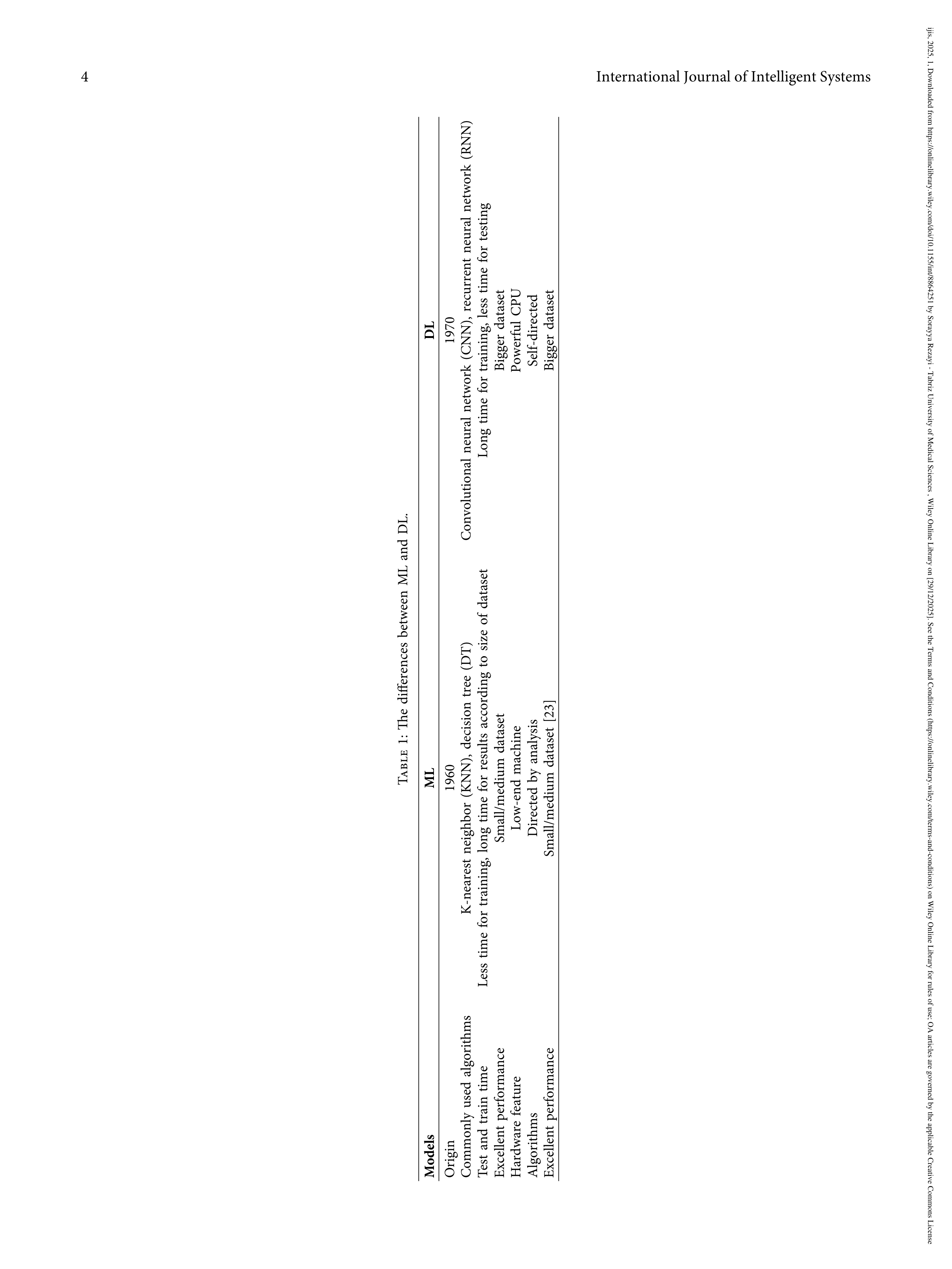
Te
diferences
between
ML
and
DL
are
presented
in
Table
1.
Although
ML
techniques
are
developing
various
methods
to
protect
cyberspace,
ML
techniques
are
still
vulnerable
to
cyber-attacks
[19].
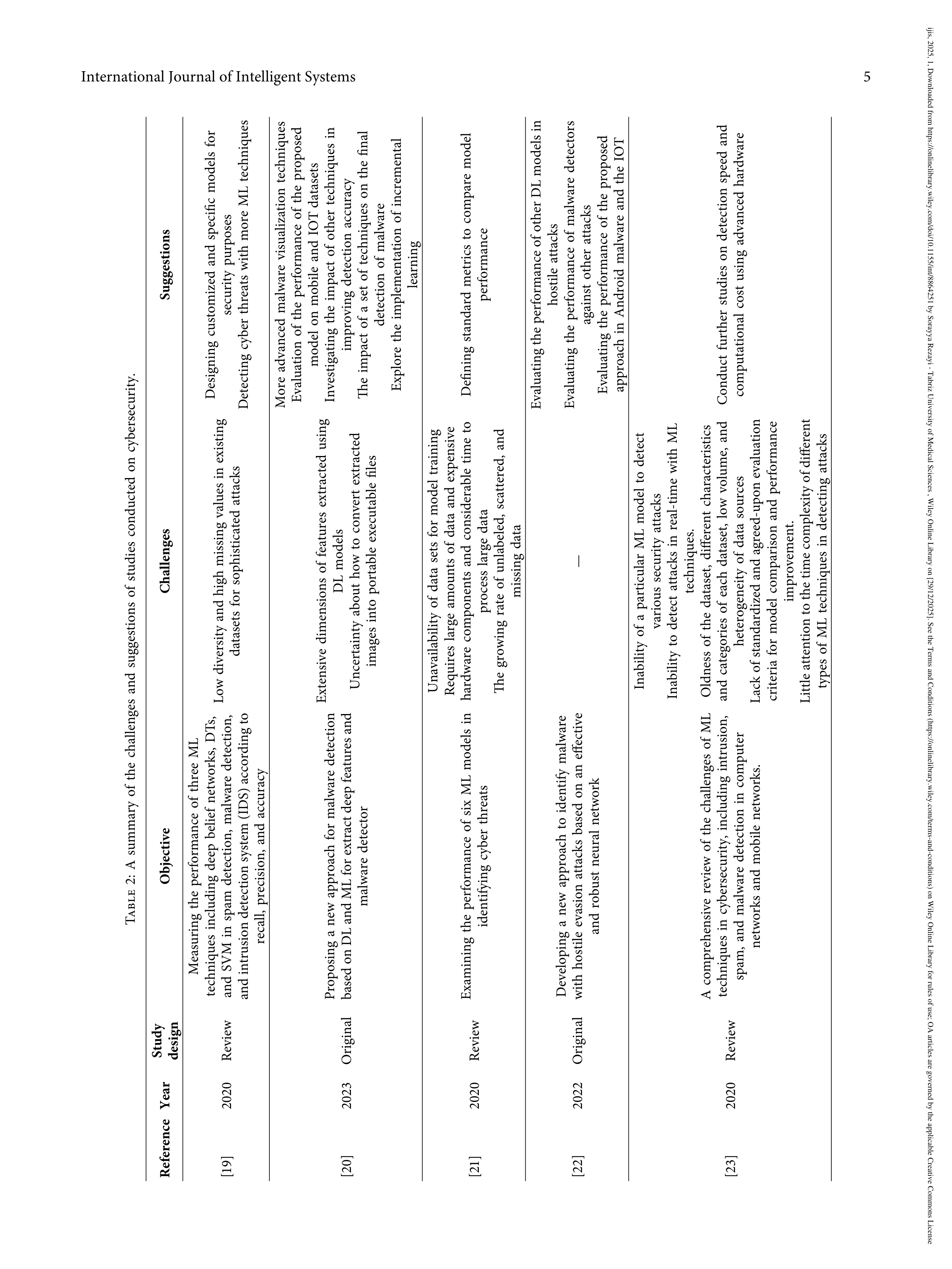
A
summary
of
the
chal-
lenges
and
recommendations
of
studies
conducted
on
cybersecurity
is
given
in
Table
2.
2.2.
Challenges
During
AI
Application
in
Business.
Today,
asking
the
public
for
information
or
conducting
surveys
to
purchase
consumer
products
by
organizations
is
un-
necessary.
Extracting
and
summarizing
public
opinion
is
done
by
automated
sentiment
analysis
systems
on
websites
[24].
Many
organizations
in
the
world
collect
public
opin-
ions about products, services, or policies, and analyzing this
data can be useful for making correct, timely decisions, and
for efcient business growth. In the study by Shaukat et al.,
Python
was
used
for
efcient
opinion
extraction
due
to
its
efcient
modules
and
extensive
support
for
NLP,
and
Py-
thon’s Matplotlib library was used to visualize the results of
opinion
extraction
[24].
In
another
study,
Shaukat
et
al.
acknowledged that to assess emotions, one must strengthen
the
knowledge
of
words
in
a
specifc
domain,
extract
the
meanings of words in multiple contexts, and interpret words
based
on
the
meanings
of
words
in
that
specifc
domain.
Tey recommended designing algorithms for examining the
scope
of
the
data
set
for
future
studies
[25].
2.3.ChallengesAfterAIApplicationinBusiness.
Te duration
of
training
and
testing
the
model
determines
time
com-
plexity,
one
of
the
metrics
for
measuring
computational
complexity
[26].
Time
complexity
is
expressed
in
terms
of
the number of operations or instructions executed. A lower
time complexity results in faster execution of instructions or
operations.
On
the
other
hand,
analyzing
the
training
and
validation time and time complexity of the model can reveal
the accuracy of the model output [27]. In a classifcation, the
parameters afecting the execution time of an algorithm are
divided
into
two
categories:
hyperparameters
and
training
parameters.
Hyperparameters
are
set
before
the
learning
process
starts
and
training
parameters
are
set
only
after
execution. Te number of trees in random forest (RF) is an
example of a hyperparameter, and the total iteration Q and
the
number
of
support
vectors
in
support
vector
machine
(SVM)
are
examples
of
training
parameters
[28].
An important part of time complexity is the number of
samples, features, trees, epochs, neurons, number of clusters,
training samples seen, neurons in the input layer, neurons in
the output layer, the number of iterations until the threshold
is
reached,
the
model
depth,
model
size,
kernel,
number
of
channels, dimensions of the original matrix, and dimensions
of the new matrix [22, 23, 26]. Determining the complexity
International Journal of Intelligent Systems
3
ijis, 2025, 1, Downloaded from https://onlinelibrary.wiley.com/doi/10.1155/int/8864251 by Sorayya Rezayi - Tabriz University of Medical Sciences , Wiley Online Library on [29/12/2025]. See the Terms and Conditions (https://onlinelibrary.wiley.com/terms-and-conditions) on Wiley Online Library for rules of use; OA articles are governed by the applicable Creative Commons License
Table
1:
Te
diferences
between
ML
and
DL.
Models
ML
DL
Origin
1960
1970
Commonly
used
algorithms
K-nearest
neighbor
(KNN),
decision
tree
(DT)
Convolutional
neural
network
(CNN),
recurrent
neural
network
(RNN)
Test
and
train
time
Less
time
for
training,
long
time
for
results
according
to
size
of
dataset
Long
time
for
training,
less
time
for
testing
Excellent
performance
Small/medium
dataset
Bigger
dataset
Hardware
feature
Low-end
machine
Powerful
CPU
Algorithms
Directed
by
analysis
Self-directed
Excellent
performance
Small/medium
dataset
[23]
Bigger
dataset
4
International Journal of Intelligent Systems
ijis, 2025, 1, Downloaded from https://onlinelibrary.wiley.com/doi/10.1155/int/8864251 by Sorayya Rezayi - Tabriz University of Medical Sciences , Wiley Online Library on [29/12/2025]. See the Terms and Conditions (https://onlinelibrary.wiley.com/terms-and-conditions) on Wiley Online Library for rules of use; OA articles are governed by the applicable Creative Commons License
Table
2:
A
summary
of
the
challenges
and
suggestions
of
studies
conducted
on
cybersecurity.
Reference
Year
Study
design
Objective
Challenges
Suggestions
[19]
2020
Review
Measuring
the
performance
of
three
ML
techniques
including
deep
belief
networks,
DTs,
and
SVM
in
spam
detection,
malware
detection,
and intrusion detection system (IDS) according to
recall,
precision,
and
accuracy
Low diversity and high missing values in existing
datasets
for
sophisticated
attacks
Designing
customized
and
specifc
models
for
security
purposes
Detecting
cyber
threats
with
more
ML
techniques
[20]
2023
Original
Proposing
a
new
approach
for
malware
detection
based on DL and ML for extract deep features and
malware
detector
Extensive
dimensions
of
features
extracted
using
DL
models
Uncertainty
about
how
to
convert
extracted
images
into
portable
executable
fles
More
advanced
malware
visualization
techniques
Evaluation
of
the
performance
of
the
proposed
model
on
mobile
and
IOT datasets
Investigating
the
impact
of
other
techniques
in
improving
detection
accuracy
Te
impact
of
a
set
of
techniques
on
the
fnal
detection
of
malware
Explore
the
implementation
of
incremental
learning
[21]
2020
Review
Examining
the
performance
of
six
ML
models
in
identifying
cyber
threats
Unavailability
of
data
sets
for
model
training
Requires
large
amounts
of
data
and
expensive
hardware
components
and
considerable
time
to
process
large
data
Te
growing
rate
of
unlabeled,
scattered,
and
missing
data
Defning
standard
metrics
to
compare
model
performance
[22]
2022
Original
Developing
a
new
approach
to
identify
malware
with
hostile
evasion
attacks
based
on
an
efective
and
robust
neural
network
—
Evaluating the performance of other DL models in
hostile
attacks
Evaluating
the
performance
of
malware
detectors
against
other
attacks
Evaluating
the
performance
of
the
proposed
approach
in
Android
malware
and
the
IOT
[23]
2020
Review
A
comprehensive
review
of
the
challenges
of
ML
techniques
in
cybersecurity,
including
intrusion,
spam,
and
malware
detection
in
computer
networks
and
mobile
networks.
Inability
of
a
particular
ML
model
to
detect
various
security
attacks
Inability
to
detect
attacks
in
real-time
with
ML
techniques.
Oldness
of
the
dataset,
diferent
characteristics
and
categories
of
each
dataset,
low
volume,
and
heterogeneity
of
data
sources
Lack of standardized and agreed-upon evaluation
criteria
for
model
comparison
and
performance
improvement.
Little attention to the time complexity of diferent
types
of
ML
techniques
in
detecting
attacks
Conduct
further
studies
on
detection
speed
and
computational
cost
using
advanced
hardware
International Journal of Intelligent Systems
5
ijis, 2025, 1, Downloaded from https://onlinelibrary.wiley.com/doi/10.1155/int/8864251 by Sorayya Rezayi - Tabriz University of Medical Sciences , Wiley Online Library on [29/12/2025]. See the Terms and Conditions (https://onlinelibrary.wiley.com/terms-and-conditions) on Wiley Online Library for rules of use; OA articles are governed by the applicable Creative Commons License
time is important to identify the impact of each meta parameter
in building a model [29]. Shah and Bhavsar conducted a study
to
fnd
the
factors
that
afect
the
model’s
performance,
in-
cluding
the
estimated
time
required
for
the
model
to
achieve
the desired task. Tey found that factors such as the size and
number of flters, the size of the cluster, the number of layers,
and
the
size
of
the
kernel
afect
the
time
taken
by
the
model
[29]. Given resource constraints, the trade-of between model
accuracy and computational efciency in the real world leads to
fast
and
efcient
inference
[30].
3. Materials and Methods
3.1.
Information
Source
and
Search
Strategy.
In
this
study,
a
search
was
carried
out
in
the
Web
of
Sciences
(WOS)
database
using
keywords
such
as
AI
and
insurance.
Te
WOS
database
was
selected
due
to
its
superior
quality,
indexing of publications in esteemed journals, and stringent
evaluation
process
for
articles.
Tis
database
is
extensively
utilized
in
scientometric
research
due
to
its
utilization
of
comprehensive citation indices to evaluate scientifc impact.
Moreover,
utilizing
various
databases
may
lead
to
the
ac-
quisition
of
redundant
or
subpar
sources.
Te
search
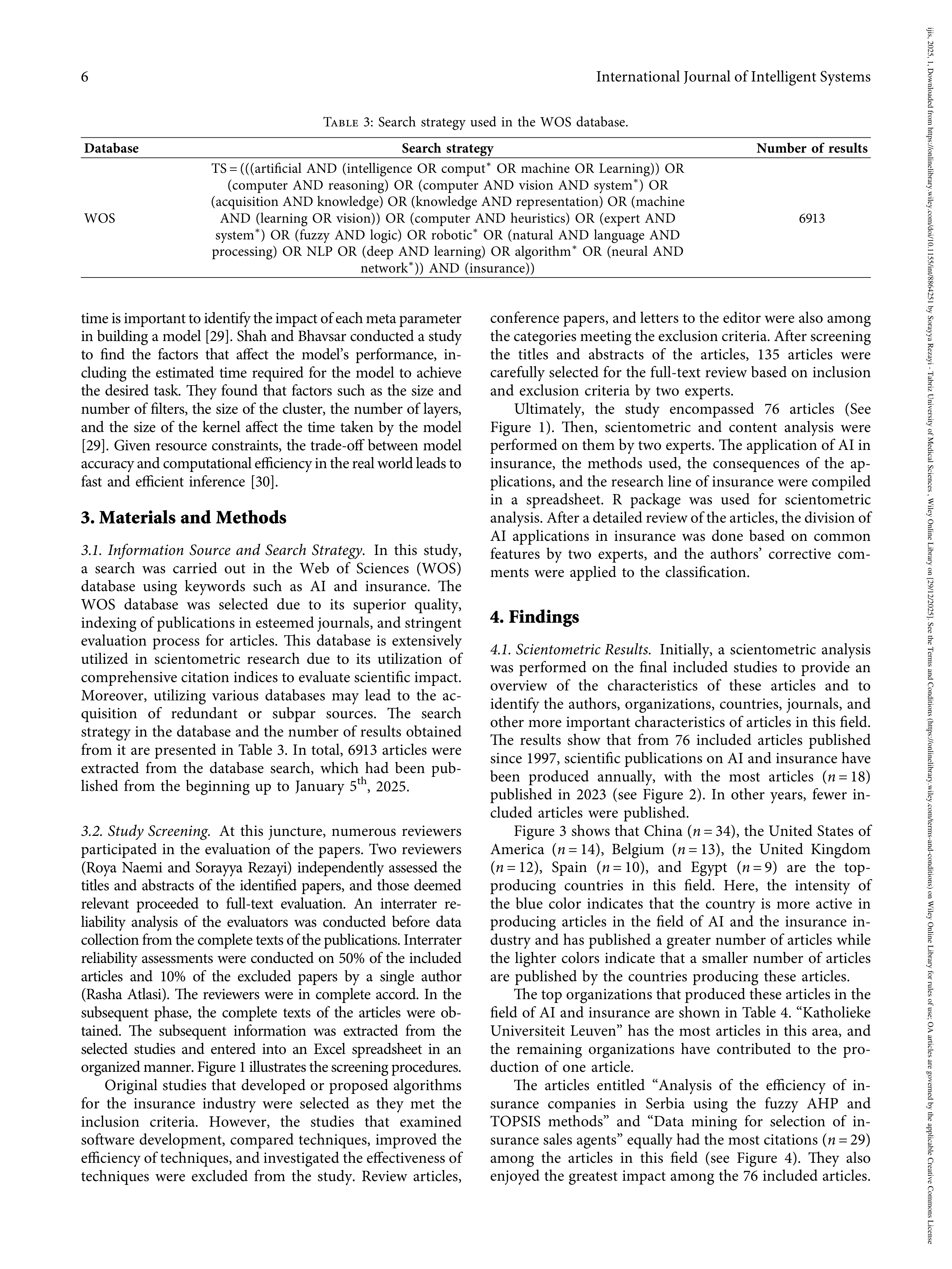
strategy in the database and the number of results obtained
from it are presented in Table 3. In total, 6913 articles were
extracted
from
the
database
search,
which
had
been
pub-
lished
from
the
beginning
up
to
January
5
th
,
2025.
3.2. Study Screening.
At
this
juncture,
numerous
reviewers
participated
in
the
evaluation
of
the
papers.
Two
reviewers
(Roya
Naemi
and
Sorayya
Rezayi)
independently
assessed
the
titles and abstracts of the identifed papers, and those deemed
relevant
proceeded
to
full-text
evaluation.
An
interrater
re-
liability
analysis
of
the
evaluators
was
conducted
before
data
collection from the complete texts of the publications. Interrater
reliability assessments were conducted on 50% of the included
articles
and
10%
of
the
excluded
papers
by
a
single
author
(Rasha Atlasi).
Te reviewers were
in
complete accord.
In
the
subsequent
phase,
the
complete
texts
of
the
articles
were
ob-
tained.
Te
subsequent
information
was
extracted
from
the
selected
studies
and
entered
into
an
Excel
spreadsheet
in
an
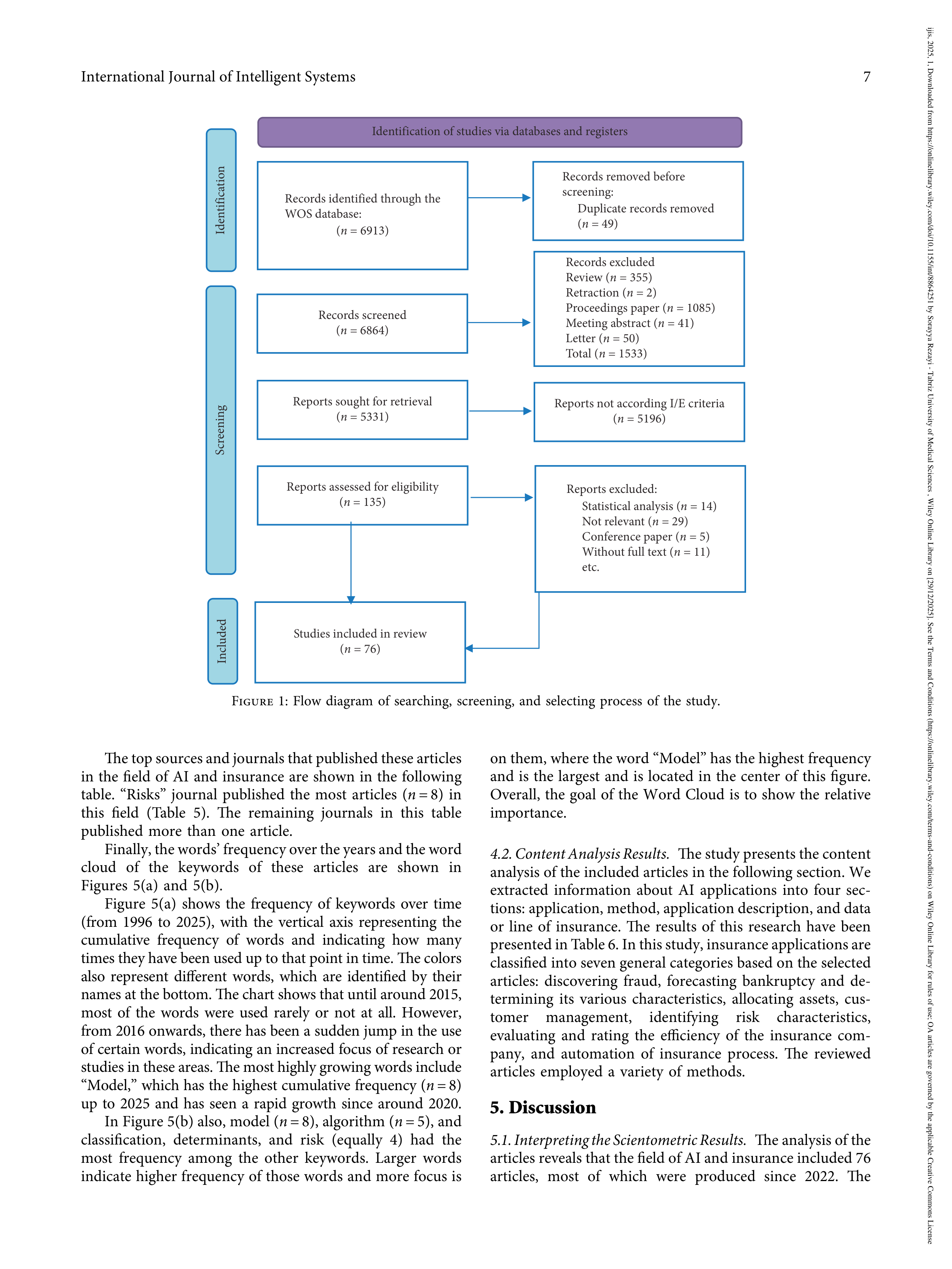
organized manner. Figure 1 illustrates the screening procedures.
Original
studies
that
developed
or
proposed algorithms
for
the
insurance
industry
were
selected
as
they
met
the
inclusion
criteria.
However,
the
studies
that
examined
software development, compared techniques, improved the
efciency of techniques, and investigated the efectiveness of
techniques
were
excluded
from
the
study.
Review
articles,
conference papers, and letters to the editor were also among
the categories meeting the exclusion criteria. After screening
the
titles
and
abstracts
of
the
articles,
135
articles
were
carefully selected for the full-text review based on inclusion
and
exclusion
criteria
by
two
experts.
Ultimately,
the
study
encompassed
76
articles
(See
Figure
1).
Ten,
scientometric
and
content
analysis
were
performed on them by two experts. Te application of AI in
insurance,
the
methods
used,
the
consequences
of
the
ap-
plications, and the research line of insurance were compiled
in
a
spreadsheet.
R
package
was
used
for
scientometric
analysis. After a detailed review of the articles, the division of
AI
applications
in
insurance
was
done
based
on
common
features
by
two
experts,
and
the
authors’
corrective
com-
ments
were
applied
to
the
classifcation.
4. Findings
4.1. Scientometric Results.
Initially,
a
scientometric
analysis
was
performed
on
the
fnal
included
studies
to
provide
an
overview
of
the
characteristics
of
these
articles
and
to
identify the
authors, organizations, countries, journals, and
other more important characteristics of articles in this feld.
Te
results
show
that
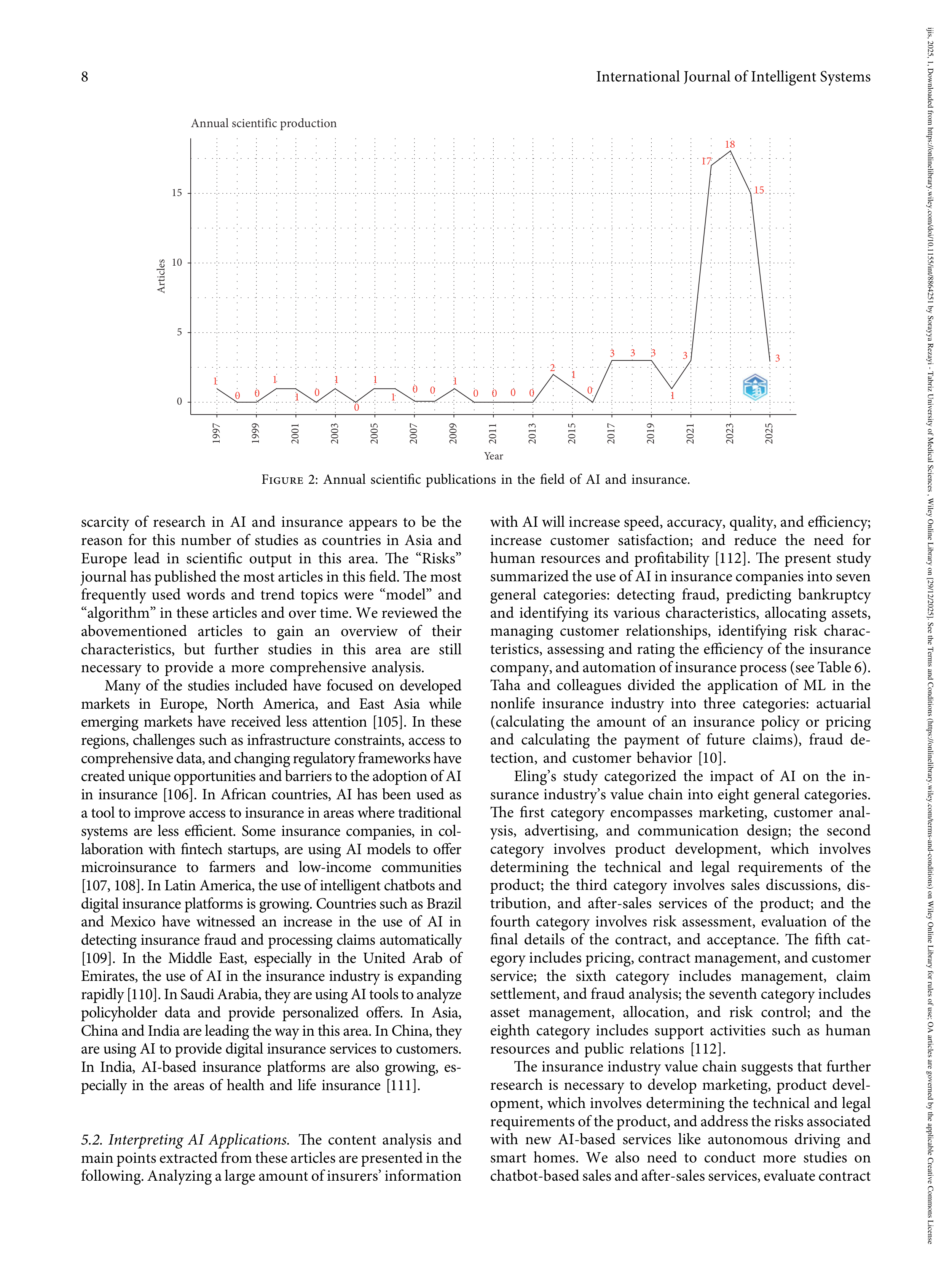
from
76
included
articles
published
since 1997, scientifc publications on AI and insurance have
been
produced
annually,
with
the
most
articles
(
n
18)
published
in
2023
(see
Figure
2).
In
other
years,
fewer
in-
cluded
articles
were
published.
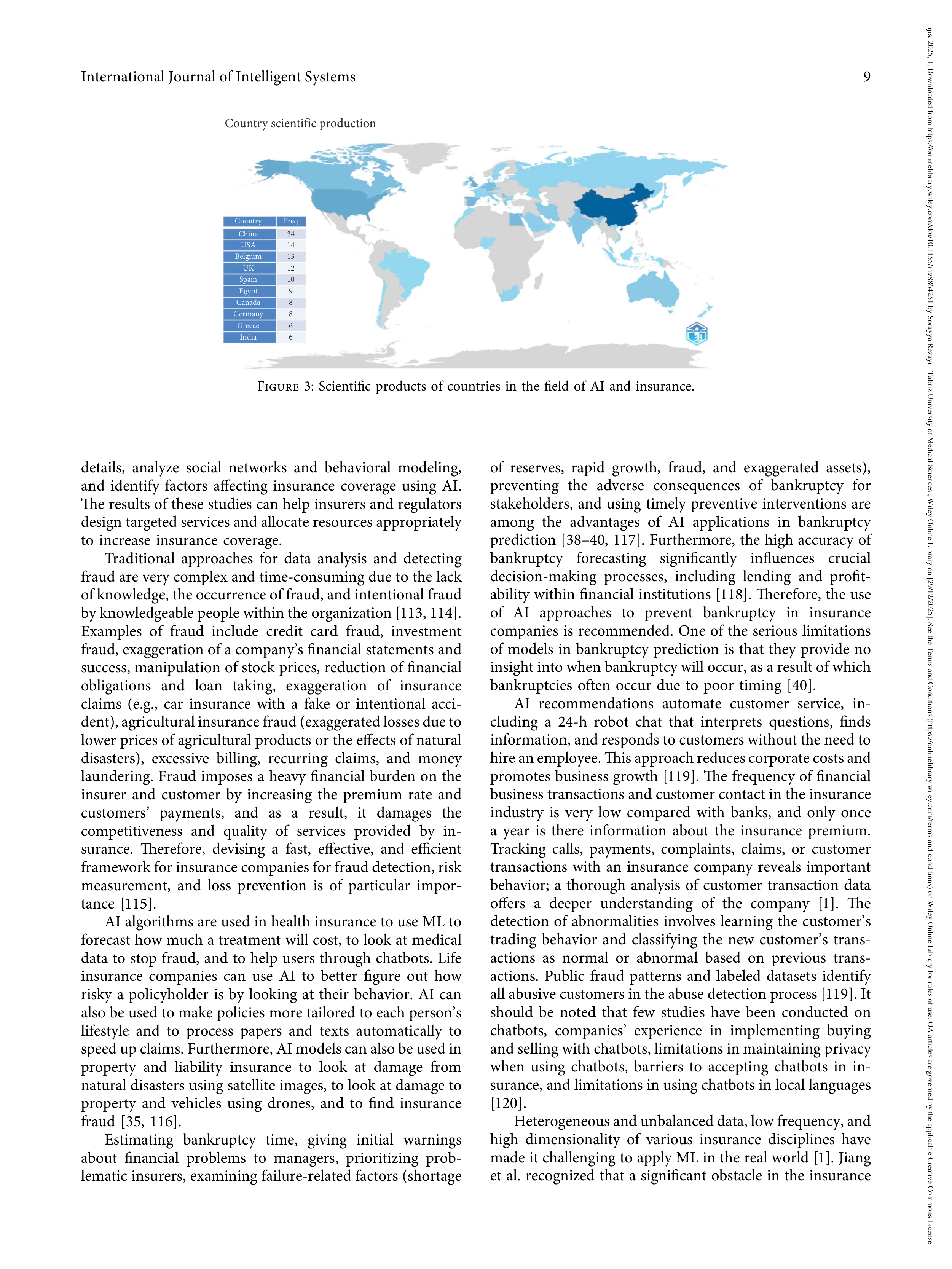
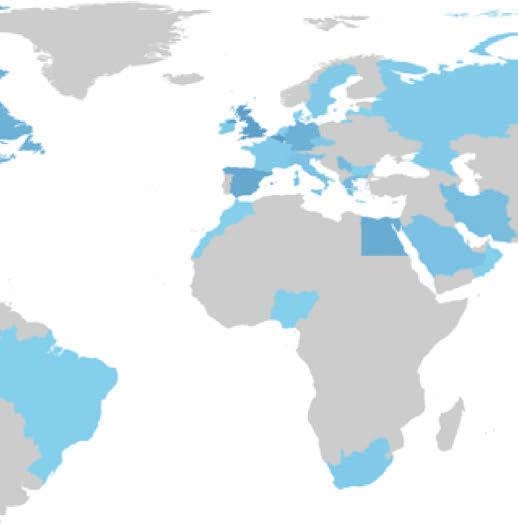
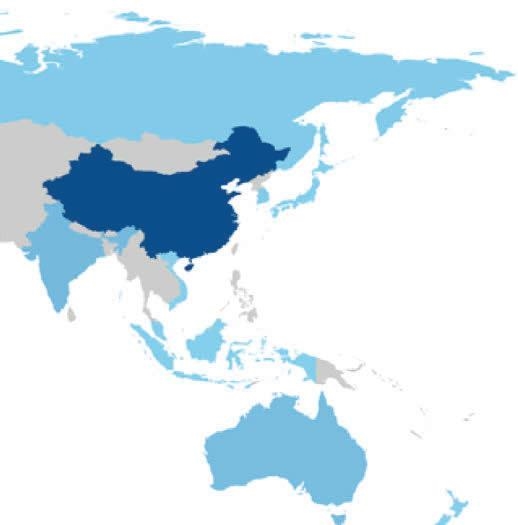
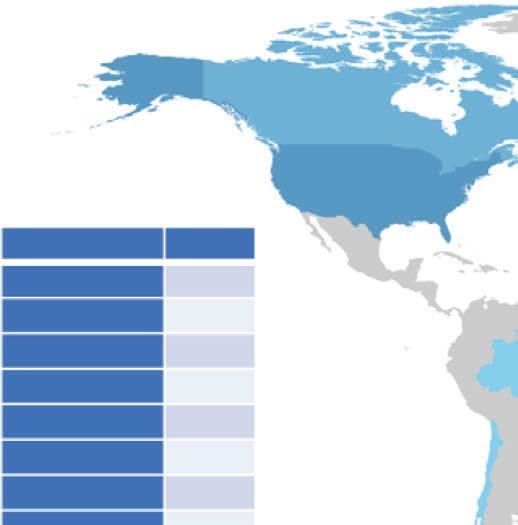
Figure 3 shows that China (
n
34), the United States of
America
(
n
14),
Belgium
(
n
13),
the
United
Kingdom
(
n
12),
Spain
(
n
10),
and
Egypt
(
n
9)
are
the
top-
producing
countries
in
this
feld.
Here,
the
intensity
of
the
blue
color
indicates
that
the
country
is
more
active
in
producing
articles
in
the
feld
of
AI
and
the
insurance
in-
dustry and has published a greater number of articles while
the
lighter
colors
indicate
that
a
smaller
number
of
articles
are
published
by
the
countries
producing
these
articles.
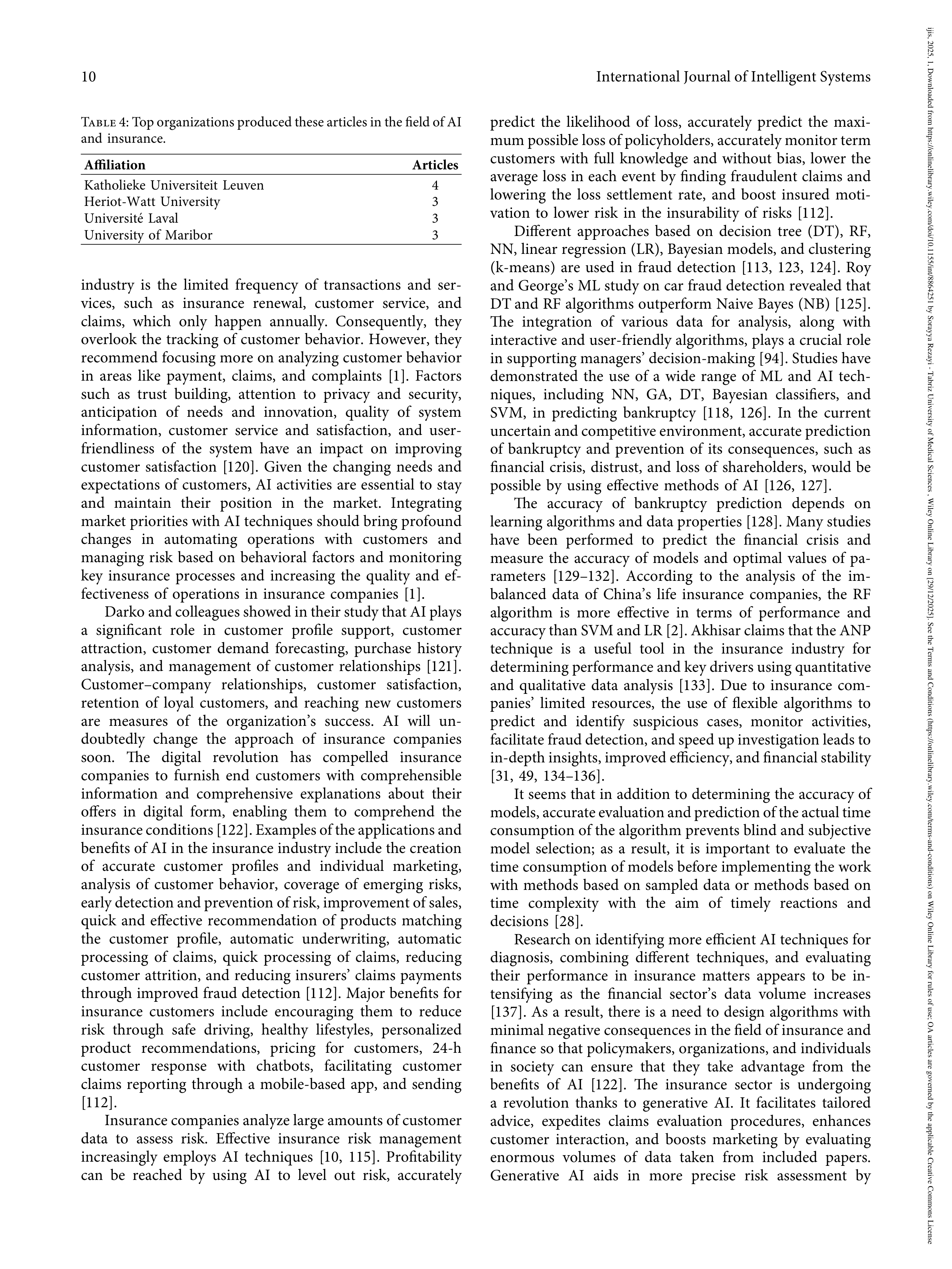
Te top organizations that produced these articles in the
feld of AI and insurance are shown in Table 4. “Katholieke
Universiteit
Leuven”
has
the
most
articles
in
this
area,
and
the
remaining
organizations
have
contributed
to
the
pro-
duction
of
one
article.
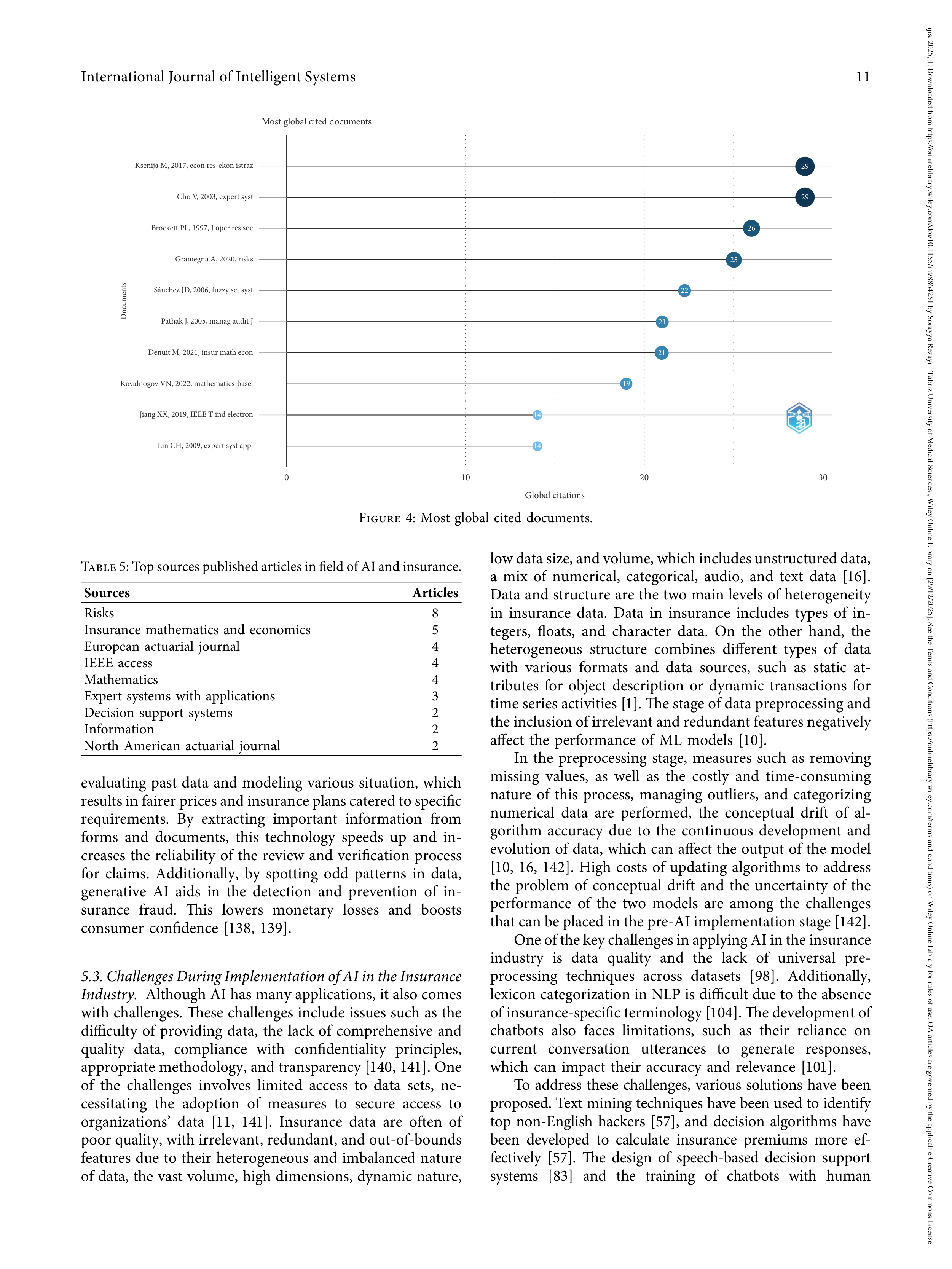
Te
articles
entitled
“Analysis
of
the
efciency
of
in-
surance
companies
in
Serbia
using
the
fuzzy
AHP
and
TOPSIS
methods”
and
“Data
mining
for
selection
of
in-
surance sales agents” equally had the most citations (
n
29)
among
the
articles
in
this
feld
(see
Figure
4).
Tey
also
enjoyed the greatest impact among the 76 included articles.
Table
3:
Search
strategy
used
in
the
WOS
database.
Database
Search
strategy
Number
of
results
WOS
TS
(((artifcial
AND
(intelligence
OR
comput
∗
OR
machine
OR
Learning))
OR
(computer
AND
reasoning)
OR
(computer
AND
vision
AND
system
∗
)
OR
(acquisition AND knowledge) OR (knowledge AND representation) OR (machine
AND
(learning
OR
vision))
OR
(computer
AND
heuristics)
OR
(expert
AND
system
∗
)
OR
(fuzzy
AND
logic)
OR
robotic
∗
OR
(natural
AND
language
AND
processing)
OR
NLP
OR
(deep
AND
learning)
OR
algorithm
∗
OR
(neural
AND
network
∗
))
AND
(insurance))
6913
6
International Journal of Intelligent Systems
ijis, 2025, 1, Downloaded from https://onlinelibrary.wiley.com/doi/10.1155/int/8864251 by Sorayya Rezayi - Tabriz University of Medical Sciences , Wiley Online Library on [29/12/2025]. See the Terms and Conditions (https://onlinelibrary.wiley.com/terms-and-conditions) on Wiley Online Library for rules of use; OA articles are governed by the applicable Creative Commons License
Te top sources and journals that published these articles
in the feld
of AI and insurance are shown in
the following
table.
“Risks”
journal
published
the
most
articles
(
n
8)
in
this
feld
(Table
5).
Te
remaining
journals
in
this
table
published
more
than
one
article.
Finally, the words’ frequency over the years and the word
cloud
of
the
keywords
of
these
articles
are
shown
in
Figures
5(a)
and
5(b).
Figure
5(a)
shows
the
frequency
of
keywords
over
time
(from
1996
to
2025),
with
the
vertical
axis
representing
the
cumulative
frequency
of
words
and
indicating
how
many
times they have been used up to that point in time. Te colors
also
represent
diferent
words,
which
are
identifed
by
their
names at the bottom. Te chart shows that until around 2015,
most
of
the
words
were
used
rarely
or
not
at
all.
However,
from 2016 onwards, there has been a sudden jump in the use
of certain words, indicating an increased focus of research or
studies in these areas. Te most highly growing words include
“Model,” which has the highest cumulative frequency (
n
8)
up
to
2025
and
has
seen
a
rapid
growth
since
around
2020.
In Figure 5(b) also, model (
n
8), algorithm (
n
5), and
classifcation,
determinants,
and
risk
(equally
4)
had
the
most
frequency
among
the
other
keywords.
Larger
words
indicate higher frequency of those words and more focus is
on them, where the word “Model” has the highest frequency
and
is
the
largest
and
is located
in
the
center of
this
fgure.
Overall, the
goal of the
Word
Cloud
is to
show the
relative
importance.
4.2. Content Analysis Results.
Te study presents the content
analysis of the included articles in the following section. We
extracted
information
about
AI
applications
into
four
sec-
tions: application, method, application description, and data
or
line
of
insurance.
Te
results
of
this
research
have
been
presented in Table 6. In this study, insurance applications are
classifed into seven general categories based on the selected
articles:
discovering
fraud,
forecasting
bankruptcy
and
de-
termining
its
various
characteristics,
allocating
assets,
cus-
tomer
management,
identifying
risk
characteristics,
evaluating
and
rating
the
efciency
of
the
insurance
com-
pany,
and
automation
of
insurance
process.
Te
reviewed
articles
employed
a
variety
of
methods.
5. Discussion
5.1. Interpretingthe Scientometric Results.
Te analysis of the
articles reveals that the feld of AI and insurance included 76
articles,
most
of
which
were
produced
since
2022.
Te
Records identified through the
WOS database:
(
n
= 6913)
Identification of studies via databases and registers
Identification
Screening
Included
Records screened
(
n
= 6864)
Reports sought for retrieval
(
n
= 5331)
Reports assessed for eligibility
(
n
= 135)
Studies included in review
(
n
= 76)
Records removed before
screening:
Duplicate records removed
(
n
= 49)
Records excluded
Review (
n
= 355)
Retraction (
n
= 2)
Proceedings paper (
n
= 1085)
Meeting abstract (
n
= 41)
Letter (
n
= 50)
Total (
n
= 1533)
Reports not according I/E criteria
(
n
= 5196)
Reports excluded:
Statistical analysis (
n
= 14)
Not relevant (
n
= 29)
Conference paper (
n
= 5)
Without full text (
n
= 11)
etc.
Figure
1:
Flow
diagram
of
searching,
screening,
and
selecting
process
of
the
study.
International Journal of Intelligent Systems
7
ijis, 2025, 1, Downloaded from https://onlinelibrary.wiley.com/doi/10.1155/int/8864251 by Sorayya Rezayi - Tabriz University of Medical Sciences , Wiley Online Library on [29/12/2025]. See the Terms and Conditions (https://onlinelibrary.wiley.com/terms-and-conditions) on Wiley Online Library for rules of use; OA articles are governed by the applicable Creative Commons License

scarcity
of
research
in
AI
and
insurance
appears
to
be
the
reason
for
this
number
of
studies
as
countries
in
Asia
and
Europe
lead
in
scientifc
output
in
this
area.
Te
“Risks”
journal has published the most articles in this feld. Te most
frequently
used
words
and
trend
topics
were
“model”
and
“algorithm” in these articles and over time. We reviewed the
abovementioned
articles
to
gain
an
overview
of
their
characteristics,
but
further
studies
in
this
area
are
still
necessary
to
provide
a
more
comprehensive
analysis.
Many
of
the
studies
included
have
focused
on
developed
markets
in
Europe,
North
America,
and
East
Asia
while
emerging
markets
have
received
less
attention
[105].
In
these
regions, challenges such as infrastructure constraints, access to
comprehensive data, and changing regulatory frameworks have
created unique opportunities and barriers to the adoption of AI
in
insurance [106].
In
African
countries,
AI
has been
used
as
a tool to improve access to insurance in areas where traditional
systems
are
less
efcient.
Some
insurance
companies,
in
col-
laboration
with
fntech
startups,
are
using
AI
models
to
ofer
microinsurance
to
farmers
and
low-income
communities
[107, 108]. In Latin America, the use of intelligent chatbots and
digital insurance platforms is growing. Countries such as Brazil
and
Mexico
have
witnessed
an
increase
in
the
use
of
AI
in
detecting insurance fraud and processing claims automatically
[109].
In
the
Middle
East,
especially
in
the
United
Arab
of
Emirates, the use of AI in the insurance industry is expanding
rapidly [110]. In Saudi Arabia, they are using AI tools to analyze
policyholder
data
and
provide
personalized
ofers.
In
Asia,
China and India are leading the way in this area. In China, they
are using AI to provide digital insurance services to customers.
In
India,
AI-based
insurance
platforms
are
also
growing,
es-
pecially
in
the
areas
of
health
and
life
insurance
[111].
5.2.
Interpreting
AI
Applications.
Te
content
analysis
and
main points extracted from these articles are presented in the
following. Analyzing a large amount of insurers’ information
with AI will increase speed, accuracy, quality, and efciency;
increase
customer
satisfaction;
and
reduce
the
need
for
human
resources
and
proftability
[112].
Te
present
study
summarized the use of AI in insurance companies into seven
general
categories:
detecting
fraud,
predicting
bankruptcy
and
identifying
its
various
characteristics,
allocating
assets,
managing
customer
relationships,
identifying
risk
charac-
teristics, assessing and rating the efciency of the insurance
company, and automation of insurance process (see Table 6).
Taha
and
colleagues
divided
the
application
of
ML
in
the
nonlife
insurance
industry
into
three
categories:
actuarial
(calculating
the
amount
of
an
insurance
policy
or
pricing
and
calculating
the
payment
of
future
claims),
fraud
de-
tection,
and
customer
behavior
[10].
Eling’s
study
categorized
the
impact
of
AI
on
the
in-
surance industry’s value chain into eight general categories.
Te
frst
category
encompasses
marketing,
customer
anal-
ysis,
advertising,
and
communication
design;
the
second
category
involves
product
development,
which
involves
determining
the
technical
and
legal
requirements
of
the
product;
the
third
category
involves
sales
discussions,
dis-
tribution,
and
after-sales
services
of
the
product;
and
the
fourth
category
involves
risk
assessment,
evaluation
of
the
fnal
details
of
the
contract,
and
acceptance.
Te
ffth
cat-
egory includes pricing, contract management, and customer
service;
the
sixth
category
includes
management,
claim
settlement, and fraud analysis; the seventh category includes
asset
management,
allocation,
and
risk
control;
and
the
eighth
category
includes
support
activities
such
as
human
resources
and
public
relations
[112].
Te insurance industry value chain suggests that further
research
is
necessary
to
develop
marketing,
product
devel-
opment, which involves determining the technical and legal
requirements of the product, and address the risks associated
with
new
AI-based
services
like
autonomous
driving
and
smart
homes.
We
also
need
to
conduct
more
studies
on
chatbot-based sales and after-sales services, evaluate contract
Annual scientific production
1
0
0
1
1
0
0
1
1
1
1
0
0
0
0
0
0
2
1
0
3
3
3
3
1
3
17
18
15
0
5
10
15
Articles
1999
2001
2003
2005
2007
2009
2011
2013
2015
2017
2019
2021
2023
2025
1997
Year
Figure
2:
Annual
scientifc
publications
in
the
feld
of
AI
and
insurance.
8
International Journal of Intelligent Systems
ijis, 2025, 1, Downloaded from https://onlinelibrary.wiley.com/doi/10.1155/int/8864251 by Sorayya Rezayi - Tabriz University of Medical Sciences , Wiley Online Library on [29/12/2025]. See the Terms and Conditions (https://onlinelibrary.wiley.com/terms-and-conditions) on Wiley Online Library for rules of use; OA articles are governed by the applicable Creative Commons License

details,
analyze
social
networks
and
behavioral
modeling,
and
identify
factors
afecting
insurance
coverage
using
AI.
Te results of these studies can help insurers and regulators
design targeted services and allocate resources appropriately
to
increase
insurance
coverage.
Traditional
approaches
for
data
analysis
and
detecting
fraud are very complex and time-consuming due to the lack
of knowledge, the occurrence of fraud, and intentional fraud
by knowledgeable people within the organization [113, 114].
Examples
of
fraud
include
credit
card
fraud,
investment
fraud, exaggeration of a company’s fnancial statements and
success, manipulation of stock prices, reduction of fnancial
obligations
and
loan
taking,
exaggeration
of
insurance
claims
(e.g.,
car
insurance
with
a
fake
or
intentional
acci-
dent), agricultural insurance fraud (exaggerated losses due to
lower prices of agricultural products or the efects of natural
disasters),
excessive
billing,
recurring
claims,
and
money
laundering. Fraud imposes a
heavy fnancial burden on the
insurer
and
customer
by
increasing
the
premium
rate
and
customers’
payments,
and
as
a
result,
it
damages
the
competitiveness
and
quality
of
services
provided
by
in-
surance.
Terefore,
devising
a
fast,
efective,
and
efcient
framework for insurance companies for fraud detection, risk
measurement,
and
loss
prevention
is
of
particular
impor-
tance
[115].
AI algorithms are used in health insurance to use ML to
forecast how much a treatment will cost, to look at medical
data to stop fraud, and to help users through chatbots. Life
insurance
companies
can
use
AI
to
better
fgure
out
how
risky
a
policyholder
is
by
looking
at
their
behavior.
AI
can
also be used to make policies more tailored to each person’s
lifestyle
and
to
process
papers
and
texts
automatically
to
speed up claims. Furthermore, AI models can also be used in
property
and
liability
insurance
to
look
at
damage
from
natural disasters using satellite images, to look at damage to
property
and
vehicles
using
drones,
and
to
fnd
insurance
fraud
[35,
116].
Estimating
bankruptcy
time,
giving
initial
warnings
about
fnancial
problems
to
managers,
prioritizing
prob-
lematic insurers, examining failure-related factors (shortage
of
reserves,
rapid
growth,
fraud,
and
exaggerated
assets),
preventing
the
adverse
consequences
of
bankruptcy
for
stakeholders,
and
using
timely
preventive
interventions
are
among
the
advantages
of
AI
applications
in
bankruptcy
prediction
[38–40, 117].
Furthermore, the
high accuracy
of
bankruptcy
forecasting
signifcantly
infuences
crucial
decision-making
processes,
including
lending
and
proft-
ability within fnancial institutions [118]. Terefore, the use
of
AI
approaches
to
prevent
bankruptcy
in
insurance
companies
is
recommended.
One
of
the
serious
limitations
of
models
in
bankruptcy
prediction
is
that
they
provide
no
insight into when bankruptcy will occur, as a result of which
bankruptcies
often
occur
due
to
poor
timing
[40].
AI
recommendations
automate
customer
service,
in-
cluding
a
24-h
robot
chat
that
interprets
questions,
fnds
information, and responds to customers without the need to
hire an employee. Tis approach reduces corporate costs and
promotes business growth [119]. Te frequency of fnancial
business transactions and customer contact in the insurance
industry
is
very
low
compared
with
banks,
and
only
once
a
year
is
there
information
about
the
insurance
premium.
Tracking
calls,
payments,
complaints,
claims,
or
customer
transactions
with
an
insurance
company
reveals
important
behavior;
a
thorough
analysis
of
customer
transaction
data
ofers
a
deeper
understanding
of
the
company
[1].
Te
detection
of
abnormalities
involves
learning
the
customer’s
trading
behavior
and
classifying
the
new
customer’s
trans-
actions
as
normal
or
abnormal
based
on
previous
trans-
actions.
Public
fraud
patterns
and
labeled
datasets
identify
all abusive customers in the abuse detection process [119]. It
should
be
noted
that
few
studies
have
been
conducted
on
chatbots,
companies’
experience
in
implementing
buying
and selling with chatbots, limitations in maintaining privacy
when
using
chatbots,
barriers
to
accepting
chatbots
in
in-
surance, and limitations in using chatbots in local languages
[120].
Heterogeneous and unbalanced data, low frequency, and
high
dimensionality
of
various
insurance
disciplines
have
made it challenging to apply ML in the real world [1]. Jiang
et al. recognized that a signifcant obstacle in the insurance
Country scientific production
Country
China
USA
Belgium
UK
Spain
Egypt
Canada
Germany
Greece
India
Freq
34
14
13
12
10
9
8
8
6
6
Figure
3:
Scientifc
products
of
countries
in
the
feld
of
AI
and
insurance.
International Journal of Intelligent Systems
9
ijis, 2025, 1, Downloaded from https://onlinelibrary.wiley.com/doi/10.1155/int/8864251 by Sorayya Rezayi - Tabriz University of Medical Sciences , Wiley Online Library on [29/12/2025]. See the Terms and Conditions (https://onlinelibrary.wiley.com/terms-and-conditions) on Wiley Online Library for rules of use; OA articles are governed by the applicable Creative Commons License
industry
is
the
limited
frequency
of
transactions
and
ser-
vices,
such
as
insurance
renewal,
customer
service,
and
claims,
which
only
happen
annually.
Consequently,
they
overlook the tracking of customer
behavior. However, they
recommend focusing more on analyzing customer behavior
in
areas
like
payment,
claims,
and
complaints
[1].
Factors
such
as
trust
building,
attention
to
privacy
and
security,
anticipation
of
needs
and
innovation,
quality
of
system
information,
customer
service
and
satisfaction,
and
user-
friendliness
of
the
system
have
an
impact
on
improving
customer
satisfaction
[120].
Given
the
changing
needs
and
expectations of customers, AI activities are essential to stay
and
maintain
their
position
in
the
market.
Integrating
market priorities with AI techniques should bring profound
changes
in
automating
operations
with
customers
and
managing
risk
based
on
behavioral
factors
and
monitoring
key
insurance
processes
and
increasing
the
quality
and
ef-
fectiveness
of
operations
in
insurance
companies
[1].
Darko and colleagues showed in their study that AI plays
a
signifcant
role
in
customer
profle
support,
customer
attraction,
customer
demand
forecasting,
purchase
history
analysis,
and
management
of
customer
relationships
[121].
Customer–company
relationships,
customer
satisfaction,
retention
of
loyal
customers,
and
reaching
new
customers
are
measures
of
the
organization’s
success.
AI
will
un-
doubtedly
change
the
approach
of
insurance
companies
soon.
Te
digital
revolution
has
compelled
insurance
companies
to
furnish
end
customers
with
comprehensible
information
and
comprehensive
explanations
about
their
ofers
in
digital
form,
enabling
them
to
comprehend
the
insurance conditions [122]. Examples of the applications and
benefts of AI in the insurance industry include the creation
of
accurate
customer
profles
and
individual
marketing,
analysis
of
customer
behavior,
coverage
of
emerging
risks,
early detection and prevention of risk, improvement of sales,
quick
and
efective
recommendation
of
products
matching
the
customer
profle,
automatic
underwriting,
automatic
processing
of
claims,
quick
processing
of
claims,
reducing
customer
attrition,
and
reducing insurers’
claims payments
through improved fraud detection [112]. Major benefts for
insurance
customers
include
encouraging
them
to
reduce
risk
through
safe
driving,
healthy
lifestyles,
personalized
product
recommendations,
pricing
for
customers,
24-h
customer
response
with
chatbots,
facilitating
customer
claims
reporting
through
a
mobile-based
app,
and
sending
[112].
Insurance companies analyze large amounts of customer
data
to
assess
risk.
Efective
insurance
risk
management
increasingly
employs
AI
techniques
[10,
115].
Proftability
can
be
reached
by
using
AI
to
level
out
risk,
accurately
predict
the
likelihood
of
loss,
accurately
predict
the
maxi-
mum possible loss of policyholders, accurately monitor term
customers
with
full
knowledge
and
without
bias,
lower
the
average loss in each event by fnding fraudulent claims and
lowering
the
loss
settlement
rate,
and
boost
insured
moti-
vation
to
lower
risk
in
the
insurability
of
risks
[112].
Diferent
approaches
based
on
decision
tree
(DT),
RF,
NN, linear regression (LR), Bayesian models, and clustering
(k-means)
are
used
in
fraud
detection
[113,
123,
124].
Roy
and George’s ML study on car fraud detection revealed that
DT and RF algorithms outperform Naive Bayes (NB) [125].
Te
integration
of
various
data
for
analysis,
along
with
interactive and user-friendly algorithms, plays a crucial role
in supporting managers’ decision-making [94]. Studies have
demonstrated
the
use
of
a
wide
range
of
ML
and
AI
tech-
niques,
including
NN,
GA,
DT,
Bayesian
classifers,
and
SVM,
in
predicting
bankruptcy
[118,
126].
In
the
current
uncertain and competitive environment, accurate prediction
of
bankruptcy
and
prevention
of
its
consequences,
such
as
fnancial
crisis,
distrust,
and
loss
of
shareholders,
would
be
possible
by
using
efective
methods
of
AI
[126,
127].
Te
accuracy
of
bankruptcy
prediction
depends
on
learning algorithms and data properties [128]. Many studies
have
been
performed
to
predict
the
fnancial
crisis
and
measure
the
accuracy
of
models
and
optimal
values
of
pa-
rameters
[129–132].
According
to
the
analysis
of
the
im-
balanced
data
of
China’s
life
insurance
companies,
the
RF
algorithm
is
more
efective
in
terms
of
performance
and
accuracy than SVM and LR [2]. Akhisar claims that the ANP
technique
is
a
useful
tool
in
the
insurance
industry
for
determining performance and key drivers using quantitative
and
qualitative
data
analysis
[133].
Due
to
insurance
com-
panies’
limited
resources,
the
use
of
fexible
algorithms
to
predict
and
identify
suspicious
cases,
monitor
activities,
facilitate fraud detection, and speed up investigation leads to
in-depth insights, improved efciency, and fnancial stability
[31,
49,
134–136].
It seems that in addition to determining the accuracy of
models, accurate evaluation and prediction of the actual time
consumption of the algorithm prevents blind and subjective
model
selection;
as
a
result,
it
is
important
to
evaluate
the
time consumption of models before implementing the work
with
methods
based
on
sampled
data
or
methods
based
on
time
complexity
with
the
aim
of
timely
reactions
and
decisions
[28].
Research on identifying more efcient AI techniques for
diagnosis,
combining
diferent
techniques,
and
evaluating
their
performance
in
insurance
matters
appears
to
be
in-
tensifying
as
the
fnancial
sector’s
data
volume
increases
[137]. As a result, there is a need to design algorithms with
minimal negative consequences in the feld of insurance and
fnance so that policymakers, organizations, and individuals
in
society
can
ensure
that
they
take
advantage
from
the
benefts
of
AI
[122].
Te
insurance
sector
is
undergoing
a
revolution
thanks
to
generative
AI.
It
facilitates
tailored
advice,
expedites
claims
evaluation
procedures,
enhances
customer
interaction,
and
boosts
marketing
by
evaluating
enormous
volumes
of
data
taken
from
included
papers.
Generative
AI
aids
in
more
precise
risk
assessment
by
Table
4: Top organizations produced these articles in the feld of AI
and
insurance.
Afliation
Articles
Katholieke
Universiteit
Leuven
4
Heriot-Watt
University
3
Universit´e
Laval
3
University
of
Maribor
3
10
International Journal of Intelligent Systems
ijis, 2025, 1, Downloaded from https://onlinelibrary.wiley.com/doi/10.1155/int/8864251 by Sorayya Rezayi - Tabriz University of Medical Sciences , Wiley Online Library on [29/12/2025]. See the Terms and Conditions (https://onlinelibrary.wiley.com/terms-and-conditions) on Wiley Online Library for rules of use; OA articles are governed by the applicable Creative Commons License

evaluating
past
data
and
modeling
various
situation,
which
results in fairer prices and insurance plans catered to specifc
requirements.
By
extracting
important
information
from
forms
and
documents,
this
technology
speeds
up
and
in-
creases
the
reliability
of
the
review
and
verifcation
process
for
claims.
Additionally,
by
spotting
odd
patterns
in
data,
generative
AI
aids
in
the
detection
and
prevention
of
in-
surance
fraud.
Tis
lowers
monetary
losses
and
boosts
consumer
confdence
[138,
139].
5.3. Challenges During Implementation of AI in the Insurance
Industry.
Although AI has many applications, it also comes
with challenges. Tese challenges include issues such as the
difculty
of
providing
data,
the
lack
of
comprehensive
and
quality
data,
compliance
with
confdentiality
principles,
appropriate methodology, and transparency [140, 141]. One
of
the
challenges
involves
limited
access
to
data
sets,
ne-
cessitating
the
adoption
of
measures
to
secure
access
to
organizations’
data
[11,
141].
Insurance
data
are
often
of
poor quality, with irrelevant, redundant, and out-of-bounds
features
due
to
their
heterogeneous
and
imbalanced
nature
of data, the vast volume, high dimensions, dynamic nature,
low data size, and volume, which includes unstructured data,
a
mix
of
numerical,
categorical,
audio,
and
text
data
[16].
Data and structure are the two main levels of heterogeneity
in
insurance
data.
Data
in
insurance
includes
types
of
in-
tegers,
foats,
and
character
data.
On
the
other
hand,
the
heterogeneous
structure
combines
diferent
types
of
data
with
various
formats
and
data
sources,
such
as
static
at-
tributes
for
object
description
or
dynamic
transactions
for
time series activities [1]. Te stage of data preprocessing and
the inclusion of irrelevant and redundant features negatively
afect
the
performance
of
ML
models
[10].
In
the
preprocessing
stage,
measures
such
as
removing
missing
values,
as
well
as
the
costly
and
time-consuming
nature
of
this
process,
managing
outliers,
and
categorizing
numerical
data
are
performed,
the
conceptual
drift
of
al-
gorithm
accuracy
due
to
the
continuous
development
and
evolution of data, which can afect the output of the model
[10,
16,
142].
High
costs
of
updating
algorithms
to
address
the
problem
of
conceptual
drift
and
the
uncertainty
of
the
performance
of
the
two
models
are
among
the
challenges
that can be placed in the pre-AI implementation stage [142].
One of the key challenges in applying AI in the insurance
industry
is
data
quality
and
the
lack
of
universal
pre-
processing
techniques
across
datasets
[98].
Additionally,
lexicon categorization in NLP is difcult due to the absence
of insurance-specifc terminology [104]. Te development of
chatbots
also
faces
limitations,
such
as
their
reliance
on
current
conversation
utterances
to
generate
responses,
which
can
impact
their
accuracy
and
relevance
[101].
To
address
these
challenges,
various
solutions
have
been
proposed. Text mining techniques have been used to identify
top
non-English
hackers
[57],
and
decision
algorithms
have
been
developed
to
calculate
insurance
premiums
more
ef-
fectively
[57].
Te
design
of
speech-based
decision
support
systems
[83]
and
the
training
of
chatbots
with
human
Table
5: Top sources published articles in feld of AI and insurance.
Sources
Articles
Risks
8
Insurance
mathematics
and
economics
5
European
actuarial
journal
4
IEEE
access
4
Mathematics
4
Expert
systems
with
applications
3
Decision
support
systems
2
Information
2
North
American
actuarial
journal
2
Most global cited documents
Ksenija M, 2017, econ res-ekon istraz
Cho V, 2003, expert syst
Brockett PL, 1997, J oper res soc
Gramegna A, 2020, risks
Documents
Sánchez JD, 2006, fuzzy set syst
Pathak J, 2005, manag audit J
Denuit M, 2021, insur math econ
Kovalnogov VN, 2022, mathematics-basel
Jiang XX, 2019, IEEE T ind electron
Lin CH, 2009, expert syst appl
0
10
20
30
Global citations
29
29
26
25
22
21
21
19
14
14
Figure
4:
Most
global
cited
documents.
International Journal of Intelligent Systems
11
ijis, 2025, 1, Downloaded from https://onlinelibrary.wiley.com/doi/10.1155/int/8864251 by Sorayya Rezayi - Tabriz University of Medical Sciences , Wiley Online Library on [29/12/2025]. See the Terms and Conditions (https://onlinelibrary.wiley.com/terms-and-conditions) on Wiley Online Library for rules of use; OA articles are governed by the applicable Creative Commons License
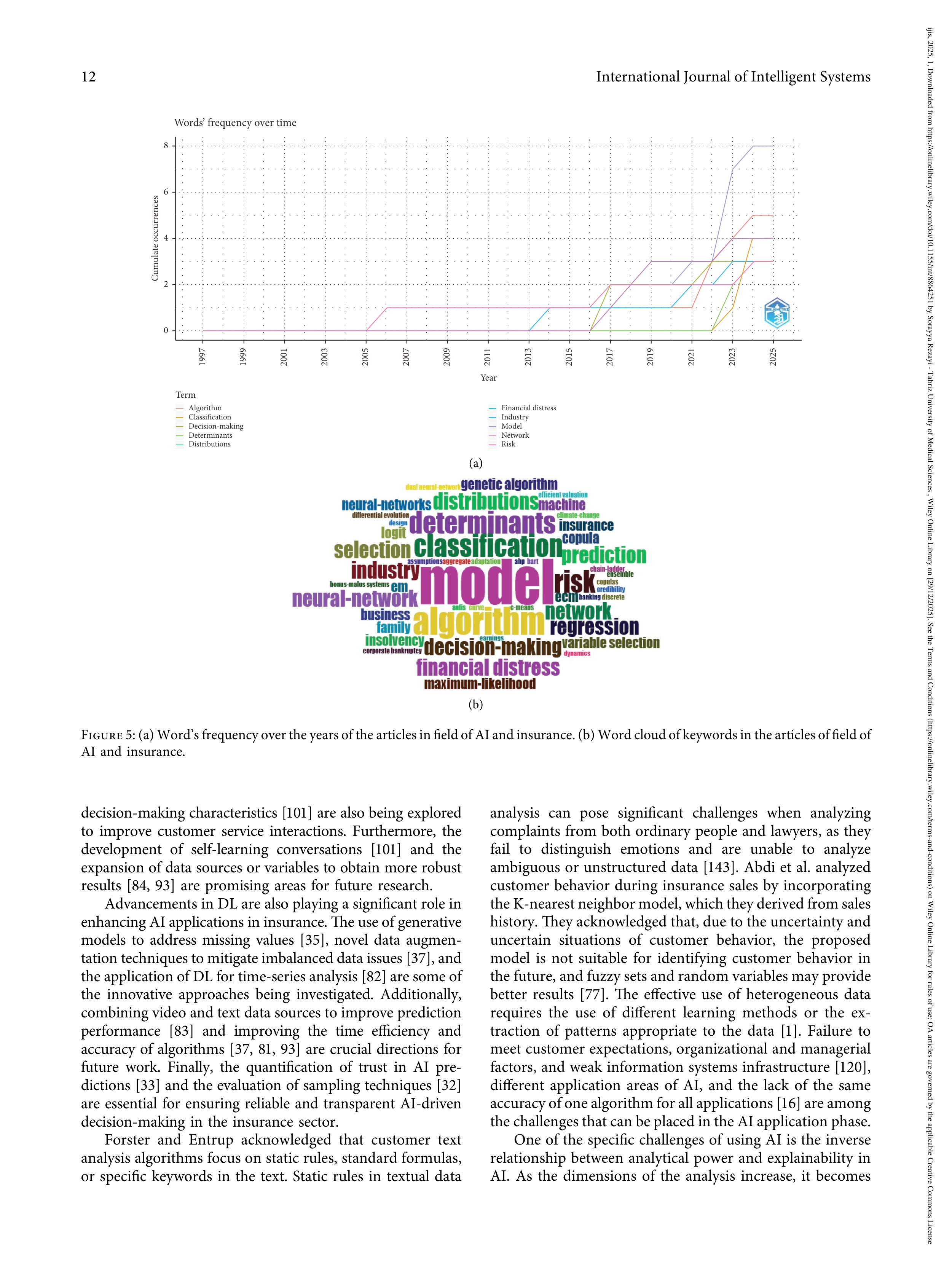

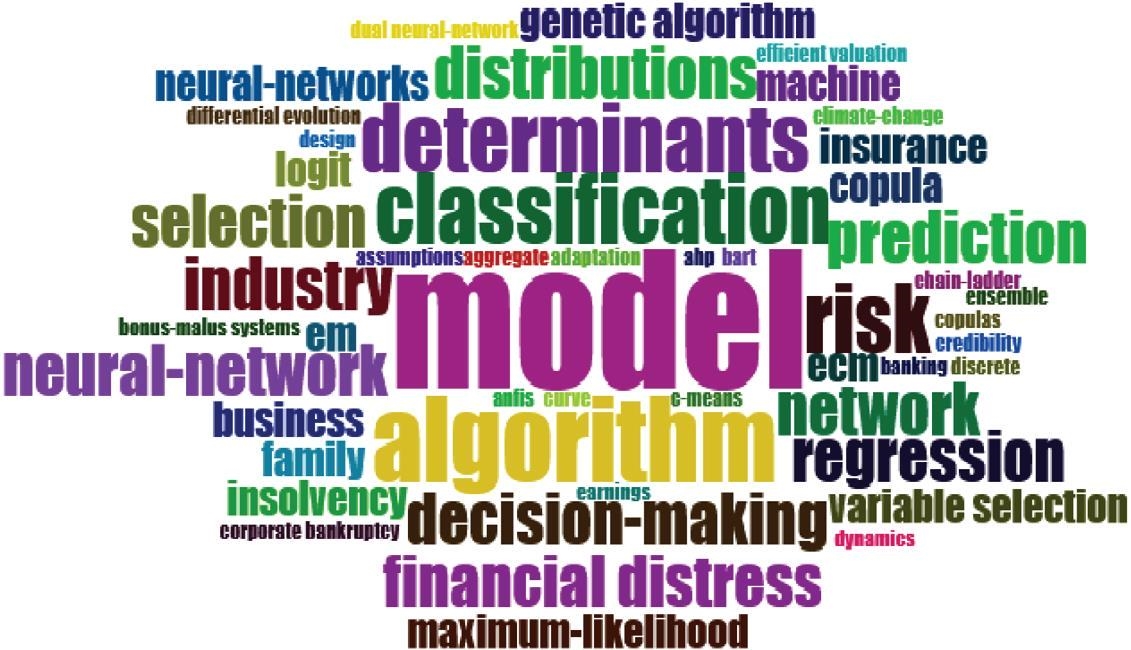
decision-making characteristics [101] are also being explored
to
improve
customer
service
interactions.
Furthermore,
the
development
of
self-learning
conversations
[101]
and
the
expansion of data sources or variables to obtain more robust
results
[84,
93]
are
promising
areas
for
future
research.
Advancements in DL are also playing a signifcant role in
enhancing AI applications in insurance. Te use of generative
models
to
address
missing
values
[35],
novel
data
augmen-
tation techniques to mitigate imbalanced data issues [37], and
the application of DL for time-series analysis [82] are some of
the
innovative
approaches
being
investigated.
Additionally,
combining video and text data sources to improve prediction
performance
[83]
and
improving
the
time
efciency
and
accuracy
of
algorithms
[37,
81,
93]
are
crucial
directions
for
future
work.
Finally,
the
quantifcation
of
trust
in
AI
pre-
dictions [33] and the evaluation of sampling techniques [32]
are
essential
for
ensuring
reliable
and
transparent
AI-driven
decision-making
in
the
insurance
sector.
Forster
and
Entrup
acknowledged
that
customer
text
analysis algorithms focus on static rules, standard formulas,
or
specifc
keywords
in
the
text.
Static
rules
in
textual
data
analysis
can
pose
signifcant
challenges
when
analyzing
complaints from both ordinary people and lawyers, as they
fail
to
distinguish
emotions
and
are
unable
to
analyze
ambiguous or unstructured data [143]. Abdi et al. analyzed
customer
behavior
during
insurance
sales
by
incorporating
the K-nearest neighbor model, which they derived from sales
history. Tey acknowledged that, due to the uncertainty and
uncertain
situations
of
customer
behavior,
the
proposed
model
is
not
suitable
for
identifying
customer
behavior
in
the future, and fuzzy sets and random variables may provide
better
results
[77].
Te
efective
use
of
heterogeneous
data
requires
the
use
of
diferent
learning
methods
or
the
ex-
traction
of
patterns
appropriate
to
the
data
[1].
Failure
to
meet customer expectations, organizational and managerial
factors, and weak information systems infrastructure [120],
diferent
application
areas
of
AI,
and
the
lack
of
the
same
accuracy of one algorithm for all applications [16] are among
the challenges that can be placed in the AI application phase.
One of the specifc challenges of using AI is the inverse
relationship
between
analytical
power
and
explainability
in
AI.
As
the
dimensions
of
the
analysis
increase,
it
becomes
Words’ frequency over time
1999
2001
2003
2005
2007
2009
2011
2013
2015
2017
2019
2021
2023
2025
1997
Year
8
6
4
2
0
Cumulate occurrences
Financial distress
Industry
Model
Network
Risk
Algorithm
Classification
Decision-making
Determinants
Distributions
Term
(a)
(b)
Figure
5: (a) Word’s frequency over the years of the articles in feld of AI and insurance. (b) Word cloud of keywords in the articles of feld of
AI
and
insurance.
12
International Journal of Intelligent Systems
ijis, 2025, 1, Downloaded from https://onlinelibrary.wiley.com/doi/10.1155/int/8864251 by Sorayya Rezayi - Tabriz University of Medical Sciences , Wiley Online Library on [29/12/2025]. See the Terms and Conditions (https://onlinelibrary.wiley.com/terms-and-conditions) on Wiley Online Library for rules of use; OA articles are governed by the applicable Creative Commons License
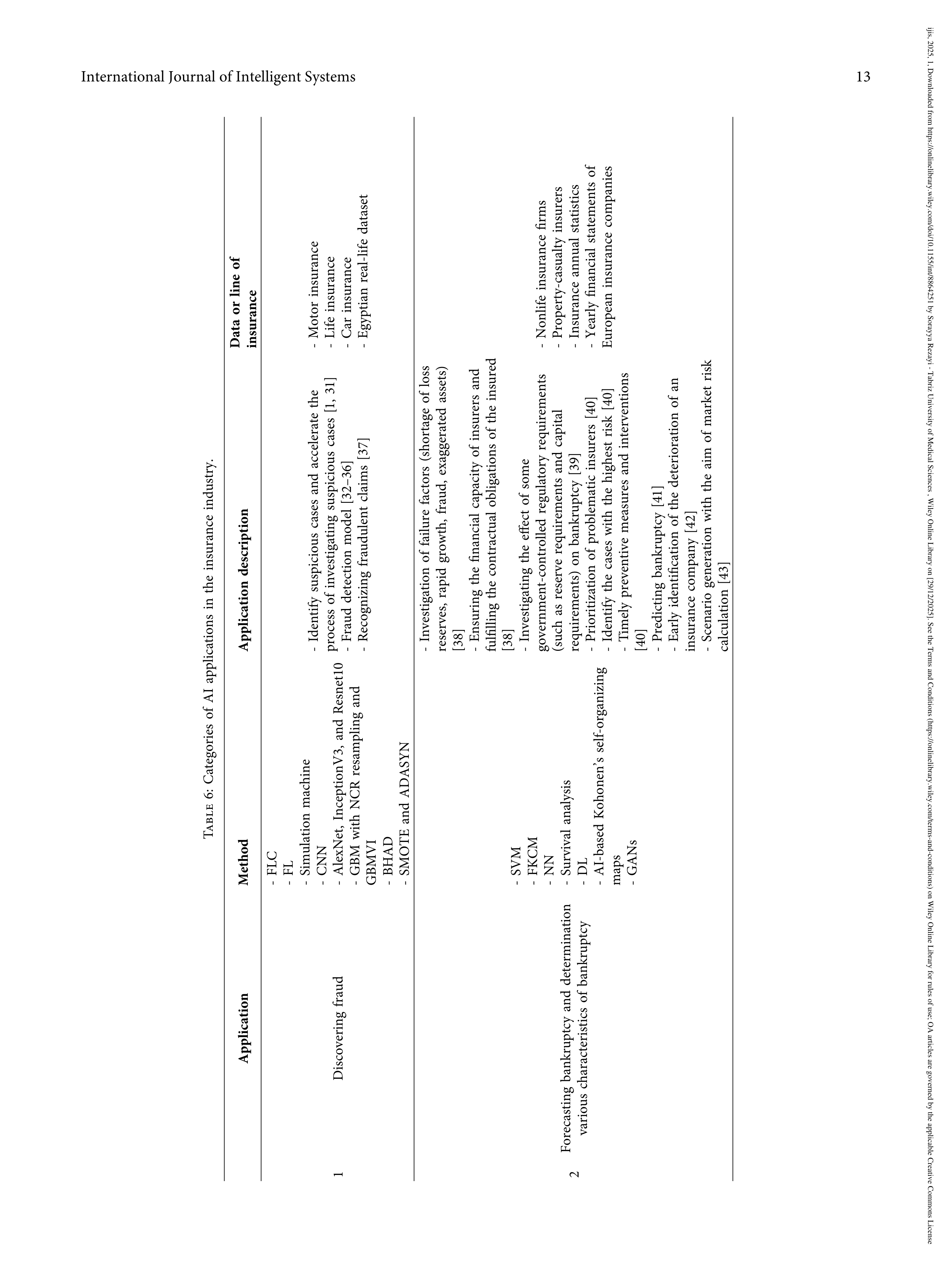
Table
6:
Categories
of
AI
applications
in
the
insurance
industry.
Application
Method
Application
description
Data
or
line
of
insurance
1
Discovering
fraud
-
FLC
-
FL
-
Simulation
machine
-
CNN
-
AlexNet,
InceptionV3,
and
Resnet10
-
GBM
with
NCR
resampling
and
GBMVI
-
BHAD
-
SMOTE
and
ADASYN
-
Identify
suspicious
cases
and
accelerate
the
process
of
investigating
suspicious
cases
[1,
31]
-
Fraud
detection
model
[32–36]
-
Recognizing
fraudulent
claims
[37]
-
Motor
insurance
-
Life
insurance
-
Car
insurance
-
Egyptian
real-life
dataset
2
Forecasting
bankruptcy
and
determination
various
characteristics
of
bankruptcy
-
SVM
-
FKCM
-
NN
-
Survival
analysis
-
DL
-
AI-based
Kohonen’s
self-organizing
maps
-
GANs
-
Investigation
of
failure
factors
(shortage
of
loss
reserves,
rapid
growth,
fraud,
exaggerated
assets)
[38]
-
Ensuring
the
fnancial
capacity
of
insurers
and
fulflling
the
contractual
obligations
of
the
insured
[38]
-
Investigating
the
efect
of
some
government-controlled
regulatory
requirements
(such
as
reserve
requirements
and
capital
requirements)
on
bankruptcy
[39]
-
Prioritization
of
problematic
insurers
[40]
-
Identify
the
cases
with
the
highest
risk
[40]
-
Timely
preventive
measures
and
interventions
[40]
-
Predicting
bankruptcy
[41]
-
Early
identifcation
of
the
deterioration
of
an
insurance
company
[42]
-
Scenario
generation
with
the
aim
of
market
risk
calculation
[43]
-
Nonlife
insurance
frms
-
Property-casualty
insurers
-
Insurance
annual
statistics
-
Yearly
fnancial
statements
of
European
insurance
companies
International Journal of Intelligent Systems
13
ijis, 2025, 1, Downloaded from https://onlinelibrary.wiley.com/doi/10.1155/int/8864251 by Sorayya Rezayi - Tabriz University of Medical Sciences , Wiley Online Library on [29/12/2025]. See the Terms and Conditions (https://onlinelibrary.wiley.com/terms-and-conditions) on Wiley Online Library for rules of use; OA articles are governed by the applicable Creative Commons License
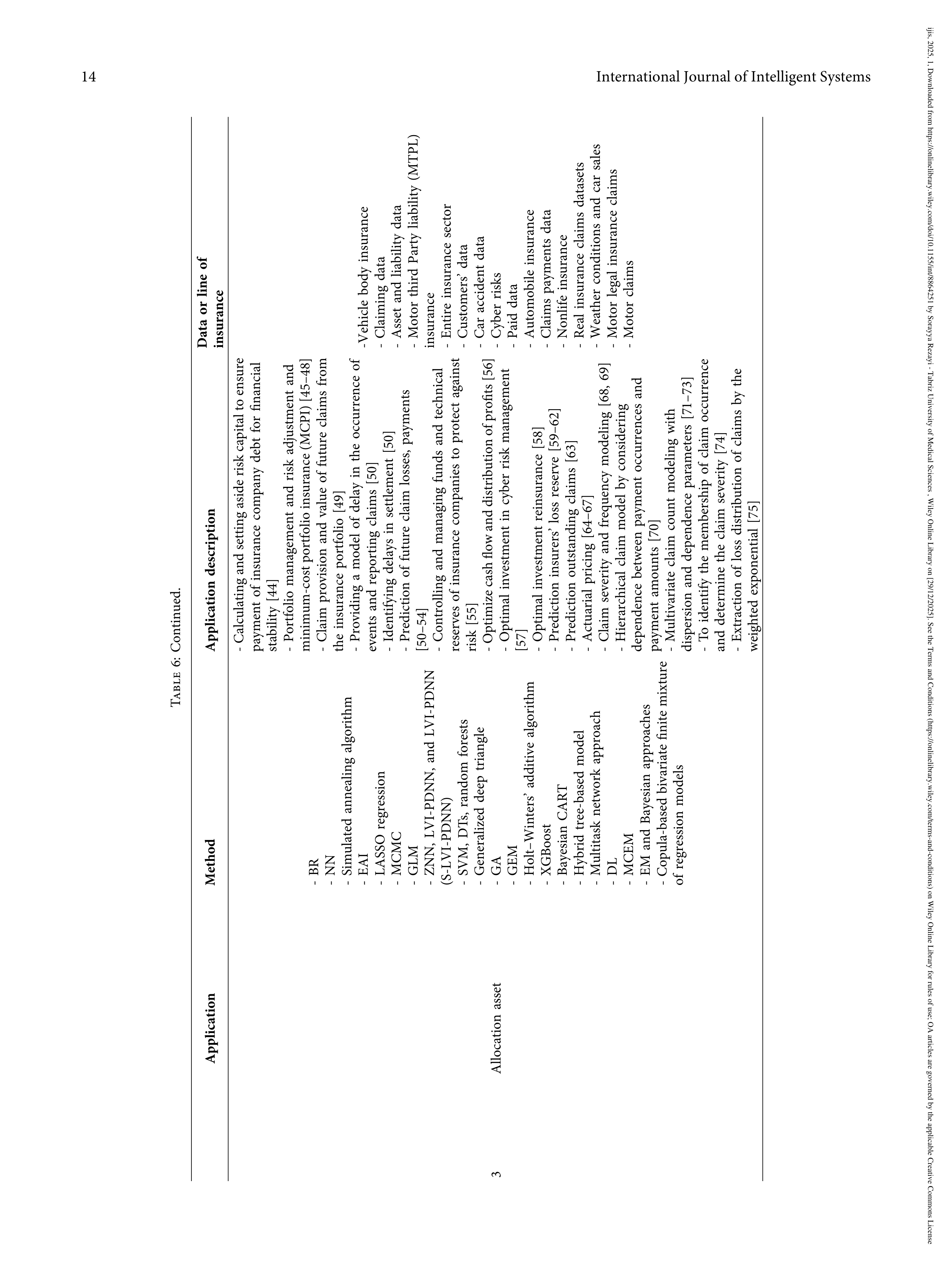
T
able
6:
Continued.
Application
Method
Application
description
Data
or
line
of
insurance
3
Allocation
asset
-
BR
-
NN
-
Simulated
annealing
algorithm
-
EAI
-
LASSO
regression
-
MCMC
-
GLM
-
ZNN,
LVI-PDNN,
and
LVI-PDNN
(S-LVI-PDNN)
-
SVM,
DTs,
random
forests
-
Generalized
deep
triangle
-
GA
-
GEM
-
Holt–Winters’
additive
algorithm
-
XGBoost
-
Bayesian
CART
-
Hybrid
tree-based
model
-
Multitask
network
approach
-
DL
-
MCEM
-
EM
and
Bayesian
approaches
- Copula-based bivariate fnite mixture
of
regression
models
- Calculating and setting aside risk capital to ensure
payment
of
insurance
company
debt
for
fnancial
stability
[44]
-
Portfolio
management
and
risk
adjustment
and
minimum-cost portfolio insurance (MCPI) [45–48]
-
Claim
provision
and
value
of
future
claims
from
the
insurance
portfolio
[49]
-
Providing
a
model
of
delay
in
the
occurrence
of
events
and
reporting
claims
[50]
-
Identifying
delays
in
settlement
[50]
-
Prediction
of
future
claim
losses,
payments
[50–54]
-
Controlling
and
managing
funds
and
technical
reserves
of
insurance
companies
to
protect
against
risk
[55]
- Optimize cash fow and distribution of profts [56]
-
Optimal
investment
in
cyber
risk
management
[57]
-
Optimal
investment
reinsurance
[58]
-
Prediction
insurers’
loss
reserve
[59–62]
-
Prediction
outstanding
claims
[63]
-
Actuarial
pricing
[64–67]
-
Claim
severity
and
frequency
modeling
[68,
69]
-
Hierarchical
claim
model
by
considering
dependence
between
payment
occurrences
and
payment
amounts
[70]
-
Multivariate
claim
count
modeling
with
dispersion
and
dependence
parameters
[71–73]
-
To
identify
the
membership
of
claim
occurrence
and
determine
the
claim
severity
[74]
-
Extraction
of
loss
distribution
of
claims
by
the
weighted
exponential
[75]
-Vehicle
body
insurance
-
Claiming
data
-
Asset
and
liability
data
-
Motor
third
Party
liability
(MTPL)
insurance
-
Entire
insurance
sector
-
Customers’
data
-
Car
accident
data
-
Cyber
risks
-
Paid
data
-
Automobile
insurance
-
Claims
payments
data
-
Nonlife
insurance
-
Real
insurance
claims
datasets
-
Weather
conditions
and
car
sales
-
Motor
legal
insurance
claims
-
Motor
claims
14
International Journal of Intelligent Systems
ijis, 2025, 1, Downloaded from https://onlinelibrary.wiley.com/doi/10.1155/int/8864251 by Sorayya Rezayi - Tabriz University of Medical Sciences , Wiley Online Library on [29/12/2025]. See the Terms and Conditions (https://onlinelibrary.wiley.com/terms-and-conditions) on Wiley Online Library for rules of use; OA articles are governed by the applicable Creative Commons License
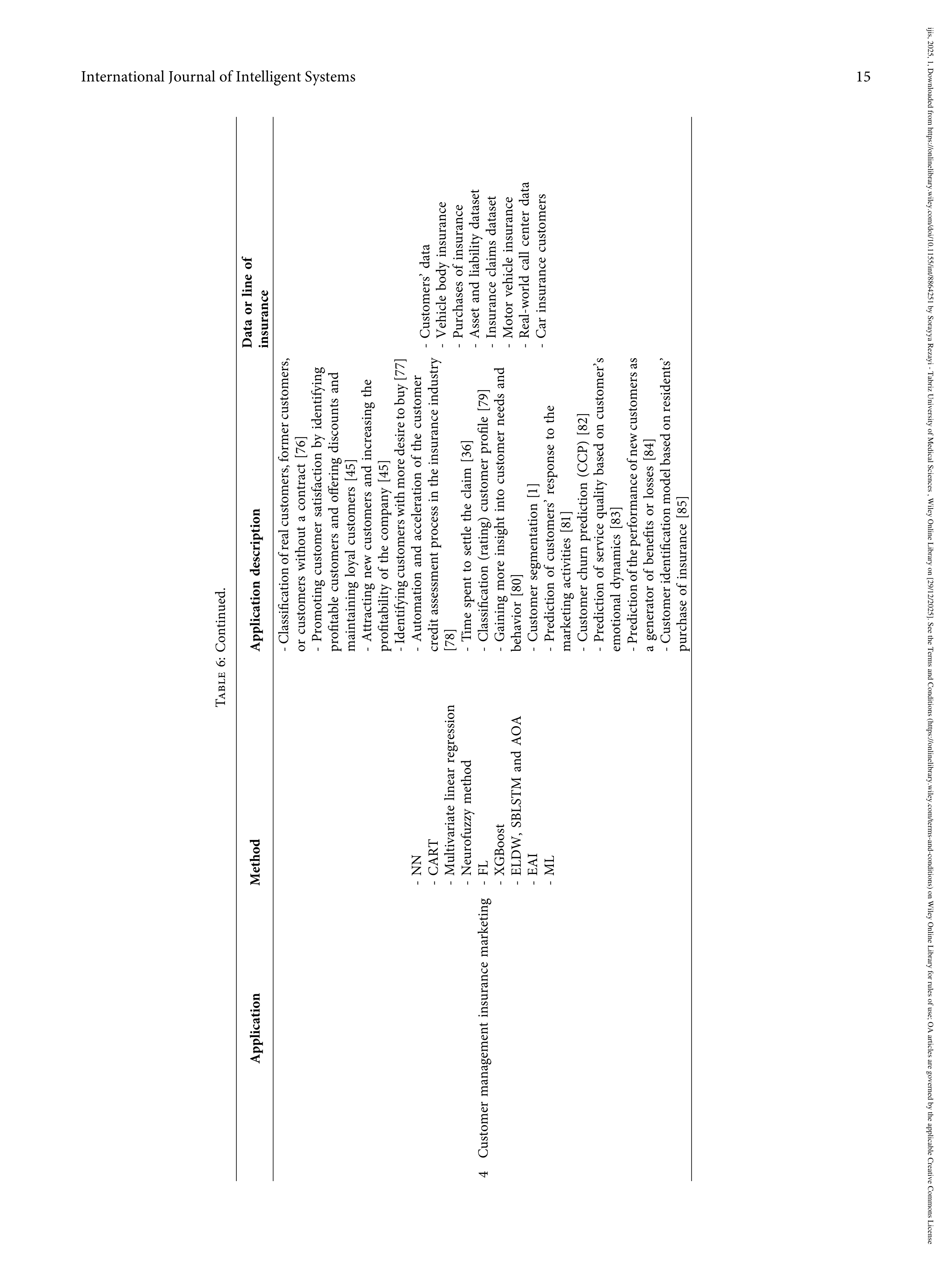
T
able
6:
Continued.
Application
Method
Application
description
Data
or
line
of
insurance
4
Customer
management
insurance
marketing
-
NN
-
CART
-
Multivariate
linear
regression
-
Neurofuzzy
method
-
FL
-
XGBoost
-
ELDW,
SBLSTM
and
AOA
-
EAI
-
ML
- Classifcation of real customers, former customers,
or
customers
without
a
contract
[76]
-
Promoting
customer
satisfaction
by
identifying
proftable
customers
and
ofering
discounts
and
maintaining
loyal
customers
[45]
-
Attracting
new
customers
and
increasing
the
proftability
of
the
company
[45]
- Identifying customers with more desire to buy [77]
-
Automation
and
acceleration
of
the
customer
credit assessment process in the insurance industry
[78]
-
Time
spent
to
settle
the
claim
[36]
-
Classifcation
(rating)
customer
profle
[79]
-
Gaining
more
insight
into
customer
needs
and
behavior
[80]
-
Customer
segmentation
[1]
-
Prediction
of
customers’
response
to
the
marketing
activities
[81]
-
Customer
churn
prediction
(CCP)
[82]
-
Prediction
of
service
quality
based
on
customer’s
emotional
dynamics
[83]
- Prediction of the performance of new customers as
a
generator
of
benefts
or
losses
[84]
- Customer identifcation model based on residents’
purchase
of
insurance
[85]
-
Customers’
data
-
Vehicle
body
insurance
-
Purchases
of
insurance
-
Asset
and
liability
dataset
-
Insurance
claims
dataset
-
Motor
vehicle
insurance
-
Real-world
call
center
data
-
Car
insurance
customers
International Journal of Intelligent Systems
15
ijis, 2025, 1, Downloaded from https://onlinelibrary.wiley.com/doi/10.1155/int/8864251 by Sorayya Rezayi - Tabriz University of Medical Sciences , Wiley Online Library on [29/12/2025]. See the Terms and Conditions (https://onlinelibrary.wiley.com/terms-and-conditions) on Wiley Online Library for rules of use; OA articles are governed by the applicable Creative Commons License
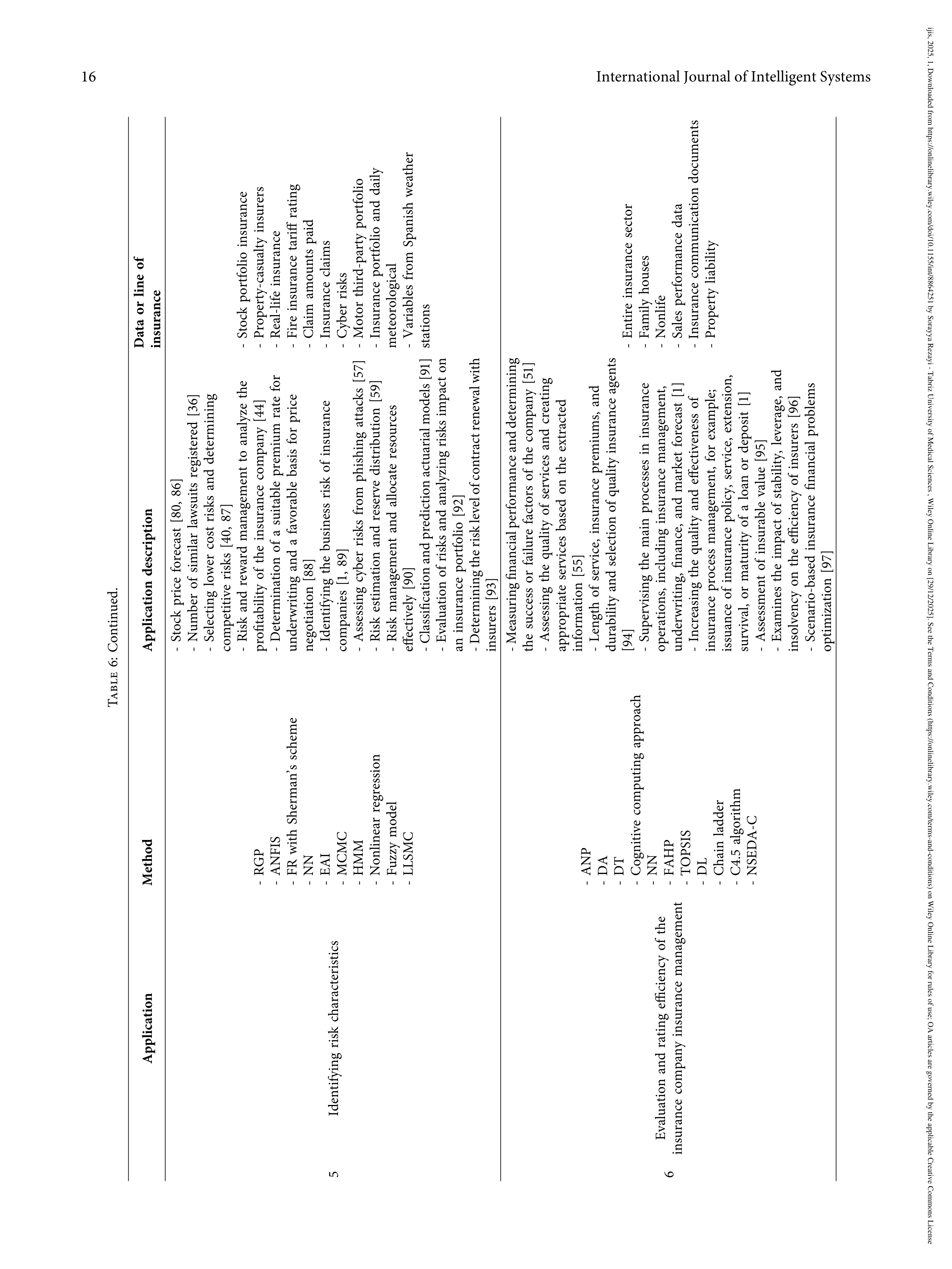
T
able
6:
Continued.
Application
Method
Application
description
Data
or
line
of
insurance
5
Identifying
risk
characteristics
-
RGP
-
ANFIS
-
FR
with
Sherman’s
scheme
-
NN
-
EAI
-
MCMC
-
HMM
-
Nonlinear
regression
-
Fuzzy
model
-
LLSMC
-
Stock
price
forecast
[80,
86]
-
Number
of
similar
lawsuits
registered
[36]
-
Selecting
lower
cost
risks
and
determining
competitive
risks
[40,
87]
-
Risk
and
reward
management
to
analyze
the
proftability
of
the
insurance
company
[44]
-
Determination
of
a
suitable
premium
rate
for
underwriting
and
a
favorable
basis
for
price
negotiation
[88]
-
Identifying
the
business
risk
of
insurance
companies
[1,
89]
-
Assessing
cyber
risks
from
phishing
attacks
[57]
-
Risk
estimation
and
reserve
distribution
[59]
-
Risk
management
and
allocate
resources
efectively
[90]
- Classifcation and prediction actuarial models [91]
- Evaluation of risks and analyzing risks impact on
an
insurance
portfolio
[92]
- Determining the risk level of contract renewal with
insurers
[93]
-
Stock
portfolio
insurance
-
Property-casualty
insurers
-
Real-life
insurance
-
Fire
insurance
tarif
rating
-
Claim
amounts
paid
-
Insurance
claims
-
Cyber
risks
-
Motor
third-party
portfolio
-
Insurance
portfolio
and
daily
meteorological
-
Variables
from
Spanish
weather
stations
6
Evaluation
and
rating
efciency
of
the
insurance
company
insurance
management
-
ANP
-
DA
-
DT
-
Cognitive
computing
approach
-
NN
-
FAHP
-
TOPSIS
-
DL
-
Chain
ladder
-
C4.5
algorithm
-
NSEDA-C
- Measuring fnancial performance and determining
the
success
or
failure
factors
of
the
company
[51]
-
Assessing
the
quality
of
services
and
creating
appropriate
services
based
on
the
extracted
information
[55]
-
Length
of
service,
insurance
premiums,
and
durability and selection of quality insurance agents
[94]
-
Supervising
the
main
processes
in
insurance
operations,
including
insurance
management,
underwriting,
fnance,
and
market
forecast
[1]
-
Increasing
the
quality
and
efectiveness
of
insurance
process
management,
for
example;
issuance
of
insurance
policy,
service,
extension,
survival,
or
maturity
of
a
loan
or
deposit
[1]
-
Assessment
of
insurable
value
[95]
-
Examines
the
impact
of
stability,
leverage,
and
insolvency
on
the
efciency
of
insurers
[96]
-
Scenario-based
insurance
fnancial
problems
optimization
[97]
-
Entire
insurance
sector
-
Family
houses
-
Nonlife
-
Sales
performance
data
- Insurance communication documents
-
Property
liability
16
International Journal of Intelligent Systems
ijis, 2025, 1, Downloaded from https://onlinelibrary.wiley.com/doi/10.1155/int/8864251 by Sorayya Rezayi - Tabriz University of Medical Sciences , Wiley Online Library on [29/12/2025]. See the Terms and Conditions (https://onlinelibrary.wiley.com/terms-and-conditions) on Wiley Online Library for rules of use; OA articles are governed by the applicable Creative Commons License
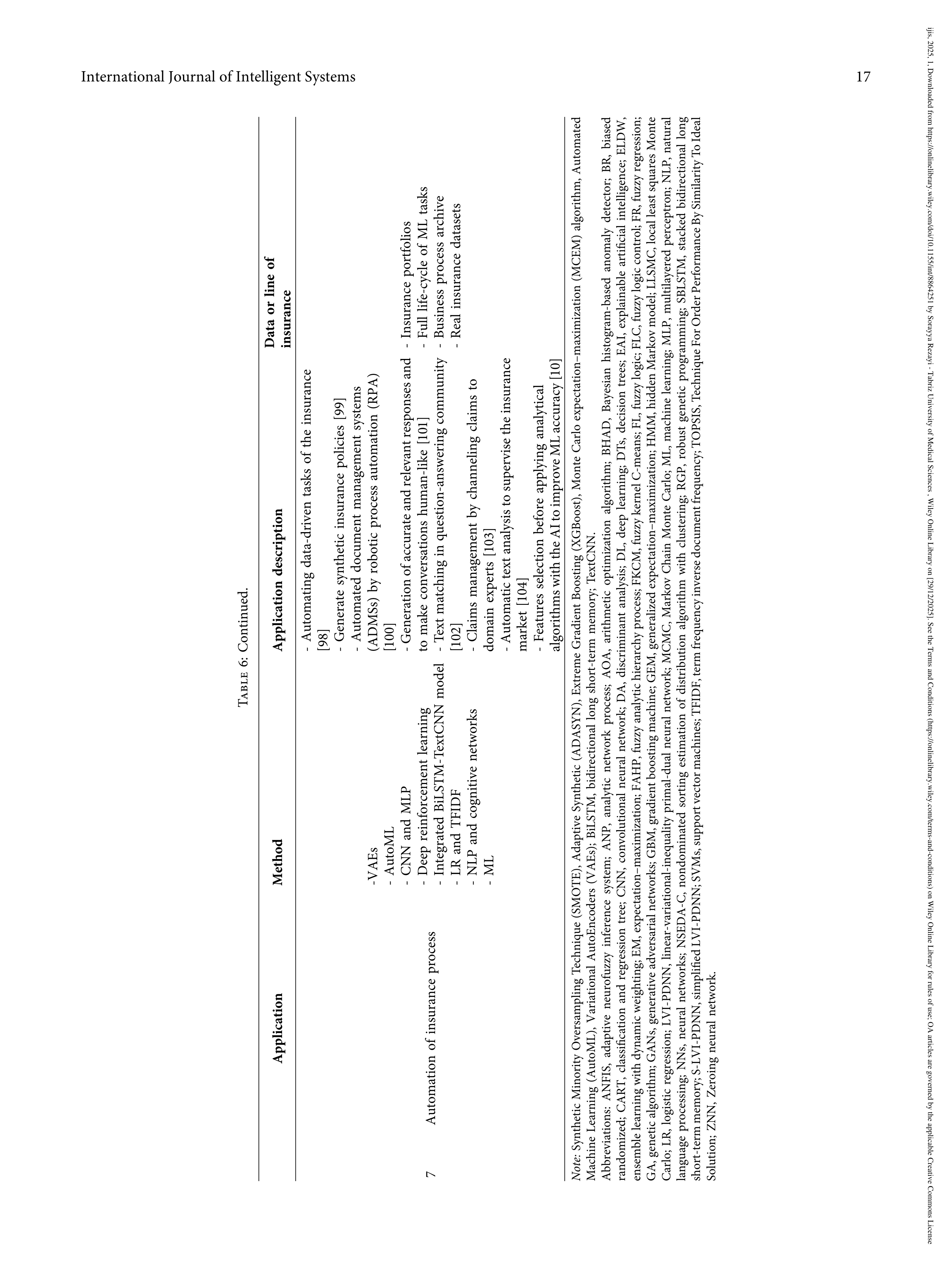
T
able
6:
Continued.
Application
Method
Application
description
Data
or
line
of
insurance
7
Automation
of
insurance
process
-VAEs
-
AutoML
-
CNN
and
MLP
-
Deep
reinforcement
learning
-
Integrated
BiLSTM-TextCNN
model
-
LR
and
TFIDF
-
NLP
and
cognitive
networks
-
ML
-
Automating
data-driven
tasks
of
the
insurance
[98]
-
Generate
synthetic
insurance
policies
[99]
-
Automated
document
management
systems
(ADMSs)
by
robotic
process
automation
(RPA)
[100]
- Generation of accurate and relevant responses and
to
make
conversations
human-like
[101]
- Text matching in question-answering community
[102]
-
Claims
management
by
channeling
claims
to
domain
experts
[103]
- Automatic text analysis to supervise the insurance
market
[104]
-
Features
selection
before
applying
analytical
algorithms with the AI to improve ML accuracy [10]
-
Insurance
portfolios
-
Full
life-cycle
of
ML
tasks
-
Business
process
archive
-
Real
insurance
datasets
Note:
Synthetic Minority Oversampling Technique (SMOTE), Adaptive Synthetic (ADASYN), Extreme Gradient Boosting (XGBoost), Monte Carlo expectation–maximization (MCEM) algorithm, Automated
Machine
Learning
(AutoML),
Variational
AutoEncoders
(VAEs);
BiLSTM,
bidirectional
long
short-term
memory;
TextCNN.
Abbreviations:
ANFIS,
adaptive
neurofuzzy
inference
system;
ANP,
analytic
network
process;
AOA,
arithmetic
optimization
algorithm;
BHAD,
Bayesian
histogram-based
anomaly
detector;
BR,
biased
randomized;
CART,
classifcation
and
regression
tree;
CNN,
convolutional
neural
network;
DA,
discriminant
analysis;
DL,
deep
learning;
DTs,
decision
trees;
EAI,
explainable
artifcial
intelligence;
ELDW,
ensemble learning with dynamic weighting; EM, expectation–maximization; FAHP, fuzzy analytic hierarchy process; FKCM, fuzzy kernel C-means; FL, fuzzy logic; FLC, fuzzy logic control; FR, fuzzy regression;
GA, genetic algorithm; GANs, generative adversarial networks; GBM, gradient boosting machine; GEM, generalized expectation–maximization; HMM, hidden Markov model; LLSMC, local least squares Monte
Carlo; LR, logistic
regression; LVI-PDNN, linear-variational-inequality primal-dual
neural network;
MCMC, Markov
Chain Monte Carlo;
ML, machine learning;
MLP, multilayered
perceptron; NLP, natural
language
processing;
NNs,
neural
networks;
NSEDA-C,
nondominated
sorting
estimation
of
distribution
algorithm
with
clustering;
RGP,
robust
genetic
programming;
SBLSTM,
stacked
bidirectional
long
short-term memory; S-LVI-PDNN, simplifed LVI-PDNN; SVMs, support vector machines; TFIDF, term frequency inverse document frequency; TOPSIS, Technique For Order Performance By Similarity To Ideal
Solution;
ZNN,
Zeroing
neural
network.
International Journal of Intelligent Systems
17
ijis, 2025, 1, Downloaded from https://onlinelibrary.wiley.com/doi/10.1155/int/8864251 by Sorayya Rezayi - Tabriz University of Medical Sciences , Wiley Online Library on [29/12/2025]. See the Terms and Conditions (https://onlinelibrary.wiley.com/terms-and-conditions) on Wiley Online Library for rules of use; OA articles are governed by the applicable Creative Commons License
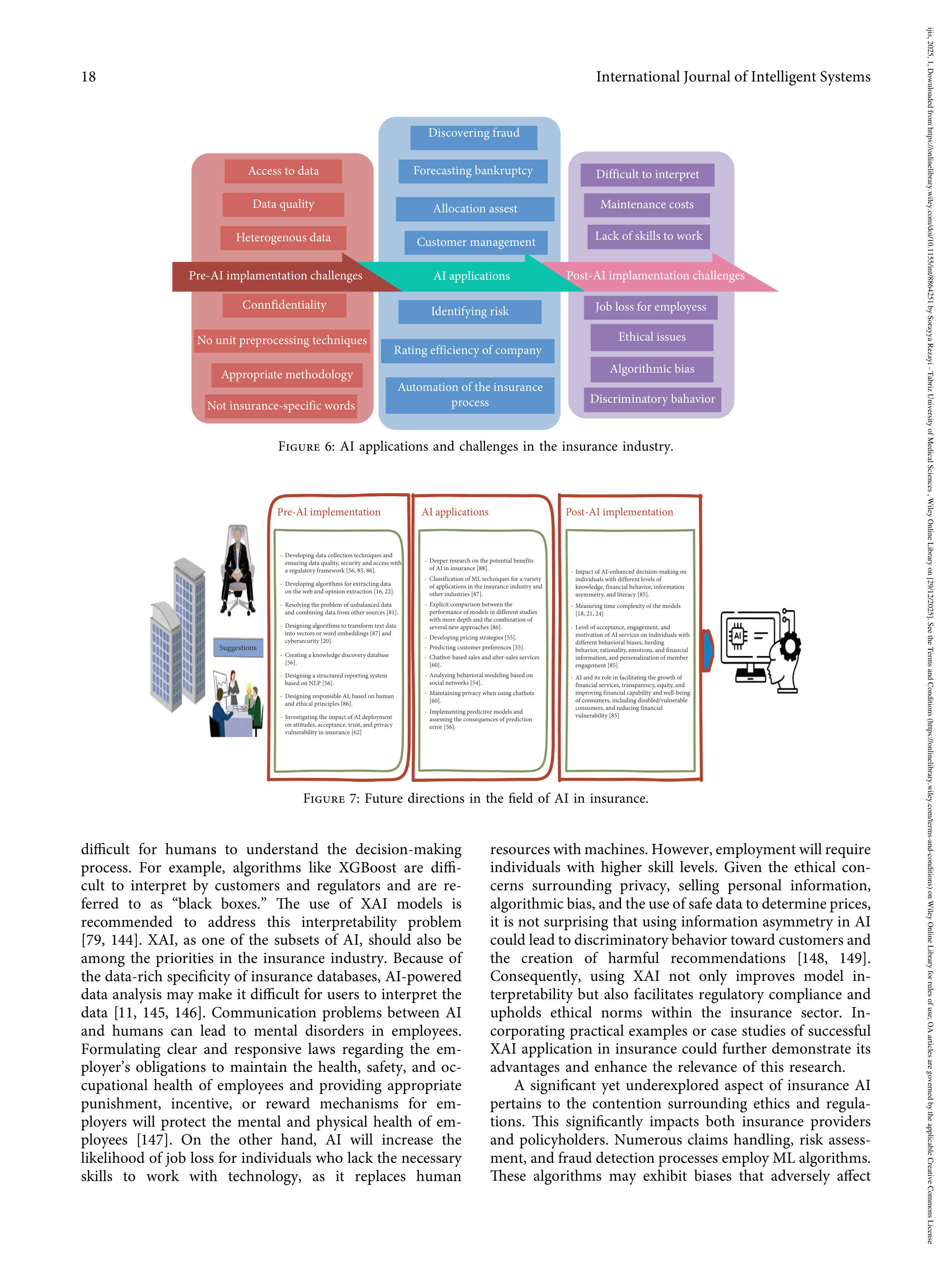
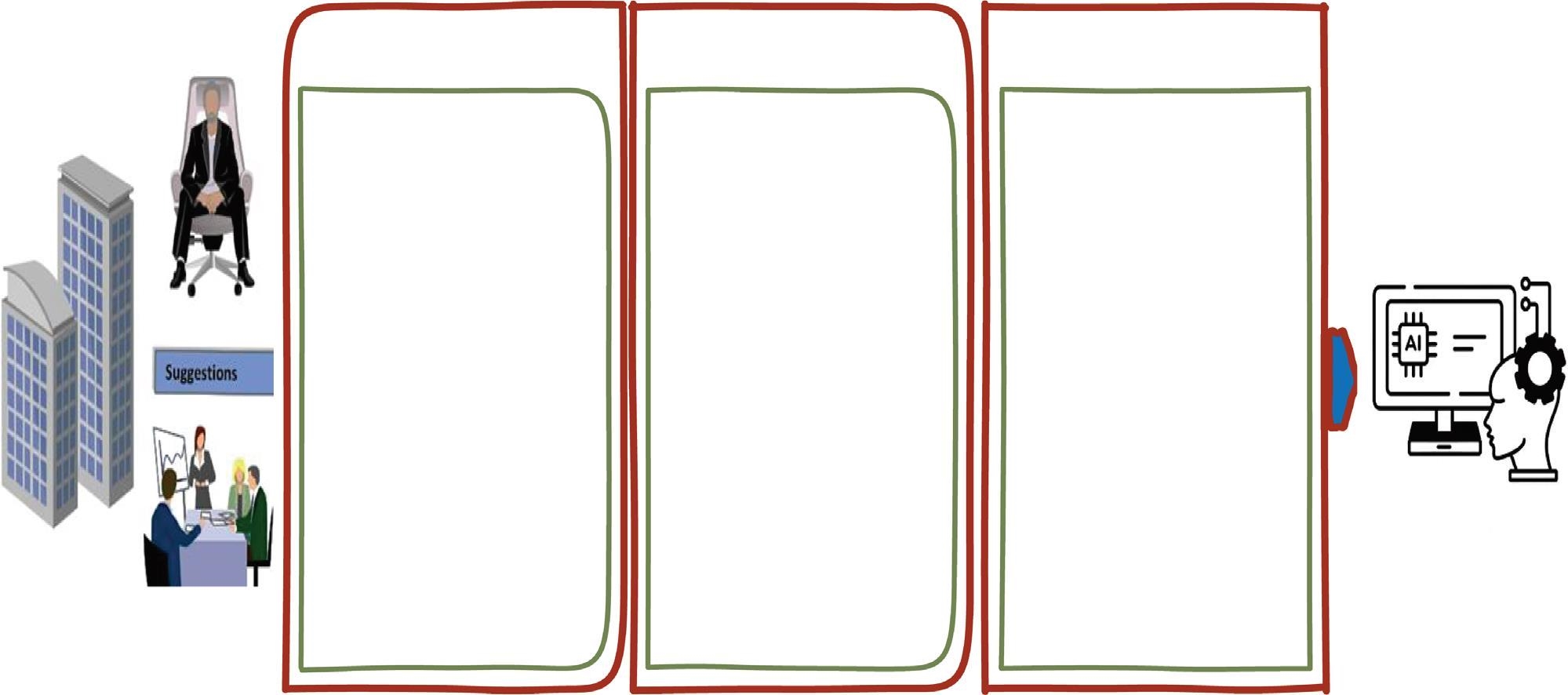
difcult
for
humans
to
understand
the
decision-making
process.
For
example,
algorithms
like
XGBoost
are
dif-
cult
to
interpret
by
customers
and
regulators
and
are
re-
ferred
to
as
“black
boxes.”
Te
use
of
XAI
models
is
recommended
to
address
this
interpretability
problem
[79,
144].
XAI,
as
one
of
the
subsets
of
AI,
should
also
be
among
the
priorities
in
the
insurance
industry.
Because
of
the data-rich specifcity of insurance databases, AI-powered
data analysis may make it difcult for users to interpret the
data
[11,
145,
146].
Communication
problems
between
AI
and
humans
can
lead
to
mental
disorders
in
employees.
Formulating
clear
and
responsive
laws
regarding
the
em-
ployer’s
obligations
to
maintain
the
health,
safety,
and
oc-
cupational
health
of
employees
and
providing
appropriate
punishment,
incentive,
or
reward
mechanisms
for
em-
ployers
will
protect
the
mental
and
physical
health
of
em-
ployees
[147].
On
the
other
hand,
AI
will
increase
the
likelihood of job loss for individuals who lack the necessary
skills
to
work
with
technology,
as
it
replaces
human
resources with machines. However, employment will require
individuals
with
higher
skill
levels.
Given
the
ethical
con-
cerns
surrounding
privacy,
selling
personal
information,
algorithmic bias, and the use of safe data to determine prices,
it is not surprising that using information asymmetry in AI
could lead to discriminatory behavior toward customers and
the
creation
of
harmful
recommendations
[148,
149].
Consequently,
using
XAI
not
only
improves
model
in-
terpretability
but
also
facilitates
regulatory
compliance
and
upholds
ethical
norms
within
the
insurance
sector.
In-
corporating
practical examples or case studies of successful
XAI
application
in
insurance
could
further
demonstrate
its
advantages
and
enhance
the
relevance
of
this
research.
A
signifcant
yet
underexplored
aspect
of
insurance
AI
pertains
to
the
contention
surrounding
ethics
and
regula-
tions.
Tis
signifcantly
impacts
both
insurance
providers
and
policyholders.
Numerous
claims
handling,
risk
assess-
ment, and fraud detection processes employ ML algorithms.
Tese
algorithms
may
exhibit
biases
that
adversely
afect
Discovering fraud
Access to data
Forecasting bankruptcy
Difficult to interpret
Data quality
Allocation assest
Maintenance costs
Heterogenous data
Customer management
Lack of skills to work
Pre-AI implamentation challenges
AI applications
Post-AI implamentation challenges
Connfidentiality
Identifying risk
Job loss for employess
No unit preprocessing techniques
Rating efficiency of company
Ethical issues
Appropriate methodology
Algorithmic bias
Not insurance-specific words
Automation of the insurance
process
Discriminatory bahavior
Figure
6:
AI
applications
and
challenges
in
the
insurance
industry.
Developing data collection techniques and
ensuring data quality, security and access with
a regulatory framework [56, 85, 86].
Investigating the impact of AI deployment
on attitudes, acceptance, trust, and privacy
vulnerability in insurance [62]
Designing responsible AI, based on human
and ethical principles [86].
Designing a structured reporting system
based on NLP [56].
Creating a knowledge discovery database
[56].
Designing algorithms to transform text data
into vectors or word embeddings [87] and
cybersecurity [20].
Resolving the problem of unbalanced data
and combining data from other sources [81].
Developing algorithms for extracting data
on the web and opinion extraction [16, 22].
-
-
-
-
-
-
-
-
Deeper research on the potential benefits
of AI in insurance [88].
Implementing predictive models and
assessing the consequences of prediction
error [56].
Maintaining privacy when using chatbots
[60].
Analyzing behavioral modeling based on
social networks [54].
Chatbot-based sales and after-sales services
[60].
Predicting customer preferences [55].
Developing pricing strategies [55].
Explicit comparison between the
performance of models in different studies
with more depth and the combination of
several new approaches [86].
Classification of ML techniques for a variety
of applications in the insurance industry and
other industries [87].
-
-
-
-
-
-
-
-
-
Impact of AI-enhanced decision-making on
individuals with different levels of
knowledge, financial behavior, information
asymmetry, and literacy [85].
AI and its role in facilitating the growth of
financial services, transparency, equity, and
improving financial capability and well-being
of consumers, including disabled/vulnerable
consumers, and reducing financial
vulnerability [85]
Level of acceptance, engagement, and
motivation of AI services on individuals with
different behavioral biases, herding
behavior, rationality, emotions, and financial
information, and personalization of member
engagement [85]
Measuring time complexity of the models
[18, 21, 24]
-
-
-
-
Pre-AI implementation
AI applications
Post-AI implementation
Suggestions
Figure
7:
Future
directions
in
the
feld
of
AI
in
insurance.
18
International Journal of Intelligent Systems
ijis, 2025, 1, Downloaded from https://onlinelibrary.wiley.com/doi/10.1155/int/8864251 by Sorayya Rezayi - Tabriz University of Medical Sciences , Wiley Online Library on [29/12/2025]. See the Terms and Conditions (https://onlinelibrary.wiley.com/terms-and-conditions) on Wiley Online Library for rules of use; OA articles are governed by the applicable Creative Commons License
some groups [148]. Data privacy poses a signifcant issue due
to
the
collection
and
analysis
of
sensitive
personal
in-
formation.
Tis
requires
explicit
regulations
and
safety
protocols
to
prevent
its
occurrence.
Clarity
in
autonomous
decision-making is crucial, as insurers must understand how
algorithms infuence insurance pricing, claims approval, and
claims
disbursements.
New
regulations,
such
as
the
EU
Artifcial
Intelligence
Act
(AI
Act),
are
establishing
criteria
for
the
safe
and
ethical
utilization
of
AI
in
the
insurance
sector
[150].
Implementing
these
regulations
may
mitigate
legal risks for insurance businesses and enhance client trust.
Considering
these
ethical
and
legal
matters
is
not
just
a matter of social responsibility and compliance but may also
provide
insurance
businesses
a
signifcant
competitive
ad-
vantage
if
they
prioritize
transparency,
equity,
and
contin-
uous
service
enhancement
[151].
Based
on
the
reviewed
studies,
a
conceptual
model
of
AI
applications
and
their
challenges in the insurance industry is presented (Figure 6).
5.4.
Future
Directions.
By
considering
and
addressing
in-
formation gaps, we can expand and impact the digital world
and
scientifc
development.
Hence,
future
research
should
focus
on
developing
advanced,
complex,
robust,
and
ac-
curate
models
[7].
Future
studies
could
beneft
from
addressing gaps such as data gaps, geographical area studied,
research methodology, technique used, application area, and
number of strategies [15]. Examining information gaps can
be
used
to
deal
with
the
anomalies
of
the
contemporary
world, reduce illegal acts and transaction errors in the world,
and
also
promote
knowledge
[15].
Future
research
should
focus
on
how
to
design
advanced
services
that
are
com-
patible
with
the
internal
processes
of
organizations
and
insurance
companies
to
pave
the
way
for
managers
and
policymakers
to
apply
AI
and
ML
intelligence
[122].
It
is
recommended
that
new
studies
be
conducted
to
determine
the
details
of
the
applications
of
AI
in
various
types
of
insurance
policies,
including
health
insurance,
life
in-
surance,
accident
insurance,
automobile
insurance,
and
agricultural
insurance.
Future
research
should
also
investigate
the
role
of
reg-
ulatory frameworks and governance mechanisms in shaping
the
ethical
use
of
AI
across
diferent
types
of
insurance.
Another
important
direction
would
be
to
assess
the
long-
term
social
implications
of
AI
adoption
in
insurance,
in-
cluding
issues
of
accessibility,
fairness,
and
inclusivity.
In
addition, interdisciplinary collaboration—linking computer
scientists,
insurance
experts,
ethicists,
and
policy-
makers—could
provide
a
more
holistic
understanding
of
both
the
opportunities
and
risks
associated
with
AI-driven
transformations.
Research
agendas
and
special
issue
calls
from
journal
editors
and
declarations
of
research
urgency
will
have
an
impact
on
correcting
gaps
[15].
Based
on
the
reviewed studies, a conceptual model of AI future directions
in
the
insurance
industry
is
presented
(Figure
7).
In
this
study,
three
categories
of
future
research
were
proposed
to
address
the
research
gaps.
In
brief,
further
directions
were
suggested
on
quality
data
collection
techniques,
cyberse-
curity,
deeper
research
on
pricing,
customer
preference
prediction, chatbot-based services, as well as measuring the
time
complexity
of
models,
the
impact
of
AI
on
fnancial
growth,
fairness,
and
consumer
satisfaction.
Including
76
publications
and
reviewing
a
reputable
database
(WOS)
are
this
study’s
two
strong
points.
Tis
evaluation of the literature primarily focuses on the adoption
of
AI
in
insurance
and
the
categorization
of
its
practical
applications, without considering comparisons of accuracy,
precision,
and
recall.
6. Conclusion
Tis study shows that AI is steadily changing the insurance
industry. It is no longer just a tool to
make things faster or
easier—it
is
actually
reshaping
the
way
key
processes
are
designed and managed. From helping companies assess risks
more
accurately
and
speeding
up
claims,
to
spotting
fraud,
predicting what customers may need, and improving pricing
methods,
AI
is
becoming
a
core
part
of
insurance
services.
Using
XAI
makes
this
even
stronger
by
ensuring
that
de-
cisions
made by machines
are clearer and
fairer. Tis helps
build
trust
with
customers
and
also
protects
sensitive
personal
data.
For managers, the message is clear and urgent. To get real
value
from
these
technologies,
insurance
companies
need
better systems to collect and organize data, raise the quality
of that data, and build databases that reveal useful patterns.
Tey also need to test smarter pricing models and tools that
help
them
understand
their
customers
better.
At
the
same
time, companies must create clear rules for the ethical use of
XAI and put in place fexible policies that can adapt to new
legal
and
ethical
challenges
in
the
future.
Tis
study
has
its
limitations.
By
relying
solely
on
the
WOS
database,
some
relevant
research
indexed
in
other
platforms such as Scopus or Google Scholar may have been
overlooked. However, we selected WOS due to its consistent
and reliable peer-reviewed content, providing a strong basis
for
our
scientometric
and
content
analyses.
Future
reviews
that
integrate
multiple
databases
could
provide
a
more
comprehensive
and richer understanding of AI’s
study and
application
in
the
insurance
industry.
Regulation
is
another
dimension
that
will
shape
the
future
of
AI
in
insurance.
New
initiatives,
such
as
the
Eu-
ropean
Union’s
AI
Act,
demonstrate
the
need
to
address
fairness, privacy, and transparency in algorithmic decision-
making.
Understanding
how
such
frameworks
afect
not
only
insurers
but
also
policyholders
will
be
critical
in
building
systems
that
are
both
efective
and
socially
responsible.
In summary, AI gives insurers the chance to work faster,
reduce
costs,
and
keep
pace
with
regulatory
change.
But
these
opportunities
will
only
be
realized
if
companies
act
deliberately
and
responsibly.
We
must
balance
technical
progress
with
ethical
responsibility
and
regulatory
aware-
ness.
If
this
balance
is
achieved,
AI
can
do
more
than
im-
prove efciency: it can strengthen trust, support fairness, and
contribute
to
the
long-term
resilience
and
sustainability
of
the
insurance
sector.
Future
research
can
add
to
these
fndings
by
conducting
empirical
studies
on
customer
International Journal of Intelligent Systems
19
ijis, 2025, 1, Downloaded from https://onlinelibrary.wiley.com/doi/10.1155/int/8864251 by Sorayya Rezayi - Tabriz University of Medical Sciences , Wiley Online Library on [29/12/2025]. See the Terms and Conditions (https://onlinelibrary.wiley.com/terms-and-conditions) on Wiley Online Library for rules of use; OA articles are governed by the applicable Creative Commons License
acceptance,
analyzing
the
implications
of
new
legal
frame-
works,
examining
the
sustainability
and
long-term
risks
of
AI
integration,
and
applying
XAI
in
real-world
insurance
processes.
Data Availability Statement
Te datasets used and/or analyzed during the current study
are
available
from
the
corresponding
author
upon
reason-
able
request.
Ethics Statement
Tis research was approved by the Ethics Committee of the
School
of
Paramedical
Sciences,
Ardabil
University
of
Medical
Sciences
(Ethical
code
no.
IR.ARUMS.MEDICINE.REC.1401.082).
Conflicts of Interest
Te
authors
declare
no
conficts
of
interest.
Author Contributions
Roya Naemi: conception
and
design
of
the work; drafting
the
work or reviewing it critically for important intellectual content;
fnal approval of the version to be published; and agreement to
be
accountable
for
all
aspects
of
the
work
in
ensuring
that
questions related to the accuracy or integrity of any part of the
work
are
appropriately
investigated
and
resolved.
Rasha Atlasi: substantial contributions to the conception
or design of the work; acquisition, analysis, or interpretation
of
data
for
the
work;
drafting
the
work
or
reviewing
it
critically
for
important
intellectual
content;
and
fnal
ap-
proval
of
the
version
to
be
published.
Abdollah
Mahdavi:
substantial
contributions
to
the
conception
or
design
of
the
work
and
fnal
approval
of
the
version
to
be
published.
Masoud
Amanzadeh:
drafting
the
work
or
reviewing
it
critically
for
important
intellectual
content;
acquisition,
analysis,
or
interpretation
of
data
for
the
work;
and
fnal
approval
of
the
version
to
be
published.
Sorayya
Rezayi:
substantial
contributions
to
the
con-
ception
or
design
of
the
work;
acquisition,
analysis,
or
in-
terpretation
of
data
for
the
work;
drafting
the
work
or
reviewing it critically for important intellectual content; and
fnal
approval
of
the
version
to
be
published.
“Rasha Atlasi” is frst author, and “Sorayya Rezayi” is the
co-frst
author.
Funding
No
funding
was
received
for
this
research.
References
[1]
X.
Jiang,
S.
Pan,
G.
Long,
F.
Xiong,
J.
Jiang,
and
C.
Zhang,
“Cost-Sensitive
Parallel
Learning
Framework
for
Insurance
Intelligence
Operation,”
IEEE
Transactions
on
Industrial
Electronics
66,
no.
12
(2019):
9713–9723,
https://doi.org/
10.1109/tie.2018.2873526.
[2]
W.
Lin,
Z.
Wu,
L.
Lin,
A.
Wen,
and
J.
Li,
“An
Ensemble
Random Forest Algorithm for Insurance Big Data Analysis,”
IEEE Access
5 (2017): 16568–16575, https://doi.org/10.1109/
access.2017.2738069.
[3]
I.
Markic,
Intelligent
Multi
Agent
Systems
for
Decision
Support
in
Insurance
Industry.
2014
37th
International
Convention on Information and Communication Technology,
Electronics
and
Microelectronics
IEEE,
(2014).
[4]
L.
Zhou,
S.
Pan,
J.
Wang,
and
A.
V.
Vasilakos,
“Machine
Learning
on
Big
Data:
Opportunities
and
Challenges,”
Neurocomputing
237
(2017):
350–361,
https://doi.org/
10.1016/j.neucom.2017.01.026.
[5]
J.
Qiu,
Q.
Wu,
G.
Ding,
Y.
Xu,
and
S.
Feng,
“A
Survey
of
Machine
Learning
for
Big
Data
Processing,”
EURASIP
Journal
on
Applied
Signal
Processing
2016,
no.
1
(2016):
67–16,
https://doi.org/10.1186/s13634-016-0355-x.
[6]
P.
Taori
and
H.
K.
Dasararaju,
Big
Data
Management.
Es-
sentials
of
Business
Analytics
(Springer,
2019).
[7]
D. Pattnaik, S. Ray, and R. Raman, “Applications of Artifcial
Intelligence and Machine Learning in the Financial Services
Industry:
A
Bibliometric
Review,”
Heliyon
10,
no. 1
(2024):
https://doi.org/10.1016/j.heliyon.2023.e23492.
[8]
E.
Owens,
B.
Sheehan,
M.
Mullins,
M.
Cunneen,
J.
Ressel,
and
G.
Castignani,
“Explainable
Artifcial
Intelligence
(Xai)
in
Insurance,”
Risks
10,
no. 12
(2022):
230,
https://doi.org/
10.3390/risks10120230.
[9]
M.
F.
Khan,
F.
Haider,
A.
Al-Hmouz,
and
M.
Mursaleen,
“Development of an Intelligent Decision Support System for
Attaining
Sustainable
Growth
Within
a
Life
Insurance
Company,”
Mathematics
9,
no.
12
(2021):
1369,
https://
doi.org/10.3390/math9121369.
[10]
A.
Taha,
B.
Cosgrave,
and
S.
Mckeever,
“Using
Feature
Selection
with
Machine
Learning
for
Generation
of
In-
surance
Insights,”
Applied
Sciences
12,
no.
6
(2022):
3209,
https://doi.org/10.3390/app12063209.
[11]
M.
M.
Young,
J.
Himmelreich,
D.
Honcharov,
and
S.
Soundarajan,
“Using
Artifcial
Intelligence
to
Identify
Administrative
Errors
in
Unemployment
Insurance,”
Gov-
ernment
Information
Quarterly
39,
no.
4
(2022):
https://
doi.org/10.1016/j.giq.2022.101758.
[12]
S.
S.
I.
Al-witwit,
Improving
Operational
Efciency
of
Gov-
ernment
Using
Artifcial
Intelligence.
IOP
Conference
Series:
Materials
Science
and
Engineering
IOP
Publishing,
(2020).
[13]
M.
Riikkinen,
H.
Saarij¨arvi,
P.
Sarlin,
and
I.
L¨ahteenm¨aki,
“Using Artifcial Intelligence to Create Value in Insurance,”
International
Journal
of
Bank
Marketing
36,
no.
6
(2018):
1145–1168,
https://doi.org/10.1108/ijbm-01-2017-0015.
[14]
Y.
Duan,
J.
S.
Edwards,
and
Y.
K.
Dwivedi,
“Artifcial
In-
telligence
for
Decision
Making
in
the
Era
of
Big
Data–
evolution,
Challenges
and
Research
Agenda,”
International
Journal
of
Information
Management
48
(2019):
63–71,
https://doi.org/10.1016/j.ijinfomgt.2019.01.021.
[15]
S. O. Pinto and V. A. Sobreiro, “Literature Review: Anomaly
Detection
Approaches
on
Digital
Business
Financial
Sys-
tems,”
Digital
Business
2,
no.
2
(2022):
https://doi.org/
10.1016/j.digbus.2022.100038.
[16]
“A
Systematic
Review
on
Healthcare Analytics:
Application
and
Teoretical
Perspective
of
Data
Mining,”
Healthcare
(2018).
[17]
K. Shaukat, N. Masood, and M. Khushi, “A Novel Approach
to
Data
Extraction
on
Hyperlinked
Webpages,”
Applied
Sciences
9,
no.
23
(2019):
5102,
https://doi.org/10.3390/
app9235102.
20
International Journal of Intelligent Systems
ijis, 2025, 1, Downloaded from https://onlinelibrary.wiley.com/doi/10.1155/int/8864251 by Sorayya Rezayi - Tabriz University of Medical Sciences , Wiley Online Library on [29/12/2025]. See the Terms and Conditions (https://onlinelibrary.wiley.com/terms-and-conditions) on Wiley Online Library for rules of use; OA articles are governed by the applicable Creative Commons License
[18]
U.
Naseem,
M.
Khushi,
S.
K.
Khan,
K.
Shaukat,
and
M. A. Moni, “A Comparative Analysis of Active Learning for
Biomedical Text Mining,”
Applied System Innovation
4, no. 1
(2021):
23,
https://doi.org/10.3390/asi4010023.
[19]
K.
Shaukat,
“Cyber
Treat
Detection
Using
Machine
Learning
Techniques:
a
Performance
Evaluation
Perspec-
tive,” in
2020 International Conference on Cyber Warfare and
Security
(ICCWS)
(April
2020).
[20]
K.
Shaukat,
S.
Luo,
and
V.
Varadharajan,
“A
Novel
Deep
Learning-based
Approach
for
Malware
Detection,”
Engi-
neering
Applications
of
Artifcial
Intelligence
122
(2023):
https://doi.org/10.1016/j.engappai.2023.106030.
[21]
K.
Shaukat,
S.
Luo,
V.
Varadharajan,
et
al.,
“Performance
Comparison
and
Current
Challenges
of
Using
Machine
Learning
Techniques
in
Cybersecurity,”
Energies
13,
no. 10
(2020):
2509,
https://doi.org/10.3390/en13102509.
[22]
K. Shaukat, S. Luo, and V. Varadharajan, “A Novel Method
for
Improving
the
Robustness
of
Deep
Learning-based
Malware
Detectors
Against
Adversarial
Attacks,”
Engineer-
ing Applications of
Artifcial
Intelligence
116
(2022): https://
doi.org/10.1016/j.engappai.2022.105461.
[23]
K. Shaukat, S. Luo, V. Varadharajan, I. A. Hameed, and M. Xu,
“A Survey on Machine Learning Techniques for Cyber Security
in
the
Last
Decade,”
IEEE
Access
8
(2020):
222310–222354,
https://doi.org/10.1109/access.2020.3041951.
[24]
K.
Shaukat,
“A
Model
to
Enhance
Governance
Issues
Trough
Opinion
Extraction,”
in
2020
11th
IEEE
Annual
Information
Technology,
Electronics
and
Mobile
Communi-
cation
Conference
(June
2020).
[25]
K.
Shaukat,
I.
A
Hameed,
S.
Luo,
et
al.,
“Domain
Specifc
Lexicon
Generation
Trough
Sentiment
Analysis,”
In-
ternational
Journal
of
Emerging
Technologies
in
Learning
(iJET)
15,
no.
09
(2020):
190–204,
https://doi.org/10.3991/
ijet.v15i09.13109.
[26]
K. Shaukat, S. Luo, and V. Varadharajan, “A Novel Machine
Learning
Approach
for
Detecting
frst-time-appeared
Mal-
ware,”
Engineering
Applications
of
Artifcial
Intelligence
131
(2024):
https://doi.org/10.1016/j.engappai.2023.107801.
[27]
“Te
Time
Complexity
Analysis
of
Neural
Network
Model
Confgurations,”
in
2020
International
Conference
on
Mathematics
and
Computers
in
Science
and
Engineering
(MACISE)
(June
2020).
[28]
X.
Zheng,
J.
Jia,
S.
Guo,
et
al.,
“Full
Parameter
Time
Complexity (FPTC): a Method to Evaluate the Running Time
of
Machine
Learning
Classifers
for
Land
use/land
Cover
Classifcation,”
Ieee
Journal
of
Selected
Topics
in
Applied
Earth
Observations
and
Remote
Sensing
14
(2021):
2222–
2235,
https://doi.org/10.1109/jstars.2021.3050166.
[29]
B. Shah and H. Bhavsar, “Time Complexity in Deep Learning
Models,”
Procedia
Computer
Science
215
(2022):
202–210,
https://doi.org/10.1016/j.procs.2022.12.023.
[30]
O. E. Taylor, B. B. Christy, and V. I. E. Anireh, “A Model for
Reduction of Time and Space Complexity on Edge Devices,”
International
Journal
13,
no.
8
(2024).
[31]
“Insurance
Fraud
Evaluation:
a
Fuzzy
Expert
System,”
in
10th IEEE International Conference on Fuzzy Systems(Cat No
01CH37297)
(IEEE,
May
2001).
[32]
B.
D.
Campo
and
K.
Antonio,
“An
Engine
to
Simulate
In-
surance
Fraud
Network
Data,”
European
Actuarial
Journal
15
(2024):
255–295,
https://doi.org/10.1007/s13385-024-
00399-z.
[33]
R. Ming, O. Mohamad, N. Innab, and M. Hanafy, “Bagging
Vs. Boosting in Ensemble Machine Learning? an Integrated
Application to Fraud Risk Analysis in the Insurance Sector,”
Applied Artifcial Intelligence
38, no.1 (2024): https://doi.org/
10.1080/08839514.2024.2355024.
[34]
A.
Vosseler,
“Unsupervised
Insurance
Fraud
Prediction
Based
on
Anomaly
Detector
Ensembles,”
Risks
10,
no.
7
(2022): 132,
https://doi.org/10.3390/risks10070132.
[35]
A.
A.
Khalil,
Z.
Liu,
A.
Fathalla,
A.
Ali,
and
A.
Salah,
“Machine
Learning
Based
Method
for
Insurance
Fraud
Detection
on
Class
Imbalance
Datasets
with
Missing
Values,”
IEEE
Access
12
(2024):
155451–155468,
https://
doi.org/10.1109/access.2024.3468993.
[36]
J. Pathak, N. Vidyarthi, and S. L. Summers, “A Fuzzy-Based
Algorithm
for
Auditors
to
Detect
Elements
of
Fraud
in
Settled
Insurance
Claims,”
Managerial
Auditing
Journal
20,
no.
6
(2005):
632–644,
https://doi.org/10.1108/
02686900510606119.
[37]
Y. Abakarim, M. Lahby, and A. Attioui, “A Bagged Ensemble
Convolutional
Neural
Networks
Approach
to
Recognize
Insurance Claim Frauds,”
Applied System Innovation
6, no. 1
(2023):
20,
https://doi.org/10.3390/asi6010020.
[38]
“Insolvency
Prediction
in
Insurance
Companies
Using
Support
Vector
Machines
and
Fuzzy
Kernel
c-means,”
in
Journal
of
Physics:
Conference
Series
(July
2018).
[39]
P. L.
Brockett,
W. W. Cooper, L.
L. Golden,
and
X. Xia,
“A
Case
Study
in
Applying
Neural
Networks
to
Predicting
Insolvency
for
Property
and
Casualty
Insurers,”
Journal
of
the
Operational
Research
Society
48,
no.
12
(1997):
1153–
1162,
https://doi.org/10.1038/sj.jors.2600461.
[40]
H. Dang, “A Competing Risks Dynamic Hazard Approach to
Investigate
the
Insolvency
Outcomes
of
property-casualty
Insurers,”
Te
Geneva
Papers
on
Risk
and
Insurance-Issues
and Practice
39, no. 1 (2014): 42–76, https://doi.org/10.1057/
gpp.2013.13.
[41]
Y. Yang, “Security Evaluation of Financial and Insurance and
Ruin
Probability
Analysis
Integrating
Deep
Learning
Models,”
Computational Intelligence and Neuroscience
2022,
no. 1
(2022): 1–10,
https://doi.org/10.1155/2022/1857100.
[42]
T. Jagriˇc, D. Zdolˇsek, R. Horvat, et al., “New Suptech Tool of
the
Predictive
Generation
for
Insurance
Companies—Te
Case of the European Market,”
Information
14, no.10 (2023):
565,
https://doi.org/10.3390/info14100565.
[43]
S. Flaig and G. Junike, “Scenario Generation for Market Risk
Models Using Generative Neural Networks,”
Risks
10, no. 11
(2022): 199,
https://doi.org/10.3390/risks10110199.
[44]
G.
W.
Peters,
R.
S.
Targino,
and
M.
W¨uthrich,
“Bayesian
Modelling, Monte Carlo Sampling and Capital Allocation of
Insurance
Risks,”
Risks
5,
no.
4
(2017):
53,
https://doi.org/
10.3390/risks5040053.
[45]
F.
Bagheri,
M.
Ziaratban,
and
M.
J.
Tarokh,
“Predicting
Behaviors
of
Insurance
Costumers
by
Using
the
Genetic
Algorithm,”
Te
Journal
of
Mathematics
and
Computer
Science
14,
no.
01
(2015):
54–70,
https://doi.org/10.22436/
jmcs.014.01.06.
[46]
H.
Nguyen,
M.
Sherris,
A.
M.
Villegas,
and
J.
Ziveyi,
“Sce-
nario Selection with LASSO Regression for the Valuation of
Variable
Annuity
Portfolios,”
Insurance:
Mathematics
and
Economics
116
(2024):
27–43,
https://doi.org/10.1016/
j.insmatheco.2024.01.006.
[47]
V.
N.
Kovalnogov,
R.
V.
Fedorov,
D.
A.
Generalov,
et
al.,
“Portfolio
Insurance
Trough
error-correction
Neural
Networks,”
Mathematics
10,
no.
18
(2022):
3335,
https://
doi.org/10.3390/math10183335.
[48]
V.
N.
Katsikis,
S.
D.
Mourtas,
P.
S.
Stanimirovi´c,
S.
Li,
and
X.
W.
Cao,
“Time-Varying
minimum-cost
Portfolio
In-
surance Problem via an Adaptive fuzzy-power LVI-PDNN,”
International Journal of Intelligent Systems
21
ijis, 2025, 1, Downloaded from https://onlinelibrary.wiley.com/doi/10.1155/int/8864251 by Sorayya Rezayi - Tabriz University of Medical Sciences , Wiley Online Library on [29/12/2025]. See the Terms and Conditions (https://onlinelibrary.wiley.com/terms-and-conditions) on Wiley Online Library for rules of use; OA articles are governed by the applicable Creative Commons License
Applied
Mathematics
and
Computation
441
(2023):
https://
doi.org/10.1016/j.amc.2022.127700.
[49]
J. d A. S´anchez, “Calculating Insurance Claim Reserves with
Fuzzy Regression,”
Fuzzy Sets and Systems
157, no. 23 (2006):
3091–3108,
https://doi.org/10.1016/j.fss.2006.07.003.
[50]
A. Matvejevs, A. Malyarenko, and A. Matvejevs, “Estimation
and
Calculation
Procedures
of
the
Technical
Provisions
for
Outstanding
Insurance
Claims,”
Applied
Computer
Systems
15,
no.
1
(2014):
14–21,
https://doi.org/10.2478/acss-2014-
0002.
[51]
E.
E.
Hassan
and
D.
Zhang,
“Te
Usage
of
Logistic
Re-
gression
and
Artifcial
Neural
Networks
for
Evaluation
and
Predicting
property-liability
Insurers’
Solvency
in
Egypt,”
Data
science
in
fnance
and
economics
1,
no.
3
(2021):
215–234,
https://doi.org/10.3934/dsfe.2021012.
[52]
M.
Salem
and
M.
G.
Khalil,
Short-Term
Insurance
Claims
Payments
Forecasting
with
Holt-Winter
Filtering
and
Re-
sidual Analysis
(Pakistan Journal of Statistics and Operation
Research,
2023).
[53]
H.
Abubakar
and
S.
R.
M.
Sabri,
“A
Bayesian
Approach
to
Weibull
Distribution
with
Application
to
Insurance
Claims
Data,”
Journal
of
Reliability
and
Statistical
Studies
(2023):
1–24,
https://doi.org/10.13052/jrss0974-8024.1611.
[54]
T.
Poufnas,
P.
Gogas,
T.
Papadimitriou,
and
E.
Zaganidis,
“Machine Learning in Forecasting Motor Insurance Claims,”
Risks
11,
no.
9
(2023):
164,
https://doi.org/10.3390/
risks11090164.
[55]
M. Ksenija, D. Boris, K. Sneˇzana, and B. Sladjana, “Analysis
of the Efciency of Insurance Companies in Serbia Using the
Fuzzy
AHP
and
TOPSIS
Methods,”
Economic
research-
Ekonomska
istraˇzivanja
30,
no.
1
(2017):
550–565,
https://
doi.org/10.1080/1331677x.2017.1305786.
[56]
Y.
Zhong
and
H.
Huang,
“Cash
Flow
Optimization
on
In-
surance:
an
Application
of
Fixed-point
Teory,”
Mathe-
matics
11,
no.
4
(2023):
902,
https://doi.org/10.3390/
math11040902.
[57]
B.
Biswas,
A.
Mukhopadhyay,
A.
Kumar,
and
D.
Delen,
“A
Hybrid Framework Using Explainable AI (XAI) in cyber-risk
Management
for
Defence
and
Recovery
Against
Phishing
Attacks,”
Decision
Support
Systems
177
(2024):
https://
doi.org/10.1016/j.dss.2023.114102.
[58]
Z.
Jin,
H.
Yang,
and
G.
Yin,
“A
Hybrid
Deep
Learning
Method
for
Optimal
Insurance
Strategies:
Algorithms
and
Convergence
Analysis,”
Insurance:
Mathematics
and
Eco-
nomics
96
(2021):
262–275,
https://doi.org/10.1016/
j.insmatheco.2020.11.012.
[59]
E.
Ramos-P´erez,
P.
J.
Alonso-Gonz´alez,
and
J.
J.
N´uñez-Vel´azquez,
“Mack-Net
Model:
Blending
Mack’s
Model
with
Recurrent
Neural
Networks,”
Expert
Systems
with
Applications
201
(2022):
https://doi.org/10.1016/
j.eswa.2022.117146.
[60]
I.
J.
Song
and
W.
Heo,
“Improving
Insurers’
Loss
Reserve
Error
Prediction:
Adopting
Combined
unsupervised-
supervised
Machine
Learning
Techniques
in
Risk
Manage-
ment,”
Te
Journal
of
Finance
and
Data
Science
8
(2022):
233–254,
https://doi.org/10.1016/j.jfds.2022.09.003.
[61]
Y. Feng and
S. Li, “Advancing the Use of
Deep Learning in
Loss Reserving: a Generalized Deeptriangle Approach,”
Risks
12,
no. 1
(2023):
4,
https://doi.org/10.3390/risks12010004.
[62]
J.
C.
Schneider
and
B.
Schwab,
“Advancing
Loss
Reserving:
a
Hybrid
Neural
Network
Approach
for
Individual
Claim
Development
Prediction,”
Journal
of
Risk
&
Insurance
92,
no.
2
(2024):
389–423,
https://doi.org/10.1111/jori.12501.
[63]
A.
B¨ucher
and
A.
Rosenstock,
“Micro-Level
Prediction
of
Outstanding Claim Counts Based on Novel Mixture Models
and Neural Networks,”
European Actuarial Journal
13, no. 1
(2023):
55–90,
https://doi.org/10.1007/s13385-022-00314-4.
[64]
M. Denuit, A. Charpentier, and J. Trufn, “Autocalibration
and
Tweedie-dominance
for
Insurance
Pricing
with
Machine
Learning,”
Insurance:
Mathematics
and
Eco-
nomics
101
(2021):
485–497,
https://doi.org/10.1016/
j.insmatheco.2021.09.001.
[65]
X.
Liu
and
Y.
Gu,
“Study
of
Pricing
of
High-Dimensional
Financial
Derivatives
Based
on
Deep
Learning,”
Mathe-
matics
11,
no.
12
(2023):
2658,
https://doi.org/10.3390/
math11122658.
[66]
R.
Van
Oirbeek,
F.
Vandervorst,
T.
Bury,
G.
Willame,
C.
Grumiau,
and
T.
Verdonck,
“Non-Diferentiable
Loss
Function
Optimization
and
Interaction
Efect
Discovery
in
Insurance
Pricing
Using
the
Genetic
Algorithm,”
Risks
12,
no.
5
(2024):
79,
https://doi.org/10.3390/risks12050079.
[67]
M. Lindholm, R. Richman, A. Tsanakas, and M. V. W¨uthrich,
“A
multi-task
Network
Approach
for
Calculating
Discrimination-free
Insurance
Prices,”
European
Actuarial
Journal
14,
no.
2
(2024):
329–369,
https://doi.org/10.1007/
s13385-023-00367-z.
[68]
Y. Zhang, L. Ji, G. Aivaliotis, and C. Taylor, “Bayesian CART
Models
for
Insurance
Claims
Frequency,”
Insurance:
Mathematics
and
Economics
114
(2024):
108–131,
https://
doi.org/10.1016/j.insmatheco.2023.11.005.
[69]
T.
C.
Fung,
G.
Tzougas,
and
M.
V.
W¨uthrich,
“Mixture
Composite
Regression
Models
with
Multi-type
Feature
Se-
lection,”
North American Actuarial Journal
27, no. 2 (2023):
396–428,
https://doi.org/10.1080/10920277.2022.2099426.
[70]
J.
Power,
M.-P.
Cˆot´e,
and
T.
Duchesne,
“A
Flexible
Hier-
archical
Insurance
Claims
Model
with
Gradient
Boosting
and
Copulas,”
North
American
Actuarial
Journal
(2024):
1–29.
[71]
H.
Jeong,
G.
Tzougas,
and
T.
C.
Fung,
“Multivariate
Claim
Count
Regression
Model
with
Varying
Dispersion
and
Dependence
Parameters,”
Journal
of
the
Royal
Statistical
Society-Series A: Statistics in Society
186, no. 1 (2023): 61–83,
https://doi.org/10.1093/jrsssa/qnac010.
[72]
L.
Berm´udez
and
D.
Karlis,
“Copula-Based
Bivariate
Finite
Mixture
Regression
Models
with
an
Application
for
In-
surance
Claim
Count
Data,”
TEST
31,
no.
4
(2022):
1082–
1099,
https://doi.org/10.1007/s11749-022-00814-1.
[73]
Y.
Havrylenko
and
J.
Heger,
“Detection
of
Interacting
Variables
for
Generalized
Linear
Models
via
Neural
Net-
works,”
European
Actuarial
Journal
14,
no.
2
(2024):
551–
580,
https://doi.org/10.1007/s13385-023-00362-4.
[74]
Z.
Quan,
Z.
Wang,
G.
Gan,
and
E.
A.
Valdez,
“On
Hybrid
Tree-based
Methods
for
short-term
Insurance
Claims,”
Probability in the Engineering and Informational Sciences
37,
no.
2
(2023):
597–620,
https://doi.org/10.1017/
s0269964823000074.
[75]
A. Mahdavi, O. Kharazmi, and J. E. Contreras-Reyes, “On the
Contaminated
Weighted
Exponential
Distribution:
Appli-
cations to Modeling Insurance Claim Data,”
Journal of Risk
and
Financial
Management
15,
no.
11
(2022):
500,
https://
doi.org/10.3390/jrfm15110500.
[76]
G. Pedrazzi,
R. Turra, and A.
Zanasi, “CRM
in a
real-world
Insurance Company,”
WIT Transactions on Information and
Communication
Technologies
25
(2000).
[77]
F.
Abdi,
K.
Khalili-Damghani,
and
S.
Abolmakarem,
“Solving
Customer
Insurance
Coverage
Sales
Plan
Problem
22
International Journal of Intelligent Systems
ijis, 2025, 1, Downloaded from https://onlinelibrary.wiley.com/doi/10.1155/int/8864251 by Sorayya Rezayi - Tabriz University of Medical Sciences , Wiley Online Library on [29/12/2025]. See the Terms and Conditions (https://onlinelibrary.wiley.com/terms-and-conditions) on Wiley Online Library for rules of use; OA articles are governed by the applicable Creative Commons License
Using a multi-stage Data Mining Approach,”
Kybernetes
47,
no. 1
(2018):
2–19,
https://doi.org/10.1108/k-07-2017-0244.
[78]
R. Doskoˇcil, “Evaluating the Creditworthiness of a Client in
the
Insurance
Industry
Using
Adaptive
neuro-fuzzy
In-
ference
System,”
Engineering
Economics
28,
no.
1
(2017):
15–24.
[79]
A.
Gramegna
and
P.
Giudici,
“Why
to
Buy
Insurance?
an
Explainable
Artifcial
Intelligence
Approach,”
Risks
8,
no.
4
(2020): 137,
https://doi.org/10.3390/risks8040137.
[80]
S.
Dehghanpour
and
A.
Esfahanipour,
“Dynamic
Portfolio
Insurance
Strategy:
a
Robust
Machine
Learning
Approach,”
Journal of Information and Telecommunication
2, no. 4 (2018):
392–410,
https://doi.org/10.1080/24751839.2018.1431447.
[81]
X. Zhang, Y. Zhou, Z. Lin, and Y. Wang, “Ensemble Learning
with
Dynamic
Weighting
for
Response
Modeling
in
Direct
Marketing,”
Electronic Commerce Research and Applications
64
(2024):
https://doi.org/10.1016/j.elerap.2024.101371.
[82]
N.
Jajam,
N.
P.
Challa,
K.
S.
Prasanna,
and
C.
H.
V.
S.
Deepthi,
“Arithmetic
Optimization
with
En-
semble
Deep
Learning
SBLSTM-RNN-IGSA
Model
for
Customer
Churn
Prediction,”
IEEE
Access
11
(2023):
93111–93128,
https://doi.org/10.1109/access.2023.3304669.
[83]
Y.
Guo,
Y.
Li,
D.
Liu,
and
S.
X.
Xu,
“Measuring
Service
Quality
Based
on
Customer
Emotion:
an
Explainable
AI
Approach,”
Decision
Support
Systems
176
(2024):
https://
doi.org/10.1016/j.dss.2023.114051.
[84]
R.
Soriano-Gonzalez,
V.
Tsertsvadze,
C.
Osorio,
N.
Fuster,
A.
A.
Juan,
and
E.
Perez-Bernabeu,
“Balancing
Risk
and
Proft:
Predicting
the
Performance
of
Potential
New
Cus-
tomers
in
the
Insurance
Industry,”
Information
15,
no.
9
(2024):
546,
https://doi.org/10.3390/info15090546.
[85]
B. Wu, X. An, W. Sun, X. Chang, and H. Su, “Construction of
a
Recommendation
Method
for
Financial
Insurance
Prod-
ucts Based on Machine Learning,”
Mathematical Problems in
Engineering
2022, no. 1 (2022): 1–7, https://doi.org/10.1155/
2022/6234947.
[86]
L.
Li
and
B.
M.
Muwafak,
“Adoption
of
Deep
Learning
Markov Model Combined with Copula Function in Portfolio
Risk
Measurement,”
Applied
Mathematics
and
Nonlinear
Sciences
0,
no.
0
(2021):
901–916,
https://doi.org/10.2478/
amns.2021.1.00085.
[87]
J. Hl Poon, “Penalising Unexplainability in Neural Networks
for Predicting Payments per Claim Incurred,”
Risks
7, no. 3
(2019):
95,
https://doi.org/10.3390/risks7030095.
[88]
C.
Lin,
“Using
Neural
Networks
as
a
Support
Tool
in
the
Decision
Making
for
Insurance
Industry,”
Expert
Systems
With
Applications
36,
no.
3
(2009):
6914–6917,
https://
doi.org/10.1016/j.eswa.2008.08.060.
[89]
D. Hainaut and A. Akbaraly, “Risk Management with Local
Least
Squares
Monte
Carlo,”
Astin
Bull
53,
no.
3
(2023):
489–514,
https://doi.org/10.1017/asb.2023.25.
[90]
L. Berm´udez, D. Anaya, and J. Belles-Sampera, “Explainable
AI
for
paid-up
Risk
Management
in
Life
Insurance
Prod-
ucts,”
Finance
Research
Letters
57
(2023):
https://doi.org/
10.1016/j.frl.2023.104242.
[91]
G. Tzougas and K. Kutzkov, “Enhancing Logistic Regression
Using
Neural
Networks
for
Classifcation
in
Actuarial
Learning,”
Algorithms
16,
no.
2
(2023):
99,
https://doi.org/
10.3390/a16020099.
[92]
F.
A.
Oquendo-Torres
and
M.
J.
Segovia-Vargas,
“Sustain-
ability
Risk
in
Insurance
Companies:
a
Machine
Learning
Analysis,”
Global
Policy
15,
no.
S7
(2024):
47–64,
https://
doi.org/10.1111/1758-5899.13440.
[93]
J.
Luki´c,
M.
Misita,
D.
D.
Milanovi´c,
A.
Borota-Tiˇsma,
and
A. Jankovi´c, “Determining the Risk Level in Client Analysis by
Applying
Fuzzy
Logic
in
Insurance
Sector,”
Mathematics
10,
no. 18
(2022):
3268,
https://doi.org/10.3390/math10183268.
[94]
V.
Cho
and
E.
W.
Ngai,
“Data
Mining
for
Selection
of
In-
surance
Sales
Agents,”
Expert
Systems
20,
no.
3
(2003):
123–132,
https://doi.org/10.1111/1468-0394.00235.
[95]
M. Cupal, M. Sedlaˇc´ık, and J. Mich´alek, “Te Assessment of
a
Building’s
Insurable
Value
Using
Multivariate
Statistics:
the
Case
of
the
Czech
Republic,”
Real
Estate
Management
and
Valuation
27,
no.
3
(2019):
81–96,
https://doi.org/
10.2478/remav-2019-0027.
[96]
S. Xuanyuan, S. Xuanyuan, and Y. Yue, “Application of C4. 5
Algorithm
in
Insurance
and
Financial
Services
Using
Data
Mining
Methods,”
Mobile
Information
Systems
2022,
no.
1
(2022): 1–8,
https://doi.org/10.1155/2022/5670784.
[97]
W.
Shi,
X.
M.
Hu,
and
W.
N.
Chen,
“An
Estimation
of
Dis-
tribution Algorithm with Clustering for Scenario-based Robust
Financial
Optimization,”
Complex
System
8,
no.
5
(2022):
3989–4003,
https://doi.org/10.1007/s40747-021-00640-2.
[98]
P.
Dong
and
Z.
Quan,
“Automated
Machine
Learning
in
In-
surance,”
Insurance:
Mathematics
and
Economics
120
(2025):
17–41,
https://doi.org/10.1016/j.insmatheco.2024.10.002.
[99]
C.
Jamotton
and
D.
Hainaut,
“Variational
Autoencoder
for
Synthetic
Insurance
Data,”
Intelligent
Systems
with
Applica-
tions
24
(2024):
https://doi.org/10.1016/j.iswa.2024.200455.
[100]
A.
Guha,
A.
Alahmadi,
D.
Samanta,
M.
Z.
Khan,
and
A.
H.
Alahmadi,
“A
multi-modal
Approach
to
Digital
Document
Stream
Segmentation
for
Title
Insurance
Do-
main,”
IEEE Access
10 (2022): 11341–11353, https://doi.org/
10.1109/access.2022.3144185.
[101]
Q.
D.
L.
Tran,
A.
C.
Le,
and
V.
N.
Huynh,
“Enhancing
Conversational
Model
with
Deep
Reinforcement
Learning
and
Adversarial
Learning,”
IEEE
Access
11
(2023):
75955–
75970,
https://doi.org/10.1109/access.2023.3297652.
[102]
Z. Li, X. Yang, L. Zhou, H. Jia, and W. Li, “Text Matching in
Insurance
question-answering
Community
Based
on
an
Integrated
BiLSTM-TextCNN
Model
Fusing
multi-feature,”
Entropy
25,
no.
4
(2023):
639,
https://doi.org/10.3390/
e25040639.
[103]
A.
Dimri,
A.
Paul,
D.
Girish,
P.
Lee,
S.
Afra,
and
A.
Jakubowski,
“A
multi-input
multi-label
Claims
Chan-
neling
System
Using
Insurance-Based
Language
Models,”
Expert Systems with Applications
202 (2022): https://doi.org/
10.1016/j.eswa.2022.117166.
[104]
S.
Claus
and
M.
Stella,
“Natural
Language
Processing
and
Cognitive Networks Identify UK Insurers’ Trends in Investor
Day
Transcripts,”
Future
Internet
14,
no.
10
(2022):
291,
https://doi.org/10.3390/f14100291.
[105]
S.
T.
Cavusgil,
“Advancing
Knowledge
on
Emerging
Mar-
kets: past and Future Research in Perspective,”
International
Business
Review
30,
no.
2
(2021):
https://doi.org/10.1016/
j.ibusrev.2021.101796.
[106]
S. Joshi, M. Sharma, R. P. Das, et al., “Modeling Conceptual
Framework
for
Implementing
Barriers
of
AI
in
Public
Healthcare
for
Improving
Operational
Excellence:
Experi-
ences from Developing Countries,”
Sustainability
14, no. 18
(2022): 11698,
https://doi.org/10.3390/su141811698.
[107]
O.
A.
Adewole,
A.
Akingbola,
A.
C.
Adegbesan,
T.
N.
Ndu-Esekea,
and
S.
B.
Olalemi,
“Leveraging
Artifcial
Intelligence
to
Improve
Health
Insurance
Access
and
Ad-
dress
Disparities
in
Rural
Africa,”
Journal
of
Medicine,
Surgery, and Public Health
5 (2025): https://doi.org/10.1016/
j.glmedi.2024.100172.
International Journal of Intelligent Systems
23
ijis, 2025, 1, Downloaded from https://onlinelibrary.wiley.com/doi/10.1155/int/8864251 by Sorayya Rezayi - Tabriz University of Medical Sciences , Wiley Online Library on [29/12/2025]. See the Terms and Conditions (https://onlinelibrary.wiley.com/terms-and-conditions) on Wiley Online Library for rules of use; OA articles are governed by the applicable Creative Commons License
[108]
P.
G.
Nyugha,
“Te
Importance
of
Artifcial
Intelligence
to
Africa’s
Development
Process:
Prospects
and
Challenges,”
Primary
Science
and
Engineering
4,
no.
6
(2024):
20–30.
[109]
T.
Chen,
M.
Gasc´o-Hernandez,
and
M.
Esteve,
“Te
Adoption
and
Implementation
of
Artifcial
Intelligence
Chatbots
in
Public
Organizations:
Evidence
from
US
State
Governments,”
Te
American
Review
of
Public
Adminis-
tration
54,
no.
3
(2024):
255–270,
https://doi.org/10.1177/
02750740231200522.
[110]
B.
Solaiman,
A.
Bashir,
and
F.
Dieng,
“Regulating
AI
in
Health
in
the
Middle
East:
Case
Studies
from
Qatar,
Saudi
Arabia
and
the
United
Arab
Emirates,”
Research
handbook
on
health,
AI
and
the
law
(2024):
332–354,
https://doi.org/
10.4337/9781802205657.00028.
[111]
K. Kuppan, D. Bhaskar Acharya, and B. Divya, “Foundational
AI
in
Insurance
and
Real
Estate:
a
Survey
of
Applications,
Challenges,
and
Future
Directions,”
IEEE
Access
12
(2024):
181282–181302,
https://doi.org/10.1109/access.2024.3509918.
[112]
M. Eling, D. Nuessle, and J. Staubli, “Te Impact of Artifcial
Intelligence
Along
the
Insurance
Value
Chain
and
on
the
Insurability
of
Risks,”
Te
Geneva
Papers
on
Risk
and
In-
surance-Issues and Practice
47, no. 2 (2021): 205–241, https://
doi.org/10.1057/s41288-020-00201-7.
[113]
A.
Sheshasayee
and
S.
S.
Tomas,
“Implementation
of
Data
Mining
Techniques
in
Upcoding
Fraud
Detection
in
the
Monetary
Domains,”
in
2017
International
Conference
on
In-
novative
Mechanisms
for
Industry
Applications
(Icimia)
(June
2017),
730–734,
https://doi.org/10.1109/icimia.2017.7975561.
[114]
J.
B.
M.
West
and
M.
Bhattacharya,
“Intelligent
Financial
Fraud
Detection:
a
Comprehensive
Review,”
Computers
&
Security
57,
no.
57
(2016):
47–66,
https://doi.org/10.1016/
j.cose.2015.09.005.
[115]
N.
Dhieb,
H.
Ghazzai,
H.
Besbes,
and
Y.
Massoud,
“A
Secure
ai-driven
Architecture
for
Automated
Insurance
Systems:
Fraud
Detection
and
Risk
Measurement,”
IEEE
Access
8
(2020):
58546–58558,
https://doi.org/10.1109/
access.2020.2983300.
[116]
A.
Alam
and
V.
R.
Prybutok,
“Use
of
Responsible
Artifcial
Intelligence to Predict Health Insurance Claims in the USA
Using Machine Learning Algorithms,”
Exploration of Digital
Health
Technologies
2,
no.
1
(2024):
30–45,
https://doi.org/
10.37349/edht.2024.00009.
[117]
N.
S.
Chiet,
Insolvency
Prediction
Model
Using
Artifcial
Neural Network for Malaysian General Insurers. 2009 World
Congress
on
Nature
&
Biologically
Inspired
Computing
(Nabic)
IEEE,
(2009).
[118]
C.
Tsai,
“Financial
Decision
Support
Using
Neural
Net-
works
and
Support
Vector
Machines,”
Expert
Systems
25,
no.
4
(2008):
380–393,
https://doi.org/10.1111/j.1468-
0394.2008.00449.x.
[119]
“Accelerating Business
Growth
with
Big
Data
and
Artifcial
Intelligence,”
in
2020
Fourth
International
Conference
on
I-SMAC (IoT in Social, Mobile, Analytics and Cloud)
(March
2020).
[120]
H.
D.
Wube,
S.
Z.
Esubalew,
F.
F.
Weldesellasie,
and
T.
G.
Debelee,
“Text-Based
Chatbot
in
Financial
Sector:
a Systematic Literature Review,”
Data Science in Finance and
Economics
2, no. 3 (2022): 232–259, https://doi.org/10.3934/
dsfe.2022011.
[121]
M.
D’Arco,
L.
Lo
Presti,
V.
Marino,
and
R.
Resciniti,
“Embracing AI and Big Data in Customer Journey Mapping:
from
Literature
Review
to
a
Teoretical
Framework,”
In-
novative Marketing
15, no. 4 (2019):102–115, https://doi.org/
10.21511/im.15(4).2019.09.
[122]
G. Pisoni and N. D´ıaz-Rodr´ıguez, “Responsible and Human
Centric
AI-based
Insurance
Advisors,”
Information
Pro-
cessing
&
Management
60,
no.
3
(2023):
https://doi.org/
10.1016/j.ipm.2023.103273.
[123]
B.
Itri,
Y.
Mohamed,
Q.
Mohammed,
and
B.
Omar,
“Per-
formance
Comparative
Study
of
Machine
Learning
Algo-
rithms for Automobile Insurance Fraud Detection,” in
2019
Tird
International
Conference
on
Intelligent
Computing
in
Data
Sciences
(Icds
2019)
(May
2019).
[124]
S.
Yaram,
“Machine
Learning
Algorithms
for
Document
Clustering and Fraud Detection,” in
Proceedings of the 2016
International
Conference
on
Data
Science
&
Engineering
(Icdse)
(August
2016),
103–108.
[125]
“Detecting Insurance Claims Fraud Using Machine Learning
Techniques,”
in
2017
International
Conference
on
Circuit,
Power
and
Computing
Technologies
(ICCPCT)
(April
2017).
[126]
C.-H.
H.
S.-C.
Chou,
S.
C.
Hsieh,
and
C.
J.
Qiu,
“Hybrid
Genetic
Algorithm
and
Fuzzy
Clustering
for
Bankruptcy
Prediction,”
Applied
Soft
Computing
56,
no.
56
(2017):
298–316,
https://doi.org/10.1016/j.asoc.2017.03.014.
[127]
S.
A.
M.
Aly,
M.
Alfonse,
and
A.
B.
M.
Salem,
“Bankruptcy
Prediction
Using
Artifcial
Intelligence
Techniques:
a
Sur-
vey,”
Lecture Notes in Networks and Systems
(2022): 335–360,
https://doi.org/10.1007/978-981-16-2275-5 21.
[128]
S. K. J. Cho and J. K. Bae, “An Integrative Model with Subject
Weight Based
on
Neural
Network Learning
for
Bankruptcy
Prediction,”
Expert
Systems
with
Applications
34,
no.
1
(2009):
403–410.
[129]
C.-H. T. G.-H. Wu, G. H. Tzeng, Y. J. Goo, and W. C. Fang,
“A
real-valued
Genetic
Algorithm
to
Optimize
the
Param-
eters of Support Vector Machine for Predicting Bankruptcy,”
Expert
Systems
with
Applications
32,
no.
2
(2007):
397–408,
https://doi.org/10.1016/j.eswa.2005.12.008.
[130]
C.-F.
W.
J.-W.
Tsai
and
J.
Wu,
“Using
Neural
Network
Ensembles
for
Bankruptcy
Prediction
and
Credit
Scoring,”
Expert Systems with Applications
34, no. 4 (2008): 2639–2649,
https://doi.org/10.1016/j.eswa.2007.05.019.
[131]
G.
H.
M.
Zhang,
M.
Y
Hu,
B.
Eddy
Patuwo,
and
D.
Indro,
“Artifcial
Neural
Networks
in
Bankruptcy
Prediction:
General
Framework
and
cross-validation
Analysis,”
Euro-
pean
Journal
of
Operational
Research
116,
no.
1
(1999):
16–32,
https://doi.org/10.1016/s0377-2217(98)00051-4.
[132]
K.-S.
L.
T.
Shin,
T.
S.
Lee,
and
H.
Kim,
“An
Application
of
Support Vector Machines in Bankruptcy Prediction Model,”
Expert
Systems
with
Applications
28,
no. 1
(2005): 127–135,
https://doi.org/10.1016/j.eswa.2004.08.009.
[133]
I.
Akhisar,
“Performance
Ranking
of
Turkish
Insurance
Companies: the ANP Application,”
Finansal Aras¸tırmalar ve
Çalıs¸malar
Dergisi
6,
no.
11
(2014):
1–13,
https://doi.org/
10.14784/jfrs.2014117324.
[134]
S. K. Majhi, “Fuzzy Clustering Algorithm Based on Modifed
Whale
Optimization
Algorithm
for
Automobile
Insurance
Fraud Detection,”
Evolutionary intelligence
14, no. 1 (2021):
35–46,
https://doi.org/10.1007/s12065-019-00260-3.
[135]
M.
R.
P.
M.
Sumalatha
and
M.
Prabha,
“Mediclaim
Fraud
Detection
and
Management
Using
Predictive
Analytics,”
in
International
Conference
on
Computational
Intelligence
and
Knowledge
Economy
(ICCIKE)
(September
2019),
517–522,
https://doi.org/10.1109/iccike47802.2019.9004241.
[136]
B. Itri, Y. Mohamed, B. Omar, and Q. Mohamed, “Empirical
Oversampling
Treshold
Strategy
for
Machine
Learning
Performance
Optimisation
in
Insurance
Fraud
Detection,”
International
Journal
of
Advanced
Computer
Science
and
24
International Journal of Intelligent Systems
ijis, 2025, 1, Downloaded from https://onlinelibrary.wiley.com/doi/10.1155/int/8864251 by Sorayya Rezayi - Tabriz University of Medical Sciences , Wiley Online Library on [29/12/2025]. See the Terms and Conditions (https://onlinelibrary.wiley.com/terms-and-conditions) on Wiley Online Library for rules of use; OA articles are governed by the applicable Creative Commons License
Applications
11,
no.
10
(2020):
432–437,
https://doi.org/
10.14569/ijacsa.2020.0111054.
[137]
E. W. Ngai, Y. Hu, Y. H. Wong, Y. Chen, and X. Sun, “Te
Application
of
Data
Mining
Techniques
in
Financial
Fraud
Detection:
a
Classifcation
Framework
and
an
Academic
Review
of
Literature,”
Decision
Support
Systems
50,
no.
3
(2011):
559–569,
https://doi.org/10.1016/j.dss.2010.08.006.
[138]
M.
Malaga,
“Harnessing
the
Synergy
of
Generative
AI,
Machine
Learning,
and
Chatbots:
Innovations
in
Conver-
sational Systems and Intelligent Automation,”
World Journal
of
Advanced
Engineering
Technology
and
Sciences
14,
no.
1
(2025):
254–272,
https://doi.org/10.30574/
wjaets.2025.14.1.0021.
[139]
M.
K.
Gopal,
J.
Shetty,
G.
Yenduri,
P.
K.
R.
Maddikunta,
R.
Murugan,
and
T.
R.
Gadekallu,
“Experts
Opinion
on
Generative
AI:
Adoption
and
Challenges
in
Actuarial
Sci-
ence”
(2024).
[140]
D. Tesmar, D. Sraer, L. Pinheiro, N. Dadson, R. Veliche, and
P.
Greenberg,
“Combining
the
Power
of
Artifcial
In-
telligence
with
the
Richness
of
Healthcare
Claims
Data:
Opportunities
and
Challenges,”
PharmacoEconomics
37,
no.
6
(2019):
745–752,
https://doi.org/10.1007/s40273-019-
00777-6.
[141]
G.
Schrijver,
D.
K.
Sarmah,
and
M.
El-Hajj,
“Automobile
Insurance Fraud Detection Using Data Mining: a Systematic
Literature
Review,”
Intelligent
Systems
with
Applications
21
(2024):
https://doi.org/10.1016/j.iswa.2024.200340.
[142]
A. Ali, S. Abd Razak, S. H. Othman, et al., “Financial Fraud
Detection
Based
on
Machine
Learning:
a
Systematic
Liter-
ature
Review,”
Applied
Sciences
12,
no.
19
(2022):
9637,
https://doi.org/10.3390/app12199637.
[143]
“A
Cognitive
Computing
Approach
for
Classifcation
of
Complaints
in
the
Insurance
Industry,”
in
IOP
Conference
Series:
Materials
Science
and
Engineering
(April
2017).
[144]
S. Rezayi, S. R Niakan Kalhori, and S. Saeedi, “Efectiveness
of
Artifcial
Intelligence
for
Personalized
Medicine
in
Neoplasms:
a
Systematic
Review,”
BioMed
Research
In-
ternational
2022, no. 1 (2022): https://doi.org/10.1155/2022/
7842566.
[145]
S.
Rezayi,
M.
Ghazisaeedi,
S.
R.
N.
Kalhori,
and
S.
Saeedi,
“Artifcial
Intelligence
Approaches
on
X-ray-oriented
Im-
ages
Process
for
Early
Detection
of
COVID-19,”
Journal
of
Medical Signals & Sensors
12, no. 3 (2022): 233–253, https://
doi.org/10.4103/jmss.jmss 111 21.
[146]
N. Osmani, S. Rezayi, E. Esmaeeli, and A. Karimi, “Transfer
Learning
from
Non-medical
Images
to
Medical
Images
Using
Deep
Learning
Algorithms,”
Frontiers
in
Health
In-
formatics.
13
(2024):
177,
https://doi.org/10.30699/
fhi.v13i0.549.
[147]
M.
Jarota,
“Artifcial
Intelligence
in
the
Work
Process.
A
Refection on the Proposed European Union Regulations on
Artifcial
Intelligence
from
an
Occupational
Health
and
Safety
Perspective,”
Computer
Law
&
Security
Report
49
(2023):
https://doi.org/10.1016/j.clsr.2023.105825.
[148]
M. Mullins, C. P. Holland, and M. Cunneen, “Creating Ethics
Guidelines for Artifcial Intelligence and Big Data Analytics
Customers:
the
Case
of
the
Consumer
European
Insurance
Market,”
Patterns
2,
no.
10
(2021):
https://doi.org/10.1016/
j.patter.2021.100362.
[149]
A.
Cevolini
and
E.
Esposito,
“From
Pool
to
Profle:
Social
Consequences
of
Algorithmic
Prediction
in
Insurance,”
Big
Data
&
Society
7,
no.
2
(2020):
https://doi.org/10.1177/
2053951720939228.
[150]
D.
Wilkinson,
A.
Christie,
A.
A.
Tarr,
and
J.-A.
Tarr,
“Big
Data,
Artifcial
Intelligence
and
Insurance”
(2024).
[151]
Y. Mishra and A. Shaw, “Artifcial Intelligence in the Health
Insurance
Sector:
Sustainable
or
Unsustainable
from
the
Lens
of
Ethical-Legal
and
Socio-Economic
Standards,”
Te
Impact
of
Climate
Change
and
Sustainability
Standards
on
the Insurance Market
(2023): 57–74, https://doi.org/10.1002/
9781394167944.ch4.
International Journal of Intelligent Systems
25
ijis, 2025, 1, Downloaded from https://onlinelibrary.wiley.com/doi/10.1155/int/8864251 by Sorayya Rezayi - Tabriz University of Medical Sciences , Wiley Online Library on [29/12/2025]. See the Terms and Conditions (https://onlinelibrary.wiley.com/terms-and-conditions) on Wiley Online Library for rules of use; OA articles are governed by the applicable Creative Commons License