


Journal of Advanced Research in Applied Sciences and Engineering Technology
62, Issue 2 (2026) 19-34
19
Journal of Advanced Research in Applied
Sciences and Engineering Technology
Journal homepage:
https://semarakilmu.com.my/journals/index.php/applied_sciences_eng_tech/index
ISSN: 2462-1943
Merging the Application of Artificial Intelligence Technology in Maritime
Industry: A Systematic Literature Review
Mohd Shafeeq Mohd Tahir
1,*
, Ramlee Mustapha
1
, Mohd Ekram Al Hafis Hashim
2
, Norsalwati Mohd
Razalli
3
, Arthit Kleebrung
4
1
2
3
4
Faculty of Technical and Vocational, Sultan Idris Education University, 35900 Tanjung Malim, Perak, Malaysia
Faculty of Art, Sustainability and Creative Industry, Sultan Idris Education University, 35900 Tanjung Malim, Perak, Malaysia
Manjung Community College, 32040 Seri Manjung, Perak, Malaysia
Faculty of Information Technology Development, Khon Kaen Vocational College, Mueang Khon Kaen District, Khon Kaen 40000, Thailand
ARTICLE INFO
ABSTRACT
Article history:
Received
Received in revised form
Accepted
Available online
This article presents a thorough literature review on the use of technology in artificial
intelligence
technology
within
the
maritime
industry.
The
aim
is
to
analyse
existing
research
and
identify
crucial
themes,
theoretical
frameworks,
methodologies,
and
areas
of
research
gaps
in
this
field.
Specific
keywords
related
to
artificial
intelligence
and the maritime industry were used to search the Web of Science (WoS) and Scopus
databases.
A
list
of
the
34
most
frequently
cited
articles
was
compiled
and
analysed
using
the
Preferred
Reporting
Items
for
Systematic
Reviews
and
Meta-Analyses
(PRISMA)
guidelines
to
ensure
a
systematic
and
rigorous
approach
to
selecting
relevant
manuscripts.
The
analysis
revealed
three
key
themes:
(1)
Role
of
Artificial
Intelligence
technology
in
the
maritime
industry,
(2)
challenges
in
adapting
Artificial
Intelligence
technology
in
the
maritime
industry
and
(3)
digitalisation
and
smart
shipyards. Additionally, navigational safety and environmental impact were identified
as
important
considerations
in
this
field.
Integrating
artificial
intelligence
into
maritime
organisations
able
to
develop
immersive
and
impactful
syllabus
that
simulate
advanced
technology.
This
allows
maritime
practitioners
to
develop
related
skills
and
better
understand
advanced
technology.
Furthermore,
this
integration
fosters
growth
and
success
in
the
maritime
industry,
preparing
for
future
development.
Keywords:
Artificial intelligence; Technology;
Maritime industry; Navigation
1. Introduction
The
maritime
industry
is
currently
undergoing
a
profound
technological
revolution,
characterised
by
the
integration
of
innovations
such
as
autonomous
vessels,
Artificial
Intelligence
(AI),
data-driven
decision-making,
and
intelligent
shipyards.
This
compilation
of
articles
examines
the intricate details of these advancements, shedding light on their transformative influence on the
industry's
trajectory.
Within
the
context
of
autonomous
maritime
operations,
a
significant
paradigm
shift
is
unfolding
as
vessels
adapt
to
navigate,
communicate,
and
interact
in
complex
*
Corresponding author.
E-mail address: mohdshafeeq.6173@gmail.com
https://doi.org/10.37934/araset.63.2.1934
Journal of Advanced Research in Applied Sciences and Engineering Technology
Volume 63, Issue 2 (2026) 19-34
20
maritime environments. In order a vessel to equipped with AI systems and advanced sensor arrays,
the
vessel
is
prepared
to
redefine
conventional
concepts
of
vessel
control
[11,12].
An
innovative
approach
termed
"Autonomous
Collision
Avoidance"
utilises
Multi-Agent
Deep
Reinforcement
Learning (MADRL) to simulate integration of collision avoidance awareness among multiple vessels,
facilitating informed decisions analogous to human cognition [4]. The maritime domain has become
a
fertile
ground
for
data-driven
insights
and
decision-making,
with
articles
emphasising
the
interplay
between
vessel
sensor
data
and
AI
perception,
judgment,
and
control
[5,16].
Another
application
of
sensor
is
the
use
of
aerial
remote
sensing
and
ground
geophysical
methods
has
greatly benefitted researchers in archaeology and related fields, allowing for improved exploration
and
analysis.
Some
authors
suggested
that
these
techniques
can
be
used
to
identify
ancient
crop
markings
by
studying
soil
erosion.
Additionally,
advanced
data
fusion
techniques
like
"archaeo-
geophysics"
are
becoming
more
complex
and
efficient
in
rapidly
and
non-invasively
locating
and
identifying
buried
ancient
structures
[24].
Conversely,
AI
shapes
vessel
operation
and
control,
reinforcing
the
symbiotic
relationship
between
these
systems.
The
potential
of
Big
Data
and
AI
is
harnessed
to
employ
predictive
analytics
for
forecasting
LNG
bunkering
demand,
optimising
fuel
consumption,
and
minimising
environmental
impact
[38].
In
the
realm
of
digitalisation
and
smart
shipyards, the shipbuilding process has been revolutionised, guided by technology-driven solutions
[14].
Integration
of
5G
and
6G
wireless
systems
with
maritime
IoT
applications
demonstrates
the
facilitation
of
data-driven
operations
through
enhanced
communication
[21].
Furthermore,
the
convergence of Automatic Identification System (AIS), Geographic Information System (GIS), and e-
charts
provides
a
comprehensive
analysis
of
vessel
traffic
flows
and
maritime
accidents,
subsequently
enhancing
navigational
safety
and
efficiency.
The
concept
of
smart
shipyards
is
explored, highlighting the optimisation of vessel design, manufacturing, and operational processes
through
the
synergy
of
various
technologies.
Navigational
safety
and
environmental
sustainability
emerge
as
paramount
concerns
throughout
the
articles,
with
discussions
on
mitigating
potential
cybersecurity threats to autonomous vessels and the maritime industry [19,32]. The integration of
advanced technologies introduces associated risks,
prompting
the
development of
comprehensive
strategies
for
cyber
risk
mitigation
[1].
A
predictive
model
for
vessel
trajectory
is
introduced,
leveraging AIS data denoising and predictive modelling to mitigate navigational risks. In conclusion,
these
articles
collectively
underscore
the
dynamic
and
transformative
nature
of
the
maritime
industry's
technological
journey.
As
the
sector
embraces
autonomy,
data-driven
insights,
and
digitalisation,
stakeholders
must
navigate
a
landscape
replete
with
opportunities
and
challenges.
The insights drawn from this compilation provide invaluable perspectives on the ongoing evolution
of the maritime sector and its potential to redefine the future of global maritime operations.
1.1 Advanced Technology in Maritime
The
use
of
advanced
technology
such
as
Artificial
Intelligence
and
Machine
Learning
in
the
maritime industry is becoming increasingly important. This refers to the application of cutting-edge
innovations
and
digital
solutions
to
enhance
maritime
operations,
safety,
efficiency,
and
environmental sustainability [21]. From vessel navigation to cargo management, safety protocols to
environmental compliance, advanced technologies are transforming how vessels are operated and
managed
[15].
These
technologies
encompass
a
range
of
fields,
including
automation,
data
analytics, communication systems, renewable energy integration, and more. Ultimately, the aim is
to
improve
operational
efficiency,
reduce
costs,
mitigate
risks,
and
minimise
the
industry's
environmental
footprint
[21,32,33].
Concrete
examples
of
mentioned
technologies
are
started
to
Journal of Advanced Research in Applied Sciences and Engineering Technology
Volume 63, Issue 2 (2026) 19-34
21
be implemented in the maritime industry with great effect. Another approach in other sector is on
tracking
and
executing
a
GPS
tracking
system
enabled
by
IoT
with
the
aim
of
improving
the
supervision
and
security
of
school-age
children
as
they
travel
to
and
from
school
[10].
Simplifying
the language used in discussing these advancements would make them more accessible to a wider
audience.
It
is
important
to
highlight
the
critical
role
that
advanced
technology
plays
in
the
maritime
industry
and
emphasise
the
benefits
of
using
the
technologies
to
increase
the
way
of
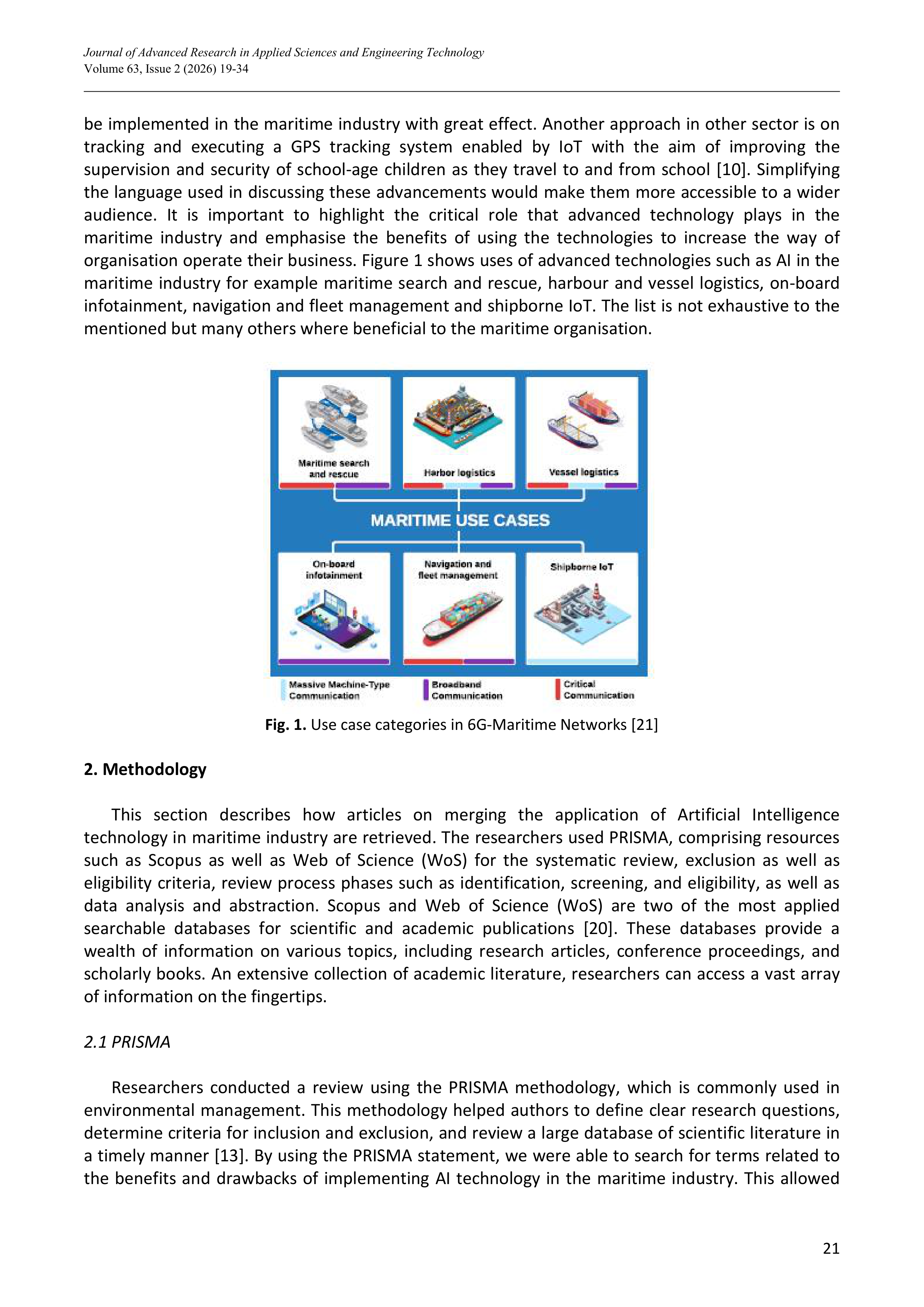
organisation operate their business. Figure 1 shows uses of advanced technologies such as AI in the
maritime industry for example maritime search and rescue, harbour
and vessel
logistics,
on-board
infotainment, navigation and fleet management and shipborne IoT. The list is not exhaustive to the
mentioned but many others where beneficial to the maritime organisation.
Fig. 1.
Use case categories in 6G-Maritime Networks [21]
2. Methodology
This
section
describes
how
articles
on
merging
the
application
of
Artificial
Intelligence
technology in maritime industry are retrieved. The researchers used PRISMA, comprising resources
such
as
Scopus
as
well
as
Web
of
Science
(WoS)
for
the
systematic
review,
exclusion
as
well
as
eligibility criteria, review process phases such as identification, screening, and eligibility, as well as
data
analysis
and
abstraction.
Scopus
and
Web
of
Science
(WoS)
are
two
of
the
most
applied
searchable
databases
for
scientific
and
academic
publications
[20].
These
databases
provide
a
wealth
of
information
on
various
topics,
including
research
articles,
conference
proceedings,
and
scholarly books. An extensive collection of academic literature, researchers can access a vast array
of information on the fingertips.
2.1 PRISMA
Researchers
conducted
a
review
using
the
PRISMA
methodology,
which
is
commonly
used
in
environmental management. This methodology helped authors to define clear research questions,
determine criteria for inclusion and exclusion, and review a large database of scientific literature in
a timely manner [13]. By using the PRISMA statement, we were able to search for terms related to
the benefits and
drawbacks
of
implementing
AI technology in
the
maritime
industry. This allowed
Journal of Advanced Research in Applied Sciences and Engineering Technology
Volume 63, Issue 2 (2026) 19-34
22
the authors to identify areas that require further research. Additionally, this methodology helped to
deeply
understand
the
challenges
faced
by
the
maritime
industry
when
plan
to
adopting
AI
technology.
2.2 Resources
In
this
study,
searching
for
articles
on
the
implementation
of
AI
technology
in
the
maritime
industry was comprehensive and focused on reliability. We used specific keywords and filtered the
databases
to
only
display
outcomes
in
the
title,
abstract,
or
keywords.
This
helped
this
study
exclude articles that did not have a substantial connection to the manuscript text. We also worked
to minimise the recurrence of articles by carefully searching through the two databases: Scopus and
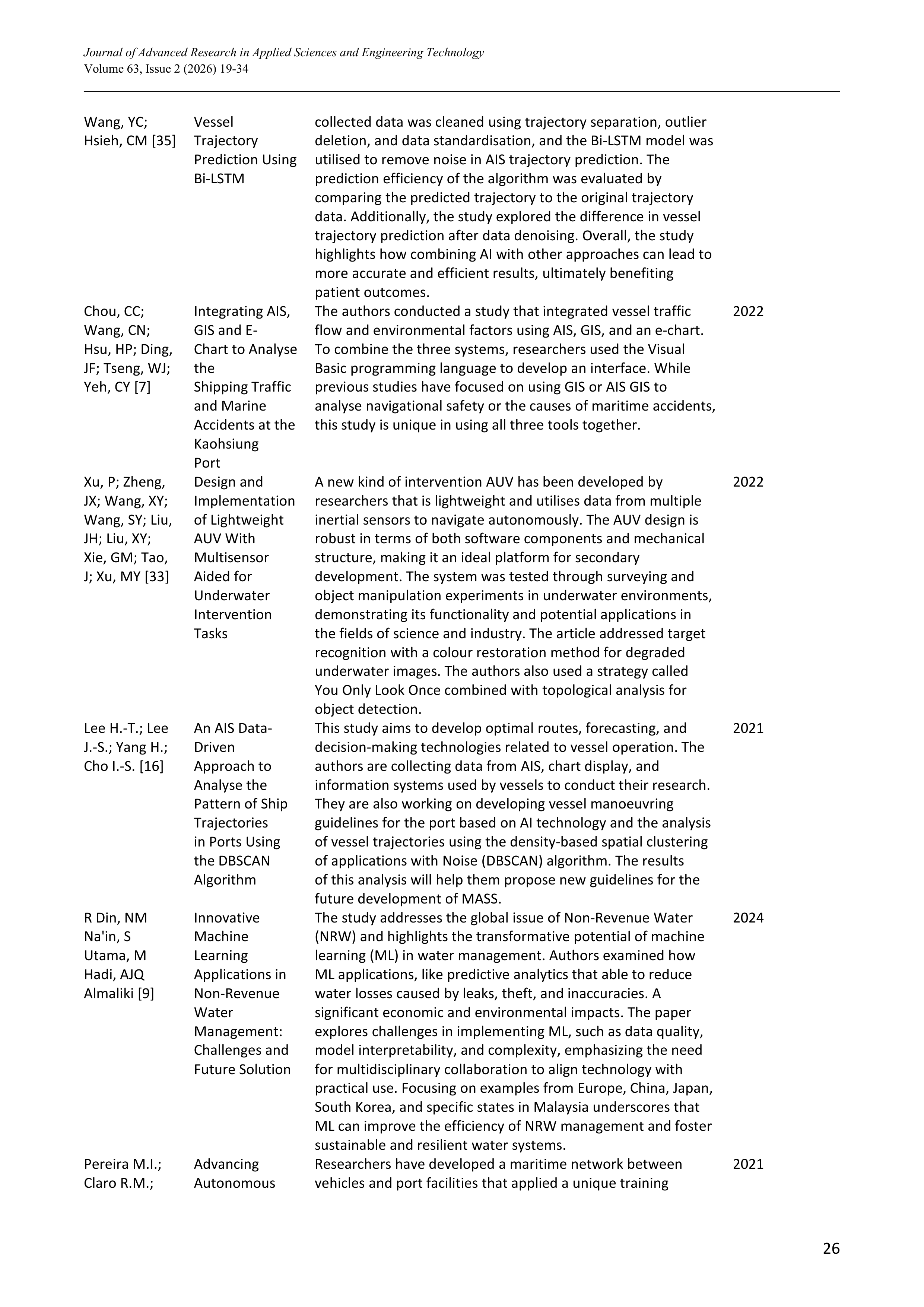
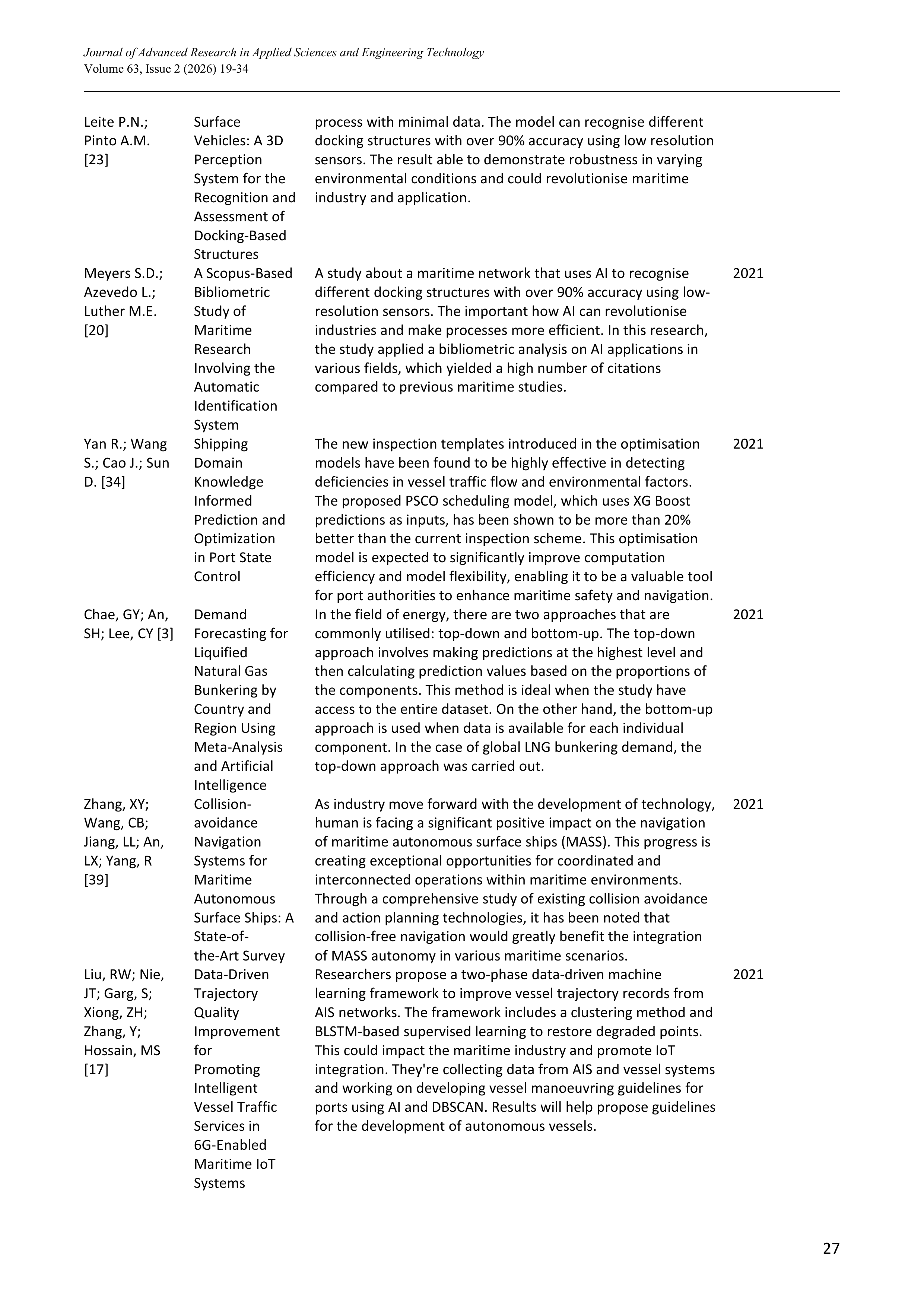
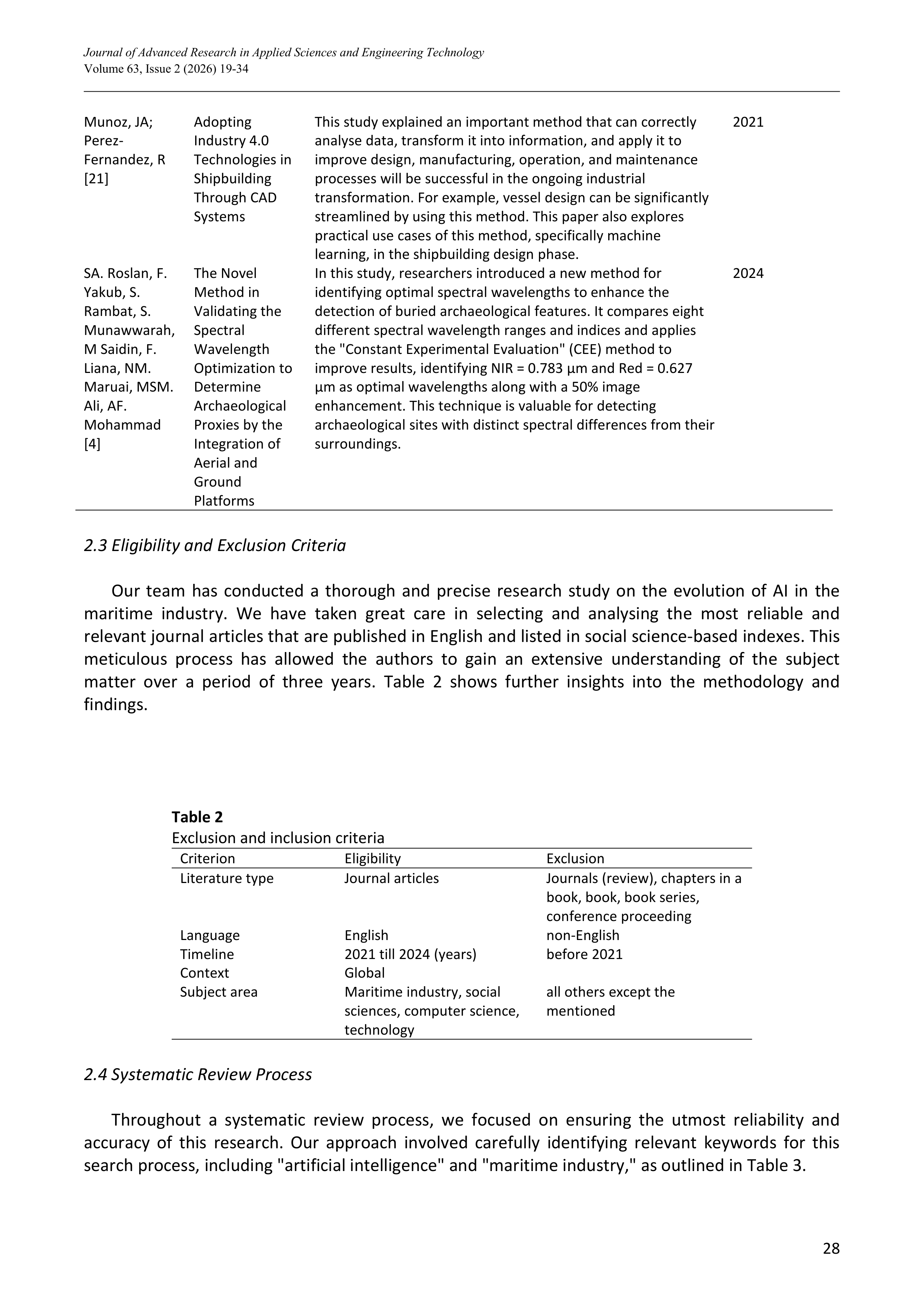
WoS. As a result, we obtained 34 research articles listed in Table 1.
Table 1
Merging the Application of Artificial Intelligence Technology in Maritime Industry, 34 most cited articles in
WoS and Scopus databases
Authors
Title
Method
Publication
Year
Sharma A.;
Undheim P.E.;
Nazir S. [23]
Design and
Implementation
of AI Chatbot
for COLREGs
Training
To help trainees in the maritime industry learn the Convention
on the International Regulations for Preventing Collisions at
Sea (COLREGs), authors-built a chatbot using the IBM Watson
Assistant service. This service enables organisations to create
conversational agents that can respond to users' queries and
provide them with relevant information. The chatbot has three
building blocks: intent, entity, and dialogue. When a user poses
a query, the chatbot recognises the intent and responds with
appropriate answers or options. With this chatbot, the study
aims to make learning the COLREGs more efficient and
accessible for trainees in the maritime industry.
2023
Lee C.; Lee S.
[14]
Vulnerability of
Clean- Label
Poisoning
Attack for
Object
Detection in
Maritime
Autonomous
Surface Ships
In this article, the collision avoidance system developer trains
an object detection model using a dataset that has been
configured without any knowledge. The dataset seems to be
normal at first glance, but it has been tampered with by an
attacker who collected footage of a vessel that close to other
vessel intention to conquered. The attacker is trying to pass off
this manipulated dataset as a trustworthy one for the collision
avoidance system. Unfortunately, this has resulted in the
object detection model misclassifying a boat as a ferry, which
could be catastrophic in real-world situations. It is crucial that
we remain vigilant and ensure that our datasets are legitimate
and free from any sort of manipulation. The authors proposed
a hypothetical object detection model with high accuracy
training to validate the effects of data poisoning on the
collision avoidance system. It is important for developers to be
aware of the potential risks of data poisoning attacks and to
take steps to prevent and mitigate them.
2023
Yoo J.; Jo Y.
[37]
Formulating
Cybersecurity
Requirements
for
Autonomous
Ships Using
the SQUARE
Methodology
Maritime communication systems can benefit greatly from the
implementation of artificial intelligence and machine learning
techniques. These approaches can assist in managing complex
integrated systems while also meeting service requirements
and energy efficiency goals. It is important to ensure that any
datasets used for this purpose is legitimate and free from
manipulation, as the misclassification of objects could have
catastrophic consequences.
2023
Journal of Advanced Research in Applied Sciences and Engineering Technology
Volume 63, Issue 2 (2026) 19-34
23
Lee C.-M.;
Jang H.-J.;
Jung B.-G. [15]
Development of
an Automated
Spare-Part
Management
Device for Ship
Controlled by
Raspberry-Pi
Microcomputer
Based on
Image-
Progressing &
Transfer-
Learning
Apparently, researchers have developed a Raspberry Pi-based
embedded application that can identify spare parts applying
learning data and algorithm. The experiment was conducted
successfully through both a Wi-Fi network and an internet
connection in an actual vessel environment, which is quite
remarkable. This innovation has the potential to save a lot of
time and effort in managing spare parts in the maritime
industry.
2023
Kalghatgi U.S.
[12]
Creating Value
for Reliability
Centred
Maintenance
(RCM) in Ship
Machinery
Maintenance
from BIG Data
and Artificial
Intelligence
A model has been developed in this study by utilising AI and Big
Data technology where there are potentials to revolutionise
Reliability Centred Maintenance. By minimising maintenance
costs, ensuring the availability of critical machinery and
avoiding downtime, this innovation can provide immense
benefits to various industries.
2023
Mansoursama
ei M.; Moradi
M.; Gonzalez-
Ramirez R.G.;
Lalla-Ruiz E.
[19]
Machine
Learning for
Promoting
Environmental
Sustainability in
Ports
This study applied PRISMA, a standardised method for
systematic review reporting. The protocol includes a 27-item
checklist and a four-phase flow diagram, which can help to
improve consistency across reviews and ensure thorough
reporting. A comprehensive methodology that can be used in a
variety of disciplines. To execute this protocol, researchers
need to define their research questions and identify their
search string and source selection.
2023
Daya A.A.;
Lazakis I. [8]
Developing an
Advanced
Reliability
Analysis
Framework for
Marine Systems
Operations and
Maintenance
The proposed methodology for vessel system reliability
combines both quantitative and qualitative reliability analysis
approaches. The use of BBN, DFTA, and FMECA to address gaps
in the literature seems like a comprehensive and effective
approach. Especially since maintenance planning can be
challenging due to defects are not identified in OEM’s
maintenance and troubleshooting manuals. Overall, this
methodology seems like a promising way to improve vessel
system reliability.
2023
Brandtner A.;
Osen O.L. [2]
Assessing
Autonomous
Ship Navigation
Using Bridge
Simulators
Enhanced by
Cycle Consistent
Adversarial
Networks
This study proposed use of maritime training simulators to
evaluate the impact of decision support on performance and
vessel’s safety including autonomous navigation. The
suggestion of using Cycle-GANs to synthesis data before
performing classification and object caption is a potentially
effective way to address this challenge and enable more
accurate and reliable testing.
2023
Ashraf, I; Park,
Y; Hur, S; Kim,
SW;
Alroobaea, R;
Bin Zikria, Y;
Nosheen, S [1]
A Survey on
Cyber Security
Threats in IoT-
Enabled
Maritime
Industry
Stakeholders in the maritime industry are concerned on cyber
threats and take action to prevent the situation. This study
focusses on vulnerabilities in digital transformation, such as
using IoT devices and modern security frameworks. The study
offers countermeasures to lessen the impact of cyber security
breaches and promote safety at sea.
2023
Yi, ZY; Mi, SY;
Tong, TQ; Li,
Intelligent Initial
Model and
Researchers proposed a conceptual model for designing a civil
smart shipbuilding factory, which has been shown to
2023
Journal of Advanced Research in Applied Sciences and Engineering Technology
Volume 63, Issue 2 (2026) 19-34
24
HM; Lin, Y;
Wang, WB;
Li, JB [36]
Case Design
Analysis of
Smart Factory
for Shipyard
in China
significantly increase production efficiency. The case study
found that the modelling of all vessels was completed with a
100% success rate, and pre-outfitting efficiency increased by
approximately 95%, while the use of wire cutting robots
resulted in a 70% increase in efficiency. These results
demonstrate the clear advantages of implementing smart
technologies in the maritime industry.
Kamarudin, N,
Nik Hassan N.
M. H,
Muhamad
M.M., Talib,
O. Kamarudin
H., Abdul
Wahab N.,
Ismail A.S.,
Borhan H.H, &
Idris N. [13]
Unveiling
Collaborative
Trends in Fuzzy
Delphi Method
(FDM)
Research: A
Co-Authorship
Bibliometrics
Study
Based on this study, the FDM uses fuzzy logic to help experts
make complex decisions by dealing with uncertainty. Despite
being popular and having many publications. This study looks
at how authors work together and how this affects FDM. The
authors looked at 766 FDM papers from the Scopus database
(1991–2022) using tools like Microsoft Excel, VOSviewer, and
Harzing’s Publish or Perish. Taiwan and Malaysia are the top
contributing countries. FDM helps decision making, building
agreement, and planning in areas like making a curriculum and
educational policies.
2024
Saafi S.;
Vikhrova O.;
Fodor G.;
Hosek J.;
Andreev S.
[21]
AI-Aided
Integrated
Terrestrial and
non-terrestrial
6G Solutions for
Sustainable
Maritime
Networking
Integrated system management is a complex task, and this
article suggests that AI and machine learning can be achieved
to meet requirements needed and optimum energy
consumption in different maritime communication scenarios.
These advancements enable more efficient diagnostics of
torpedo ladle cars and contribute to ensuring the safe and
dependable functioning of these systems.
2022
Wang M.; Yu
H.; Bell Z.;
Chu X. [33]
Constructing an
Edu- Metaverse
Ecosystem: A
New and
Innovative
Framework
This article elaborated a new theoretical framework that draws
on the latest research in instructional design and performance
technology related to Metaverse environment. These hubs
include a knowledge hub, research and technology hub, a
talent and training hub, and an instructional design and
performance technology hub. Throughout all four hubs, the
framework emphasises the importance of business industry,
communication, infrastructure, technology access and equity,
user rights, privacy policy and data security as well.
2022
Sorensen J.C.;
Lutzen M.;
Eriksen S.;
Jensen
J.B [28]
A Modular
Working Vessel
Decision
Support System
for Fuel
Consumption
Reduction
The authors prioritised energy efficiency to optimise fuel and
costs. Despite the availability of cost-effective improvements
in the industry, energy-efficient operation is often not given
enough importance. The requirements for decision support
system can be determined through interviews with workers
and observations of vessels environment. This approach will
help operator to make informed decisions and operate a vessel
in an energy-efficient manner, ultimately reducing costs and
promoting sustainability.
2022
HF. Hanafi,
MH. Adnan,
M. Huda, WA.
Mustafa, MM.
Ghani, MEA.
Hashim, A.
Alkhayyat [10]
IoT-Enabled GPS
Tracking System
for Monitoring
the Safety
Concerns of
School Students
The researchers propose an Internet of Things (IoT) GPS
tracking system to enhance child safety during commutes to
and from school, targeting children aged 4 to 10. A key feature
is the ability to monitor multiple children simultaneously. The
primary goal of this IoT solution is to provide parents with
peace of mind and a reliable way to respond promptly to any
safety concerns during their child's commute.
2024
Ichimura Y.;
Dalaklis D.;
Kitada M.;
Christodoulo
u A. [11]
Shipping in the
Era of
Digitalization:
Mapping the
Future Strategic
Plans of
In this study, the researchers applied a concept map based
Multi Document Summarisation (MDS) to analyse the
digitalisation strategies created by selected maritime players.
The study also examined how relevant terminologies are
applied and its benefits. This research demonstrates the
importance of staying up to date with the latest trends and
2022
Journal of Advanced Research in Applied Sciences and Engineering Technology
Volume 63, Issue 2 (2026) 19-34
25
Major Maritime
Commercial
Actors
innovations in the maritime industry, including digitalisation.
Zhang, MY;
Zhang, D; Fu,
SS; Kujala, P;
Hirdaris, S [38]
A Predictive
Analytics
Method for
Maritime Traffic
Flow
Complexity
Estimation in
Inland
Waterways
Researchers utilised a complex algorithm like Lempel- Ziv and
TOPSIS to analyse maritime traffic flow. The study based on AIS
data from the Yangtze River revealed that high complexity
leads to travel time sequences that are not periodic or
stochastic, but rather dependent on traffic encounters'
evolution patterns.
2022
Veerappa, M;
Anneken, M;
Burkart, N;
Huber, MF
[29]
Validation of
XAI
Explanations for
Multivariate
Time Series
Classification in
the
Maritime
Domain
The authors demonstrated deep learning-based classifiers
easier to understand by using explainable artificial intelligence
(XAI) techniques. XAI methods can explain predictions and
show which features are most important. In the maritime
industry, XAI has been used to effectively classify vessel types.
For instance, the Lime for Time technique maps time slices,
while other techniques generate heatmaps to indicate the
relevance of each input variable.
2022
Chou, CC;
Wang, CN;
Hsu, HP [6]
A Novel
Quantitative
and
Qualitative
Model for
Forecasting the
Navigational
Risks of
Maritime
Autonomous
Surface Ships
Quantitative and qualitative model in this study has shown that
the risk of mechanical malfunction accidents is highest when
operates at sea, while the risk of collision is highest when
operate around a port. The data collected from autonomous
surface vessels and analysed. All findings could prove useful for
policymakers in the future as they work to develop regulations
and guidelines for MASS navigation.
2022
Park, S; Huh,
JH [22]
Study on PLM
and Big Data
Collection for
the Digital
Transformation
of the
Shipbuilding
Industry
The maritime shipbuilding industry in Asia has been able to
collect Big Data through the utilisation of Product Lifecycle
Management (PLM) data box, which has led to a proposed
architecture for Big Data collection. This architecture could
potentially contribute to the digital transformation of the
industry and assist policymakers in making decisions regarding
port facilities and navigational safety regulations for Maritime
Autonomous Surface Ships (MASS). The findings from this study
on MASS risks, such as the risk of mechanical malfunction
accidents and collisions, could also be useful for policymakers
in developing regulations and guidelines for MASS navigation.
2022
Veitch, E;
Dybvik, H;
Steinert, M;
Alsos, OA [30]
Collaborative
Work with
Highly
Automated
Marine
Navigation
Systems
Collaborative systems and tools from Computer Support
Cooperative Work (CSCW) could be valuable in addressing
design challenges in the maritime shipbuilding industry. Studies
have indicated that collaborative approaches in diagnostics can
lead to better result than relying solely on either physicians or
AI. This is consistent with the 'cooperative eye hypothesis,'
which proposes that humans evolved to have large sclera to
better coordinate with others in cooperative activities. In order
to enhance explain ability. XAI approaches could be valuable in
the context of the proposed architecture for Big Data collection
in the maritime industry, which could contribute to the digital
transformation of the sector and inform policymaker.
2022
Yang, CH; Wu,
CH; Shao, JC;
AIS-Based
Intelligent
The study employed various techniques to predict vessel
trajectories, including data denoising and a Bi-LSTM model. The
2022
Journal of Advanced Research in Applied Sciences and Engineering Technology
Volume 63, Issue 2 (2026) 19-34
26
Wang, YC;
Hsieh, CM [35]
Vessel
Trajectory
Prediction Using
Bi-LSTM
collected data was cleaned using trajectory separation, outlier
deletion, and data standardisation, and the Bi-LSTM model was
utilised to remove noise in AIS trajectory prediction. The
prediction efficiency of the algorithm was evaluated by
comparing the predicted trajectory to the original trajectory
data. Additionally, the study explored the difference in vessel
trajectory prediction after data denoising. Overall, the study
highlights how combining AI with other approaches can lead to
more accurate and efficient results, ultimately benefiting
patient outcomes.
Chou, CC;
Wang, CN;
Hsu, HP; Ding,
JF; Tseng, WJ;
Yeh, CY [7]
Integrating AIS,
GIS and E-
Chart to Analyse
the
Shipping Traffic
and Marine
Accidents at the
Kaohsiung
Port
The authors conducted a study that integrated vessel traffic
flow and environmental factors using AIS, GIS, and an e-chart.
To combine the three systems, researchers used the Visual
Basic programming language to develop an interface. While
previous studies have focused on using GIS or AIS GIS to
analyse navigational safety or the causes of maritime accidents,
this study is unique in using all three tools together.
2022
Xu, P; Zheng,
JX; Wang, XY;
Wang, SY; Liu,
JH; Liu, XY;
Xie, GM; Tao,
J; Xu, MY [33]
Design and
Implementation
of Lightweight
AUV With
Multisensor
Aided for
Underwater
Intervention
Tasks
A new kind of intervention AUV has been developed by
researchers that is lightweight and utilises data from multiple
inertial sensors to navigate autonomously. The AUV design is
robust in terms of both software components and mechanical
structure, making it an ideal platform for secondary
development. The system was tested through surveying and
object manipulation experiments in underwater environments,
demonstrating its functionality and potential applications in
the fields of science and industry. The article addressed target
recognition with a colour restoration method for degraded
underwater images. The authors also used a strategy called
You Only Look Once combined with topological analysis for
object detection.
2022
Lee H.-T.; Lee
J.-S.; Yang H.;
Cho I.-S. [16]
An AIS Data-
Driven
Approach to
Analyse the
Pattern of Ship
Trajectories
in Ports Using
the DBSCAN
Algorithm
This study aims to develop optimal routes, forecasting, and
decision-making technologies related to vessel operation. The
authors are collecting data from AIS, chart display, and
information systems used by vessels to conduct their research.
They are also working on developing vessel manoeuvring
guidelines for the port based on AI technology and the analysis
of vessel trajectories using the density-based spatial clustering
of applications with Noise (DBSCAN) algorithm. The results
of this analysis will help them propose new guidelines for the
future development of MASS.
2021
R Din, NM
Na'in, S
Utama, M
Hadi, AJQ
Almaliki [9]
Innovative
Machine
Learning
Applications in
Non-Revenue
Water
Management:
Challenges and
Future Solution
The study addresses the global issue of Non-Revenue Water
(NRW) and highlights the transformative potential of machine
learning (ML) in water management. Authors examined how
ML applications, like predictive analytics that able to reduce
water losses caused by leaks, theft, and inaccuracies. A
significant economic and environmental impacts. The paper
explores challenges in implementing ML, such as data quality,
model interpretability, and complexity, emphasizing the need
for multidisciplinary collaboration to align technology with
practical use. Focusing on examples from Europe, China, Japan,
South Korea, and specific states in Malaysia underscores that
ML can improve the efficiency of NRW management and foster
sustainable and resilient water systems.
2024
Pereira M.I.;
Claro R.M.;
Advancing
Autonomous
Researchers have developed a maritime network between
vehicles and port facilities that applied a unique training
2021
Journal of Advanced Research in Applied Sciences and Engineering Technology
Volume 63, Issue 2 (2026) 19-34
27
Leite P.N.;
Pinto A.M.
[23]
Surface
Vehicles: A 3D
Perception
System for the
Recognition and
Assessment of
Docking-Based
Structures
process with minimal data. The model can recognise different
docking structures with over 90% accuracy using low resolution
sensors. The result able to demonstrate robustness in varying
environmental conditions and could revolutionise maritime
industry and application.
Meyers S.D.;
Azevedo L.;
Luther M.E.
[20]
A Scopus-Based
Bibliometric
Study of
Maritime
Research
Involving the
Automatic
Identification
System
A study about a maritime network that uses AI to recognise
different docking structures with over 90% accuracy using low-
resolution sensors. The important how AI can revolutionise
industries and make processes more efficient. In this research,
the study applied a bibliometric analysis on AI applications in
various fields, which yielded a high number of citations
compared to previous maritime studies.
2021
Yan R.; Wang
S.; Cao J.; Sun
D. [34]
Shipping
Domain
Knowledge
Informed
Prediction and
Optimization
in Port State
Control
The new inspection templates introduced in the optimisation
models have been found to be highly effective in detecting
deficiencies in vessel traffic flow and environmental factors.
The proposed PSCO scheduling model, which uses XG Boost
predictions as inputs, has been shown to be more than 20%
better than the current inspection scheme. This optimisation
model is expected to significantly improve computation
efficiency and model flexibility, enabling it to be a valuable tool
for port authorities to enhance maritime safety and navigation.
2021
Chae, GY; An,
SH; Lee, CY [3]
Demand
Forecasting for
Liquified
Natural Gas
Bunkering by
Country and
Region Using
Meta-Analysis
and Artificial
Intelligence
In the field of energy, there are two approaches that are
commonly utilised: top-down and bottom-up. The top-down
approach involves making predictions at the highest level and
then calculating prediction values based on the proportions of
the components. This method is ideal when the study have
access to the entire dataset. On the other hand, the bottom-up
approach is used when data is available for each individual
component. In the case of global LNG bunkering demand, the
top-down approach was carried out.
2021
Zhang, XY;
Wang, CB;
Jiang, LL; An,
LX; Yang, R
[39]
Collision-
avoidance
Navigation
Systems for
Maritime
Autonomous
Surface Ships: A
State-of-
the-Art Survey
As industry move forward with the development of technology,
human is facing a significant positive impact on the navigation
of maritime autonomous surface ships (MASS). This progress is
creating exceptional opportunities for coordinated and
interconnected operations within maritime environments.
Through a comprehensive study of existing collision avoidance
and action planning technologies, it has been noted that
collision-free navigation would greatly benefit the integration
of MASS autonomy in various maritime scenarios.
2021
Liu, RW; Nie,
JT; Garg, S;
Xiong, ZH;
Zhang, Y;
Hossain, MS
[17]
Data-Driven
Trajectory
Quality
Improvement
for
Promoting
Intelligent
Vessel Traffic
Services in
6G-Enabled
Maritime IoT
Systems
Researchers propose a two-phase data-driven machine
learning framework to improve vessel trajectory records from
AIS networks. The framework includes a clustering method and
BLSTM-based supervised learning to restore degraded points.
This could impact the maritime industry and promote IoT
integration. They're collecting data from AIS and vessel systems
and working on developing vessel manoeuvring guidelines for
ports using AI and DBSCAN. Results will help propose guidelines
for the development of autonomous vessels.
2021
Journal of Advanced Research in Applied Sciences and Engineering Technology
Volume 63, Issue 2 (2026) 19-34
28
Munoz, JA;
Perez-
Fernandez, R
[21]
Adopting
Industry 4.0
Technologies in
Shipbuilding
Through CAD
Systems
This study explained an important method that can correctly
analyse data, transform it into information, and apply it to
improve design, manufacturing, operation, and maintenance
processes will be successful in the ongoing industrial
transformation. For example, vessel design can be significantly
streamlined by using this method. This paper also explores
practical use cases of this method, specifically machine
learning, in the shipbuilding design phase.
2021
SA. Roslan, F.
Yakub, S.
Rambat, S.
Munawwarah,
M Saidin, F.
Liana, NM.
Maruai, MSM.
Ali, AF.
Mohammad
[4]
The Novel
Method in
Validating the
Spectral
Wavelength
Optimization to
Determine
Archaeological
Proxies by the
Integration of
Aerial and
Ground
Platforms
In this study, researchers introduced a new method for
identifying optimal spectral wavelengths to enhance the
detection of buried archaeological features. It compares eight
different spectral wavelength ranges and indices and applies
the "Constant Experimental Evaluation" (CEE) method to
improve results, identifying NIR = 0.783 μm and Red = 0.627
μm as optimal wavelengths along with a 50% image
enhancement. This technique is valuable for detecting
archaeological sites with distinct spectral differences from their
surroundings.
2024
2.3 Eligibility and Exclusion Criteria
Our
team
has
conducted
a
thorough
and
precise
research
study
on
the
evolution
of
AI
in
the
maritime
industry.
We
have
taken
great
care
in
selecting
and
analysing
the
most
reliable
and
relevant journal articles that are published in English and listed in social science-based indexes. This
meticulous
process
has
allowed
the
authors
to
gain
an
extensive
understanding
of
the
subject
matter
over
a
period
of
three
years.
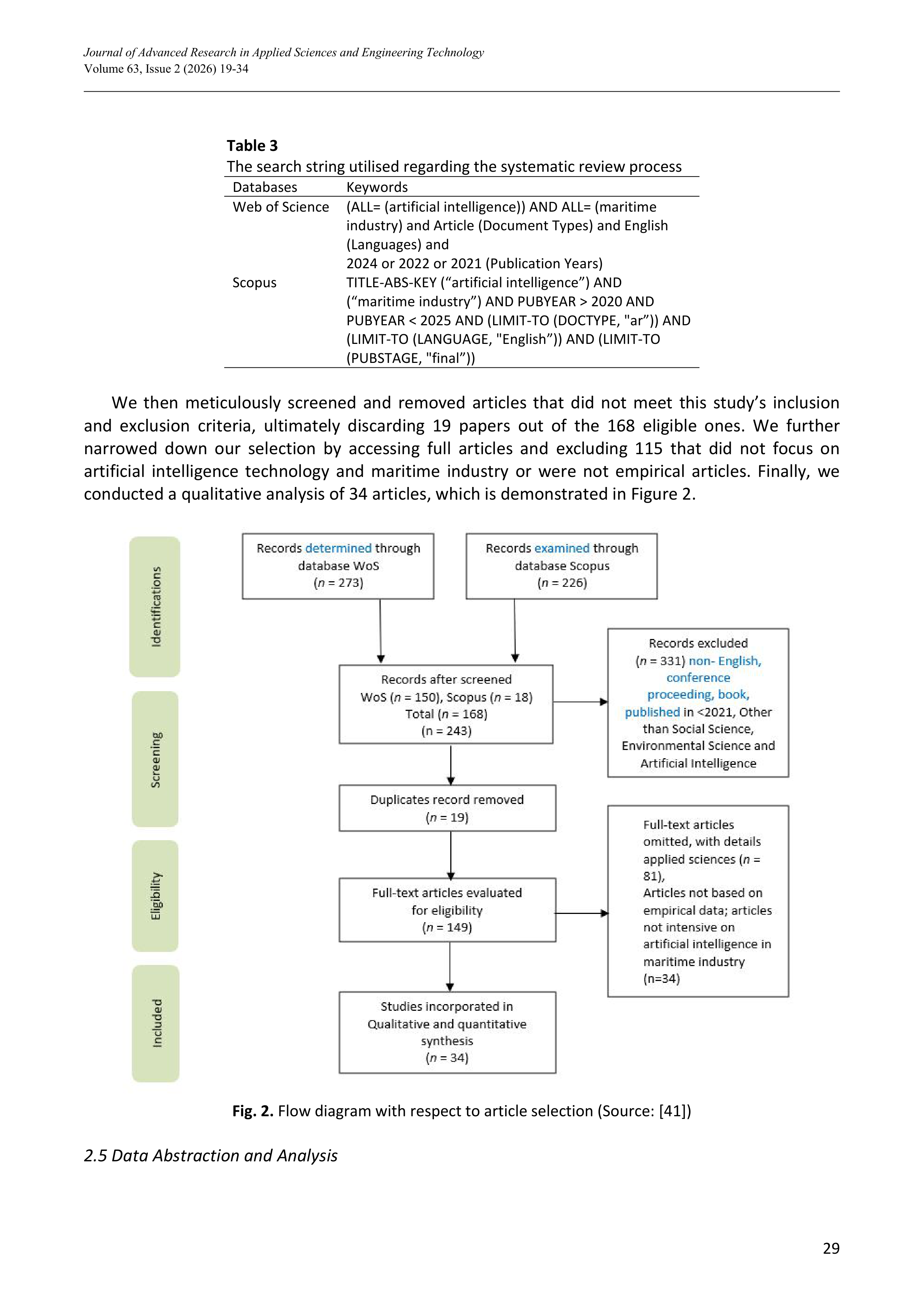
Table
2
shows
further
insights
into
the
methodology
and
findings.
Table 2
Exclusion and inclusion criteria
Criterion
Eligibility
Exclusion
Literature type
Journal articles
Journals (review), chapters in a
book, book, book series,
conference proceeding
Language
English
non-English
Timeline
2021 till 2024 (years)
before 2021
Context
Global
Subject area
Maritime industry, social
sciences, computer science,
technology
all others except the
mentioned
2.4 Systematic Review Process
Throughout
a
systematic
review
process,
we
focused
on
ensuring
the
utmost
reliability
and
accuracy
of
this
research.
Our
approach
involved
carefully
identifying
relevant
keywords
for
this
search process, including "artificial intelligence" and "maritime industry," as outlined in Table 3.
Journal of Advanced Research in Applied Sciences and Engineering Technology
Volume 63, Issue 2 (2026) 19-34
29
Table 3
The search string utilised regarding the systematic review process
Databases
Keywords
Web of Science
(ALL= (artificial intelligence)) AND ALL= (maritime
industry) and Article (Document Types) and English
(Languages) and
2024 or 2022 or 2021 (Publication Years)
Scopus
TITLE-ABS-KEY (“artificial intelligence”) AND
(“maritime industry”) AND PUBYEAR > 2020 AND
PUBYEAR < 2025 AND (LIMIT-TO (DOCTYPE, "ar”)) AND
(LIMIT-TO (LANGUAGE, "English”)) AND (LIMIT-TO
(PUBSTAGE, "final”))
We
then
meticulously
screened
and
removed
articles
that
did
not
meet
this
study’s
inclusion
and
exclusion
criteria,
ultimately
discarding
19
papers
out
of
the
168
eligible
ones.
We
further
narrowed
down
our
selection
by
accessing
full
articles
and
excluding
115
that
did
not
focus
on
artificial
intelligence
technology
and
maritime
industry
or
were
not
empirical
articles.
Finally,
we
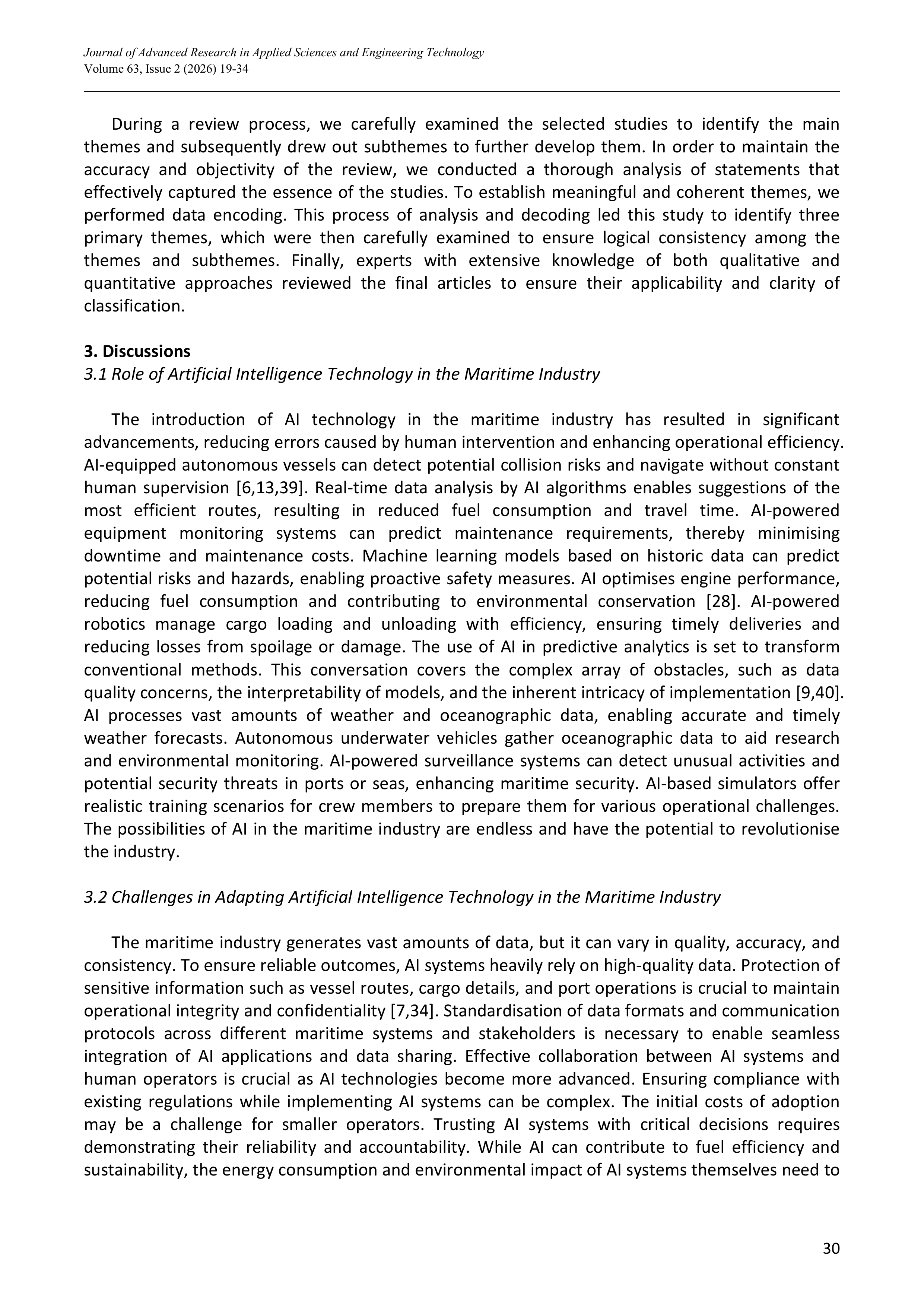
conducted a qualitative analysis of 34 articles, which is demonstrated in Figure 2.
Fig. 2.
Flow diagram with respect to article selection (Source: [41])
2.5 Data Abstraction and Analysis
Journal of Advanced Research in Applied Sciences and Engineering Technology
Volume 63, Issue 2 (2026) 19-34
30
During
a
review
process,
we
carefully
examined
the
selected
studies
to
identify
the
main
themes
and
subsequently
drew
out
subthemes
to
further
develop
them.
In
order
to
maintain
the
accuracy
and
objectivity
of
the
review,
we
conducted
a
thorough
analysis
of
statements
that
effectively captured the
essence of the
studies. To establish
meaningful and coherent themes,
we
performed
data
encoding.
This
process
of
analysis
and
decoding
led
this
study
to
identify
three
primary
themes,
which
were
then
carefully
examined
to
ensure
logical
consistency
among
the
themes
and
subthemes.
Finally,
experts
with
extensive
knowledge
of
both
qualitative
and
quantitative
approaches
reviewed
the
final
articles
to
ensure
their
applicability
and
clarity
of
classification.
3. Discussions
3.1 Role of Artificial Intelligence Technology in the Maritime Industry
The
introduction
of
AI
technology
in
the
maritime
industry
has
resulted
in
significant
advancements, reducing errors caused by human intervention and enhancing operational efficiency.
AI-equipped autonomous vessels can detect potential collision risks and navigate without constant
human
supervision
[6,13,39].
Real-time
data
analysis
by
AI
algorithms
enables
suggestions
of
the
most
efficient
routes,
resulting
in
reduced
fuel
consumption
and
travel
time.
AI-powered
equipment
monitoring
systems
can
predict
maintenance
requirements,
thereby
minimising
downtime
and
maintenance
costs.
Machine
learning
models
based
on
historic
data
can
predict
potential risks and hazards, enabling proactive safety measures. AI optimises engine performance,
reducing
fuel
consumption
and
contributing
to
environmental
conservation
[28].
AI-powered
robotics
manage
cargo
loading
and
unloading
with
efficiency,
ensuring
timely
deliveries
and
reducing
losses
from
spoilage
or
damage.
The
use
of
AI
in
predictive
analytics
is
set
to
transform
conventional
methods.
This
conversation
covers
the
complex
array
of
obstacles,
such
as
data
quality concerns, the interpretability of models, and the inherent intricacy of implementation [9,40].
AI
processes
vast
amounts
of
weather
and
oceanographic
data,
enabling
accurate
and
timely
weather
forecasts.
Autonomous
underwater
vehicles
gather
oceanographic
data
to
aid
research
and
environmental
monitoring.
AI-powered
surveillance
systems
can
detect
unusual
activities
and
potential
security
threats
in
ports
or
seas,
enhancing
maritime
security.
AI-based
simulators
offer
realistic
training
scenarios
for
crew
members
to
prepare
them
for
various
operational
challenges.
The possibilities of AI in the maritime industry are endless and have the potential to revolutionise
the industry.
3.2 Challenges in Adapting Artificial Intelligence Technology in the Maritime Industry
The maritime industry generates vast amounts of data, but it can vary in quality, accuracy, and
consistency. To ensure reliable outcomes, AI systems heavily rely on high-quality data. Protection of
sensitive information such as vessel routes, cargo details, and port operations is crucial to maintain
operational integrity and confidentiality [7,34]. Standardisation of data formats and communication
protocols
across
different
maritime
systems
and
stakeholders
is
necessary
to
enable
seamless
integration
of
AI
applications
and
data
sharing.
Effective
collaboration
between
AI
systems
and
human
operators
is
crucial
as
AI
technologies
become
more
advanced.
Ensuring
compliance
with
existing
regulations
while
implementing
AI
systems
can
be
complex.
The
initial
costs
of
adoption
may
be
a
challenge
for
smaller
operators.
Trusting
AI
systems
with
critical
decisions
requires
demonstrating
their
reliability
and
accountability.
While
AI
can
contribute
to
fuel
efficiency
and
sustainability, the energy consumption and environmental impact of AI systems themselves need to
Journal of Advanced Research in Applied Sciences and Engineering Technology
Volume 63, Issue 2 (2026) 19-34
31
be considered. AI systems must be adaptable to dynamic environments. Overcoming resistance and
fostering
a
culture
of
innovation
can
be
challenging.
Collaboration
among
industry
stakeholders,
regulatory bodies, technology providers, and research institutions is essential.
Constructive
strategies
for
AI
implementation,
data
quality,
and
security,
and
continuous
training and development of the workforce can facilitate the successful adaptation of AI technology
in
the
maritime
industry
[40].
Another
significant
hurdle
is
ensuring
that
AI
powered
systems
are
robust enough to handle the varied types and scales of data generated in maritime scenarios. This
includes
data
from
sensors
on
vessels,
satellites,
and
weather
stations,
each
of
which
provides
different
types
and
formats
of
data
that
must
be
integrated
and
processed
by
AI
systems
[19].
In
addition,
obstacle
is
the
need
for
improved
fusion
of
multimodal
data,
such
as
data
from
radar,
sonar,
and
AIS
sensors,
to
provide
a
comprehensive
understanding
of
the
maritime
environment
[28,33].
Finally,
determining
which
tasks
can
be
practically
performed
using
online
learning
capabilities
is
crucial
in
real
time
operations,
where
sensor
data
must
be
processed
on
the
fly
for
tasks such as refining a
previously learned model. Overall, addressing these
challenges is essential
for the successful implementation of AI technology in the maritime industry.
3.3 Digitalisation and Smart Shipyards
It
is
fascinating
how
the
maritime
industry
is
leveraging
data
analysis and
AI-driven
insights to
improve
operational
efficiency
and
safety.
An
article
that
talks
about
the
fusion
of
5G
and
6G
wireless
systems
with
the
maritime
IoT,
which
is
leading
the
industry
towards
innovative,
technology-driven solutions [20]. It
is interesting how the integration
of AIS,
GIS,
and e-charts can
enhance
navigational
safety
and
efficiency
by
providing
a
comprehensive
analysis
of
the
relationship
between
vessel
traffic
flows
and
marine
accidents
[7,16].
Furthermore,
some
articles
explained the implementation of smart shipyards, which is a great example of how the convergence
of
technologies
can
optimise
vessel
design,
manufacturing,
and
operational
processes
[21,33].
These
innovations
have
the
potential
to
revolutionise
the
industry
and
foster
a
safer
and
more
efficient
maritime
environment.
While
acknowledging
potential
cybersecurity
threats,
maritime
organisation needs to remain optimistic that able to face these challenges and continue advancing
towards a brighter future.
3.4 Navigational Safety and Environmental Impact
It is important to understand how the organisation in maritime is prioritising navigational safety
and environmental sustainability in their pursuit of innovative and technology-driven solutions. The
authors
encountered
an
article
discussing
potential
cybersecurity
threats
faced
by
autonomous
vessels
and
the
maritime
industry
due
to
the
integration
of
advanced
technologies
[30].
It
is
important
to
have
comprehensive
strategies
for
cyber
risk
mitigation
to
ensure
the
safety
and
security
of
the
industry.
In
other
articles,
an
explanation
about
a
predictive
model
for
vessel
trajectory that uses AIS data denoising and predictive modelling to mitigate navigational risks [6,20].
This is a great example of how the integration of technologies can lead to safer and more efficient
maritime
operations.
Overall,
it
is
inspiring
to
bring
the
industry's
commitment
to
safety
and
sustainability, and optimistic about the potential for continued advancements in these areas.
4. Conclusions and Future Research
Journal of Advanced Research in Applied Sciences and Engineering Technology
Volume 63, Issue 2 (2026) 19-34
32
The integration of advanced technology, particularly AI, has undoubtedly shown high potentials
in bringing significant benefits to the maritime industry. AI solutions have been proven to enhance
decision-making, reduce human error, optimise resource utilisation, and improve safety standards,
among
other
benefits.
The
benefits
of
AI
in
the
maritime
industry
range
from
predictive
maintenance to autonomous navigation, providing much-needed support in various aspects of the
industry's
operations.
Despite
the
progress,
there
are
still
several
areas
that
require
further
research
and
exploration
to
optimise
AI's
potential
in
the
maritime
industry.
One
of
the
critical
areas
is
investigating
robust
data
security
and
privacy
frameworks
to
ensure
that
confidential
information remains secure while utilising AI-powered tools. Moreover, developing comprehensive
regulatory
frameworks
is
also
necessary
to
ensure
that
the
industry
adheres
to
ethical
standards
and promotes responsible AI use.
Effective
human-machine
collaboration
models
are
also
crucial
to
maximise
the
benefits
of
AI
solutions. The maritime industry is human-centric, and AI should serve as a tool to support human
decision-making
processes.
Besides
that,
collaboration
between
humans
and
machines
should
be
seamless,
and
the
AI
system
must
be
capable
of
effectively
communicating
with
its
human
counterpart.
In
addition,
minimising
the
industry's
environmental
footprint
is
also
an
area
that
needs attention. AI-powered solutions can be used to optimise fuel consumption, reduce emissions,
and
enhance
overall
environmental
sustainability
[19].
Encouraging
collaboration
and
knowledge
sharing
among
industry players can
promote innovation and the development of
new AI-powered
tools and solutions.
Lastly, ethical standards must be adhered to in all
aspects of AI usage, including
development,
deployment, and use. This ensures that AI solutions do not cause harm to individuals or society. By
addressing
these
areas,
the
maritime
industry
can
create
a
safer,
more
efficient,
and
environmentally responsible sector driven by AI innovation.
Acknowledgement
This research was not funded by any grant.
References
[1]
Ashraf, Imran, Yongwan Park, Soojung Hur, Sung Won Kim, Roobaea Alroobaea, Yousaf Bin
Zikria, and Summera
Nosheen. "A survey
on cyber
security
threats in IoT-enabled maritime industry."
IEEE Transactions on Intelligent
Transportation Systems
24, no. 2 (2022): 2677-2690.
https://doi.org/10.1109/TITS.2022.3164678
[2]
Brandsæter,
Andreas,
and
Ottar
L.
Osen.
"Assessing
autonomous
ship
navigation
using
bridge
simulators
enhanced by cycle-consistent adversarial networks."
Proceedings of the Institution of Mechanical Engineers, Part
O: Journal of Risk and Reliability
237, no. 2 (2023): 508-517.
https://doi.org/10.1177/1748006X211021040
[3]
Chae,
Gi-Young,
Seung-Hyun
An,
and
Chul-Yong
Lee.
"Demand
forecasting
for
liquified
natural
gas
bunkering
by
country
and
region
using
meta-analysis
and
artificial
intelligence."
Sustainability
13,
no.
16
(2021):
9058.
https://doi.org/10.3390/su13169058
[4]
Chen,
Chen,
Feng
Ma,
Xiaobin
Xu,
Yuwang
Chen,
and
Jin
Wang.
"A
novel
ship
collision
avoidance
awareness
approach
for
cooperating
ships
using
multi-agent
deep
reinforcement
learning."
Journal
of
Marine
Science
and
Engineering
9, no. 10 (2021): 1056.
https://doi.org/10.3390/jmse9101056
[5]
Chernyi,
Sergei,
Vitalii
Emelianov,
Elena
Zinchenko,
Anton
Zinchenko,
Olga
Tsvetkova,
and
Aleksandr
Mishin.
"Application
of
artificial
intelligence
technologies
for
diagnostics
of
production
structures."
Journal
of
Marine
Science and Engineering
10, no. 2 (2022): 259.
https://doi.org/10.3390/jmse10020259
[6]
Chou,
Chien-Chang,
Chia-Nan
Wang,
and
Hsien-Pin
Hsu.
"A
novel
quantitative
and
qualitative
model
for
forecasting the navigational risks of Maritime Autonomous Surface Ships."
Ocean Engineering
248 (2022): 110852.
https://doi.org/10.1016/j.oceaneng.2022.110852
[7]
Chou,
Chien-Chang,
Chia-Nan
Wang,
Hsien-Pin
Hsu,
Ji-Feng
Ding,
Wen-Jui
Tseng,
and
Chien-Yi
Yeh.
"Integrating
AIS, GIS and E-chart to analyze the shipping traffic and marine accidents at the Kaohsiung Port."
Journal of marine
science and engineering
10, no. 10 (2022): 1543.
https://doi.org/10.3390/jmse10101543
Journal of Advanced Research in Applied Sciences and Engineering Technology
Volume 63, Issue 2 (2026) 19-34
33
[8]
Daya,
Abdullahi
Abdulkarim,
and
Iraklis
Lazakis.
"Developing
an
advanced
reliability
analysis
framework
for
marine
systems
operations
and
maintenance."
Ocean
Engineering
272
(2023):
113766.
https://doi.org/10.1016/j.oceaneng.2023.113766
[9]
Din,
Roshidi,
Nuramalina
Mohammad
Na’in,
Sunariya
Utama,
Muhaimen
Hadi,
and
Alaa
Jabbar
Qasim
Almaliki.
"Innovative
Machine
Learning
Applications
in
Non-Revenue
Water
Management:
Challenges
and
Future
Solution."
Semarak
International
Journal
of
Machine
Learning
1,
no.
1
(2024):
1-10.
https://doi.org/10.37934/sijml.1.1.110
[10]
Hanafi,
Hafizul
Fahri,
Muhamad
Hariz
Adnan,
Miftachul
Huda,
Wan
Azani
Mustafa,
Miharaini
Md
Ghani,
Mohd
Ekram
Alhafis
Hashim,
and
Ahmed
Alkhayyat.
"IoT-Enabled
GPS
Tracking
System
for
Monitoring
the
Safety
Concerns of School Students."
Journal of Advanced Research in Computing and Applications
35, no. 1 (2024): 1-9.
https://doi.org/10.37934/arca.35.1.19
[11]
Ichimura,
Yuki,
Dimitrios
Dalaklis,
Momoko
Kitada,
and
Anastasia
Christodoulou.
"Shipping
in
the
era
of
digitalization: Mapping the future strategic plans of major maritime commercial actors."
Digital Business
2, no. 1
(2022): 100022.
https://doi.org/10.1016/j.digbus.2022.100022
[12]
Kalghatgi,
Ulhas
S.
"Creating
value
for
reliability
centered
maintenance
(RCM)
in
Ship
Machinery
Maintenance
from BIG Data and Artificial Intelligence."
Journal of The Institution of Engineers (India): Series C
104, no. 2 (2023):
449-453.
https://doi.org/10.1007/s40032-022-00900-1
[13]
Kamarudin,
Nurzatulshima,
Nik
Mawar
Hanifah
Nik
Hassan,
Mohd
Mokhtar
Muhamad,
Othman
Talib,
Haryati
Kamarudin,
Norhafizan
Abdul
Wahab,
Aidatul
Shima
Ismail,
Haza
Hafeez
Borhan,
and
Nazihah
Idris.
"Unveiling
Collaborative Trends in Fuzzy Delphi Method (FDM) Research: A Co-Authorship Bibliometrics Study."
International
Journal of Computational Thinking and Data Science
2, no. 1 (2024): 1-20.
https://doi.org/10.37934/CTDS.2.1.120
[14]
Lee,
Changui, and Seojeong Lee.
"Vulnerability
of Clean-Label
Poisoning
Attack for
Object Detection
in Maritime
Autonomous
Surface
Ships."
Journal
of
Marine
Science
and
Engineering
11,
no.
6
(2023):
1179.
https://doi.org/10.3390/jmse11061179
[15]
Lee,
Chang-Min,
Hee-Joo
Jang,
and
Byung-Gun
Jung.
"Development
of
an
Automated
Spare-Part
Management
Device
for
Ship
Controlled
by
Raspberry-Pi
Microcomputer
Based
on
Image-Progressing
&
Transfer-
Learning."
Journal
of
Marine
Science
and
Engineering
11,
no.
5
(2023):
1015.
https://doi.org/10.3390/jmse11051015
[16]
Lee,
Hyeong-Tak,
Jeong-Seok
Lee,
Hyun
Yang,
and
Ik-Soon
Cho.
"An
AIS
data-driven
approach
to
analyze
the
pattern
of
ship
trajectories
in
ports
using
the
DBSCAN
algorithm."
Applied
sciences
11,
no.
2
(2021):
799.
https://doi.org/10.3390/app11020799
[17]
Liu,
Ryan
Wen,
Jiangtian
Nie,
Sahil
Garg,
Zehui
Xiong,
Yang
Zhang,
and
M.
Shamim
Hossain.
"Data-driven
trajectory
quality
improvement
for
promoting
intelligent
vessel
traffic
services
in
6G-enabled
maritime
IoT
systems."
IEEE Internet of Things Journal
8, no. 7 (2020): 5374-5385.
https://doi.org/10.1109/JIOT.2020.3028743
[18]
Liu,
Ryan
Wen,
Maohan
Liang,
Jiangtian
Nie,
Wei
Yang
Bryan
Lim,
Yang
Zhang,
and
Mohsen
Guizani.
"Deep
learning-powered
vessel
trajectory
prediction
for
improving
smart
traffic
services
in
maritime
Internet
of
Things."
IEEE
Transactions
on
Network
Science
and
Engineering
9,
no.
5
(2022):
3080-3094.
https://doi.org/10.1109/TNSE.2022.3140529
[19]
Mansoursamaei,
Meead,
Mahmoud
Moradi,
Rosa
G.
González-Ramírez,
and
Eduardo
Lalla-Ruiz.
"Machine
learning
for
promoting
environmental
sustainability
in
ports."
Journal
of
Advanced
Transportation
2023,
no.
1
(2023): 2144733.
https://doi.org/10.1155/2023/2144733
[20]
Meyers, Steven D., Laura Azevedo, and Mark E. Luther. "A Scopus-based bibliometric study of maritime research
involving
the
Automatic
Identification
System."
Transportation
research
interdisciplinary
perspectives
10
(2021):
100387.
https://doi.org/10.1016/j.trip.2021.100387
[21]
Muñoz,
J.
A.,
and
R.
Perez-Fernandez.
"Adopting
Industry
4.0
Technologies
in
Shipbuilding
Through
CAD
Systems."
International
Journal
of
Maritime
Engineering
163,
no.
A1
(2021):
41-49.
https://doi.org/10.5750/ijme.v163iA1.4
[22]
Park,
Sangil,
and
Jun-Ho
Huh.
"Study
on
PLM
and
Big
Data
Collection
for
the
Digital
Transformation
of
the
Shipbuilding
Industry."
Journal
of
Marine
Science
and
Engineering
10,
no.
10
(2022):
1488.
https://doi.org/10.3390/jmse10101488
[23]
Pereira,
Maria
Inês,
Rafael
Marques
Claro,
Pedro
Nuno
Leite,
and
Andry
Maykol
Pinto.
"Advancing
autonomous
surface vehicles:
A
3D
perception
system
for
the recognition
and assessment
of
docking-based
structures."
IEEE
Access
9 (2021): 53030-53045.
https://doi.org/10.1109/ACCESS.2021.3070694
[24]
Roslan,
Shairatul
Akma,
Fitri
Yakub,
Shuib
Rambat,
Sharifah
Munawwarah,
Mokhtar
Saidin,
Farah
Liana,
Nurshafinaz
Mohd
Maruai,
Mohamed
Sukri
Mat
Ali,
and
Ahmad
Faiz
Mohammad.
"The
Novel
Method
in
Validating the Spectral Wavelength Optimization to Determine Archaeological Proxies by the Integration of Aerial
Journal of Advanced Research in Applied Sciences and Engineering Technology
Volume 63, Issue 2 (2026) 19-34
34
and
Ground
Platforms."
Journal
of
Advanced
Research
in
Applied
Mechanics
108,
no.
1
(2023):
1-15.
https://doi.org/10.37934/sijese.2.1.115
[25]
Saafi,
Salwa,
Olga
Vikhrova,
Gábor
Fodor,
Jiri
Hosek,
and
Sergey
Andreev.
"AI-aided
integrated
terrestrial
and
non-terrestrial
6G
solutions
for
sustainable
maritime
networking."
IEEE
Network
36,
no.
3
(2022):
183-190.
https://doi.org/10.1109/MNET.104.2100351
[26]
Sanchez-Gonzalez,
Pedro-Luis,
David
Díaz-Gutiérrez,
and
Luis
R.
Núñez-Rivas.
"Digitalizing
maritime
containers
shipping
companies:
impacts
on
their
processes."
Applied
Sciences
12,
no.
5
(2022):
2532.
https://doi.org/10.3390/app12052532
[27]
Sharma,
Amit,
Per
Eirik
Undheim,
and
Salman
Nazir.
"Design
and
implementation
of
AI
chatbot
for
COLREGs
training."
WMU
Journal
of
Maritime
Affairs
22,
no.
1
(2023):
107-123.
https://doi.org/10.1007/s13437-022-
00284-0
[28]
Sørensen, Jan Corfixen, Marie Lutzen, Stig Eriksen, and Jens Brauchli Jensen. "A modular working vessel decision
support
system
for
fuel
consumption
reduction."
International
Journal
of
Information
Technology
&
Decision
Making
21, no. 03 (2022): 969-997.
https://doi.org/10.1142/S0219622022500109
[29]
Veerappa, Manjunatha, Mathias Anneken, Nadia Burkart, and Marco F. Huber. "Validation of XAI explanations for
multivariate
time
series
classification
in
the
maritime
domain."
Journal
of
Computational
Science
58
(2022):
101539.
https://doi.org/10.1016/j.jocs.2021.101539
[30]
Veitch, Erik, Henrikke Dybvik, Martin Steinert, and Ole Andreas Alsos. "Collaborative work with highly automated
marine
navigation
systems."
Computer
Supported
Cooperative
Work
(CSCW)
33,
no.
1
(2024):
7-38.
https://doi.org/10.1007/s10606-022-09450-7
[31]
Wang, Minjuan, Haiyang Yu, Zerla Bell, and Xiaoyan Chu. "Constructing an edu-metaverse ecosystem: A new and
innovative
framework."
IEEE
Transactions
on
Learning
Technologies
15,
no.
6
(2022):
685-696.
https://doi.org/10.1109/TLT.2022.3210828
[32]
Wright, R. Glenn. "Intelligent autonomous ship navigation using multi-sensor modalities."
TransNav: International
Journal
on
Marine
Navigation
and
Safety
of
Sea
Transportation
13,
no.
3
(2019).
https://doi.org/10.12716/1001.13.03.03
[33]
Xu, Peng, Jiaxi Zheng, Xinyu Wang, Siyuan Wang, Jianhua Liu, Xiangyu Liu, Guangming Xie, Jin Tao, and Minyi Xu.
"Design and implementation of lightweight AUV with multisensor aided for underwater intervention tasks."
IEEE
Transactions
on
Circuits
and
Systems
II:
Express
Briefs
69,
no.
12
(2022):
5009-5013.
https://doi.org/10.1109/TCSII.2022.3193300
[34]
Yan,
Ran,
Shuaian
Wang,
Jiannong
Cao,
and
Defeng
Sun.
"Shipping
domain
knowledge
informed
prediction
and
optimization
in
port
state
control."
Transportation
Research
Part
B:
Methodological
149
(2021):
52-78.
https://doi.org/10.1016/j.trb.2021.05.003
[35]
Yang,
Cheng-Hong,
Chih-Hsien
Wu,
Jen-Chung
Shao,
Yi-Chuan
Wang,
and
Chih-Min
Hsieh.
"AIS-based
intelligent
vessel
trajectory
prediction
using
bi-LSTM."
IEEE
Access
10
(2022):
24302-24315.
https://doi.org/10.1109/ACCESS.2022.3154812
[36]
Yi, Zhengyao, Siyao Mi, Tianqi Tong, Haoming Li, Yan Lin, Wenbiao Wang, and Jiangbo Li. "Intelligent initial model
and
case
design
analysis
of
smart
factory
for
shipyard
in
China."
Engineering
Applications
of
Artificial
Intelligence
123 (2023): 106426.
https://doi.org/10.1016/j.engappai.2023.106426
[37]
Yoo, Jiwoon, and Yonghyun Jo.
"Formulating cybersecurity requirements for
autonomous ships using
the square
methodology."
Sensors
23, no. 11 (2023): 5033.
https://doi.org/10.3390/s23115033
[38]
Zhang,
Mingyang,
Di
Zhang,
Shanshan
Fu,
Pentti
Kujala,
and
Spyros
Hirdaris.
"A
predictive
analytics
method
for
maritime
traffic
flow
complexity
estimation
in
inland
waterways."
Reliability
Engineering
&
System
Safety
220
(2022): 108317.
https://doi.org/10.1016/j.ress.2021.108317
[39]
Zhang, Xinyu,
Chengbo
Wang, Lingling
Jiang,
Lanxuan An,
and
Rui
Yang.
"Collision-avoidance
navigation
systems
for
Maritime
Autonomous
Surface
Ships:
A
state
of
the
art
survey."
Ocean
Engineering
235
(2021):
109380.
https://doi.org/10.1016/j.oceaneng.2021.109380
[40]
Zhilenkov,
Anton,
Sergei
Chernyi,
and
Vitalii
Emelianov.
"Application
of
Artificial
Intelligence
Technologies
to
Assess the Quality of Structures."
Energies
14, no. 23 (2021): 8040.
https://doi.org/10.3390/en14238040
[41]
Mustafa,
Wan
Azani,
Afiqah
Halim,
Mohd
Wafi
Nasrudin,
and
Khairul
Shakir
Ab
Rahman.
"Cervical
cancer
situation
in
Malaysia:
A
systematic
literature
review."
Biocell
46,
no.
2
(2022):
367.
https://doi.org/10.32604/biocell.2022.016814